Expert Insights on Industrial Strategy and Technology-Driven Growth
Abu Dhabi is undergoing a significant economic transformation. For decades, the emirate’s global identity has been closely tied to its role as one of the world’s leading energy producers. Revenues from hydrocarbons enabled the rapid modernization of infrastructure, the expansion of cities, and the development of one of the most influential sovereign investment ecosystems in the region.
Today, however, Abu Dhabi is entering a new phase of development. While energy continues to play a central role in the economy, policymakers are increasingly focused on strengthening the industrial base and expanding high-value production sectors. Advanced manufacturing is emerging as a strategic pillar of this transition, supporting the broader ambition of building a diversified and technology-driven economy.
Across industrial zones, logistics corridors, and innovation clusters, new manufacturing capabilities are taking shape. International companies are expanding production facilities, local industrial champions are investing in automation and digital technologies, and policymakers are reinforcing the institutional framework required to support industrial growth.
Recent figures highlight the scale of this transformation. Research from Market Research Abu Dhabi shows that the emirate’s manufacturing GDP grew by 23 percent, rising from AED 90.8 billion in 2022 to AED 111.6 billion in 2024. Manufacturing now accounts for 9.5 percent of total GDP and 17.3 percent of the non-oil economy, demonstrating the sector’s increasing importance in Abu Dhabi’s diversification strategy.
According to Damien Duhamel, Managing Partner Middle East and Asia at Eurogroup Consulting the expansion of advanced manufacturing reflects a broader shift in the emirate’s economic model.
“Advanced manufacturing is becoming one of the key pillars of Abu Dhabi’s diversification agenda. The emirate is not only expanding industrial capacity, it is building a technology-driven manufacturing ecosystem capable of competing internationally while supporting long-term economic resilience.”
Duhamel also notes that the transformation represents a deeper structural change in how Abu Dhabi approaches economic development.
“Historically, the emirate played a major role in financing global projects through its capital strength. Today there is a growing emphasis on building productive industrial capacity within the domestic economy.”
This shift aligns closely with Abu Dhabi’s long-term objective of building a knowledge-based economy capable of generating sustainable growth beyond hydrocarbons.
Industrial Policy Driving Manufacturing Growth
A major catalyst behind Abu Dhabi’s manufacturing momentum is the Abu Dhabi Industrial Strategy, a comprehensive policy initiative designed to accelerate industrial development and strengthen the emirate’s position within global supply chains.
The strategy aims to double manufacturing’s contribution to GDP to AED 172 billion by 2031 while increasing non-oil exports and reinforcing domestic industrial capabilities.
Priority sectors include pharmaceuticals, chemicals, machinery, electrical equipment, food processing, and advanced materials. These industries are considered essential for creating a diversified industrial base capable of generating long-term economic value.
Beyond identifying priority sectors, the strategy also focuses on regulatory reform, infrastructure investment, and targeted incentives designed to attract both international investors and domestic manufacturers.
Industrial hubs such as Khalifa Industrial Zone Abu Dhabi (KEZAD) and the Industrial City of Abu Dhabi (ICAD) have become central to this transformation.
These zones provide specialized industrial infrastructure, streamlined licensing procedures, and integrated logistics networks that support efficient production and export activity. Their proximity to Khalifa Port allows manufacturers to access global shipping routes quickly, strengthening Abu Dhabi’s role within international trade corridors.
Together, these ecosystems provide a platform designed to support large-scale manufacturing, export-oriented production, and cross-border trade.
Technology Reshaping the Manufacturing Landscape
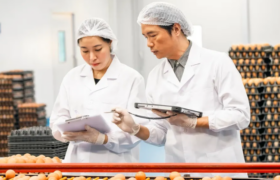
Another defining feature of Abu Dhabi’s industrial transformation is the increasing integration of advanced technologies into manufacturing operations.
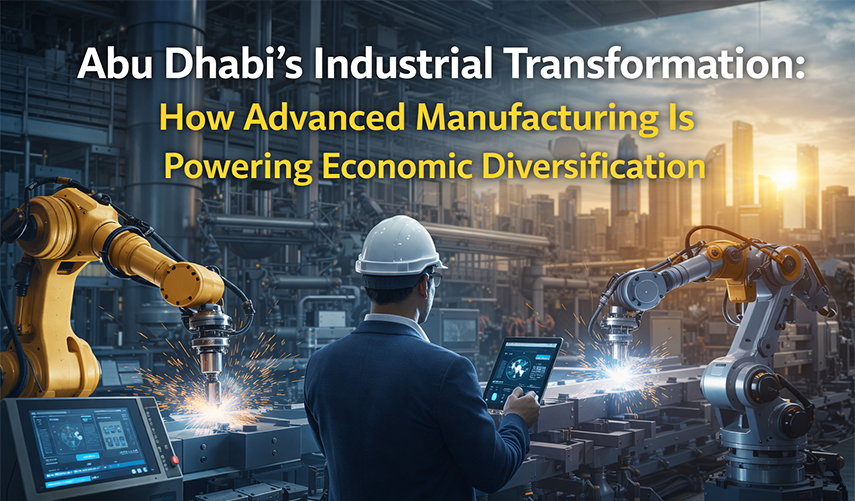
Rather than relying on traditional labor-intensive production models, the emirate is prioritizing Industry 4.0 capabilities such as automation, robotics, artificial intelligence, and digital production systems.
These technologies enable manufacturers to improve efficiency, enhance product quality, and maintain competitiveness in increasingly complex global markets.
In sectors such as aerospace, defense manufacturing, and advanced metals production, companies operating in Abu Dhabi are already implementing smart manufacturing systems.
Digital engineering platforms, automated production lines, and data-driven operational tools are becoming essential components of modern industrial activity.
The emirate is also exploring the concept of fully automated production environments known as lights-out manufacturing, where factories operate with minimal human intervention. Industrial hubs such as KEZAD are supporting these next-generation facilities by providing integrated logistics infrastructure and industrial incentives.
Duhamel believes the adoption of advanced technologies is essential for long-term competitiveness.
“Industrial competitiveness increasingly depends on productivity and technological sophistication. Automation, digital engineering, and smart manufacturing systems are becoming fundamental elements of modern industrial strategy.”
By integrating innovation and advanced engineering into industrial production, Abu Dhabi is building a more sophisticated manufacturing ecosystem capable of producing high-value products for global markets.
Strategic Geography Strengthening Global Supply Chains
Abu Dhabi’s geographic position has long been one of its greatest economic advantages.
Located between Europe, Asia, and Africa, the emirate sits at the intersection of several major trade routes connecting global markets.
As supply chains evolve, this strategic location has become even more valuable. Many companies are now seeking diversified manufacturing locations to reduce dependence on single production hubs and strengthen supply chain resilience.
The United Arab Emirates has benefited from this shift due to its political stability, advanced infrastructure, and strong global connectivity.
Abu Dhabi’s logistics ecosystem includes modern seaports, international airports, and integrated transport networks that connect industrial zones with global markets. Khalifa Port has become one of the region’s most advanced maritime gateways, supporting large-scale industrial exports and logistics operations.
For manufacturers targeting markets across the Gulf, Africa, and South Asia, Abu Dhabi offers an attractive production base that combines geographic proximity with efficient logistics infrastructure.
Expanding Opportunities for Investors and Industry
As the manufacturing ecosystem continues to expand, new opportunities are emerging for investors, industrial operators, and technology providers.
Foreign direct investment is increasingly flowing into sectors such as advanced materials, specialty chemicals, precision engineering, and industrial technology. The number of licensed industrial enterprises in Abu Dhabi has also continued to grow as new facilities and partnerships are established across the emirate.
Abu Dhabi now accounts for approximately 53 percent of the United Arab Emirates’ total industrial GDP, underscoring its central role in the country’s industrial expansion.
International manufacturers are increasingly forming partnerships with local companies to combine global expertise with regional market access. These collaborations often involve technology transfer, research and development initiatives, and workforce training programs that strengthen the emirate’s industrial capabilities.
According to Duhamel, this growing industrial activity demonstrates that Abu Dhabi’s diversification strategy is moving from vision to execution.
“Abu Dhabi is positioning itself as the industrial backbone of the UAE’s economic diversification. The scale of investment, infrastructure development, and policy support shows that this transformation is evolving from strategic ambition into tangible industrial capacity.”
At the same time, the emirate continues to refine its regulatory and investment framework to attract new industrial projects. Free zones, simplified licensing procedures, and supportive policies have made it easier for manufacturers to establish operations in Abu Dhabi.
For companies considering market entry, understanding the structure and dynamics of Abu Dhabi’s industrial sectors is becoming increasingly important.
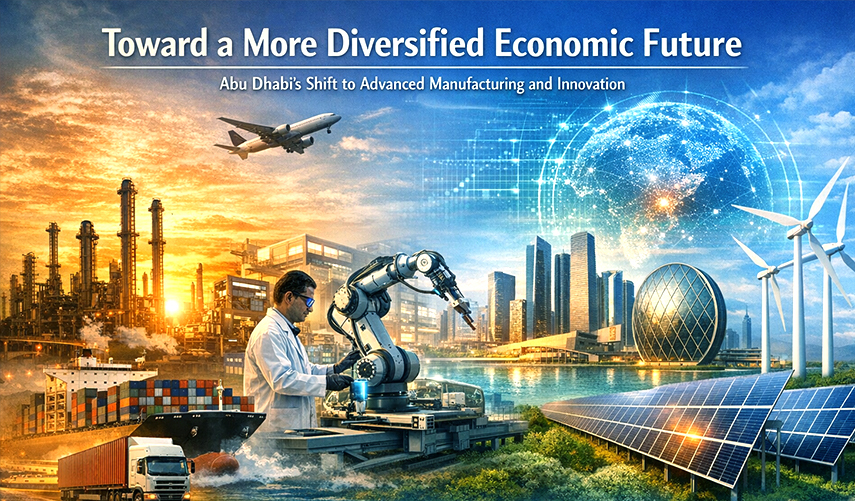
Toward a More Diversified Economic Future
Abu Dhabi’s push into advanced manufacturing reflects a broader shift toward a more balanced and resilient economic model.
While hydrocarbons will remain an important pillar of the economy, the increasing role of manufacturing, logistics, technology, and renewable energy signals the emergence of a more diversified economic structure.
These sectors are expected to play an increasingly important role in generating employment, attracting investment, and strengthening the emirate’s global competitiveness.
For policymakers, the challenge lies in sustaining momentum while continuing to develop the institutional frameworks, infrastructure, and talent needed to support industrial growth.
For businesses and investors, however, the transformation presents a compelling opportunity to participate in the development of one of the Middle East’s most dynamic industrial ecosystems.
As advanced manufacturing continues to expand across Abu Dhabi’s industrial landscape, the emirate is steadily moving toward a future where its economic identity extends far beyond energy. What was once a policy objective is now becoming a defining feature of Abu Dhabi’s next chapter of growth?
Also Read:
Enterprise intelligence goes beyond search
Trump halts attacks; Iran agrees 2-week ceasefire
Has the war ended? 10 things to know about the US-Iran ceasefire