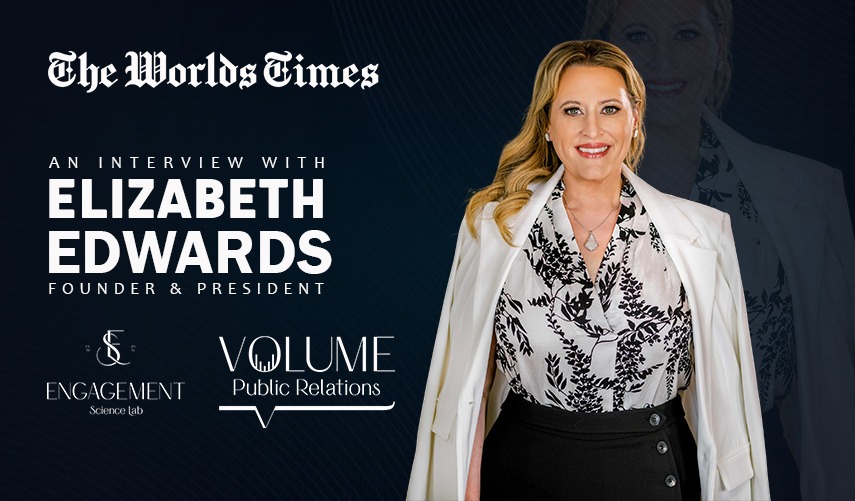
An Interview with Elizabeth Edwards
As artificial intelligence reshapes the communication landscape; organizations are being challenged to move beyond attention-driven strategies toward deeper human resonance. In this thought-provoking conversation with Elizabeth Edwards, the founder of Engagement Science Lab and the Affect Institute explores the rise of Affective Intelligence, the shift from the “attention economy” to the “resonance economy,” and the growing importance of ethical influence in an AI-powered world. Drawing from neuroscience, psychology, and systems thinking, the discussion highlights how trust, emotional alignment, and meaningful communication are becoming the foundation of sustainable impact and leadership.
Redefining Modern Communication
We started the interview by asking, “You’ve spent over two decades redefining communication. What core shift do you believe organizations must make today?”
Elizabeth Edwards replied, “The biggest shift is moving from attention extraction to meaningful resonance. For years, communication strategies have been built to capture clicks, reactions, and short-term engagement. But human beings don’t operate purely on rational or transactional logic, we respond through affect, emotion, and meaning-making. Organizations must evolve toward communication that respects how people actually process the world. This means designing messaging that creates mutual value, not manipulation. When communication aligns with human biology and psychology, it becomes more effective, more ethical, and far more sustainable.”
Understanding Affective Intelligence
The Worlds Times: What is Affective Intelligence, and why is it becoming critical in the AI era?
Elizabeth Edwards replied, “Affective Intelligence is the science of how humans interpret meaning, make decisions, and respond emotionally to communication. As AI accelerates content creation and distribution, the risk is not just misinformation; it’s misalignment with human experience. Affective Intelligence provides a framework to ensure communication remains grounded in biological and emotional truth. It integrates neuroscience, cognition, and systems thinking to create communication that works with human nature, not against it. In the AI era, this isn’t optional; it’s the foundation for maintaining trust, relevance, and ethical influence at scale.”
The Shift to the Resonance Economy
The Worlds Times: Through Engagement Science Lab, you’ve challenged the “attention economy.” What’s the alternative?
Elizabeth Edwards replied, “The alternative is what we call the “resonance economy.” The attention economy is built on interruption and reaction, it rewards noise. Resonance, on the other hand, is built on alignment and relationship. It focuses on how deeply communication connects rather than how widely it spreads. When organizations shift to resonance-based strategies, they see stronger trust, higher conversion, and longer-term loyalty. It’s not about doing more communication, it’s about doing communication that actually lands, stays, and creates meaningful impact in people’s lives.”
Rethinking Human Decision-Making
The Worlds Times: The Affect Institute is positioning itself as a counterweight to behavioral economics. What does that mean in practice?
Elizabeth Edwards replied, “Behavioral economics has largely framed human decision-making through the lens of bias and irrationality. At the Affect Institute, we’re reframing those “biases” as adaptive human instincts responses that evolved for survival and meaning-making. This changes everything. Instead of designing systems to exploit perceived flaws, we design systems that align with human intelligence in its full biological context. In practice, that means new models, new research frameworks, and new standards for communication, policy, and technology that prioritize mutual benefit over extraction.”
The Future of Ethical Influence
Lastly we asked, “What does ethical influence look like in a world driven by data, algorithms, and scale?”
“Ethical influence is about responsibility at scale. Just because we can influence behavior doesn’t mean we should do so without intention or accountability. Ethical influence ensures that communication benefits both the organization and the audience; it’s not zero-sum. It requires transparency, respect for autonomy, and alignment with human well-being. In a world where algorithms can amplify messages instantly, the standard for integrity must rise accordingly. The future belongs to those who can influence effectively while also preserving trust, dignity, and long-term societal value.” Elizabeth Edwards concluded
Connect with Elizabeth Edwards on LinkedIn
For more information visit Volume Public Relations & Engagement Science Lab
Also Read:-
Alexandra on Science, Growth, and New Beginnings
Bala Sathyanarayanan: Purpose-Driven Growth Leader
Magda Khalid Abdel Nasser on Salamty App Innovation