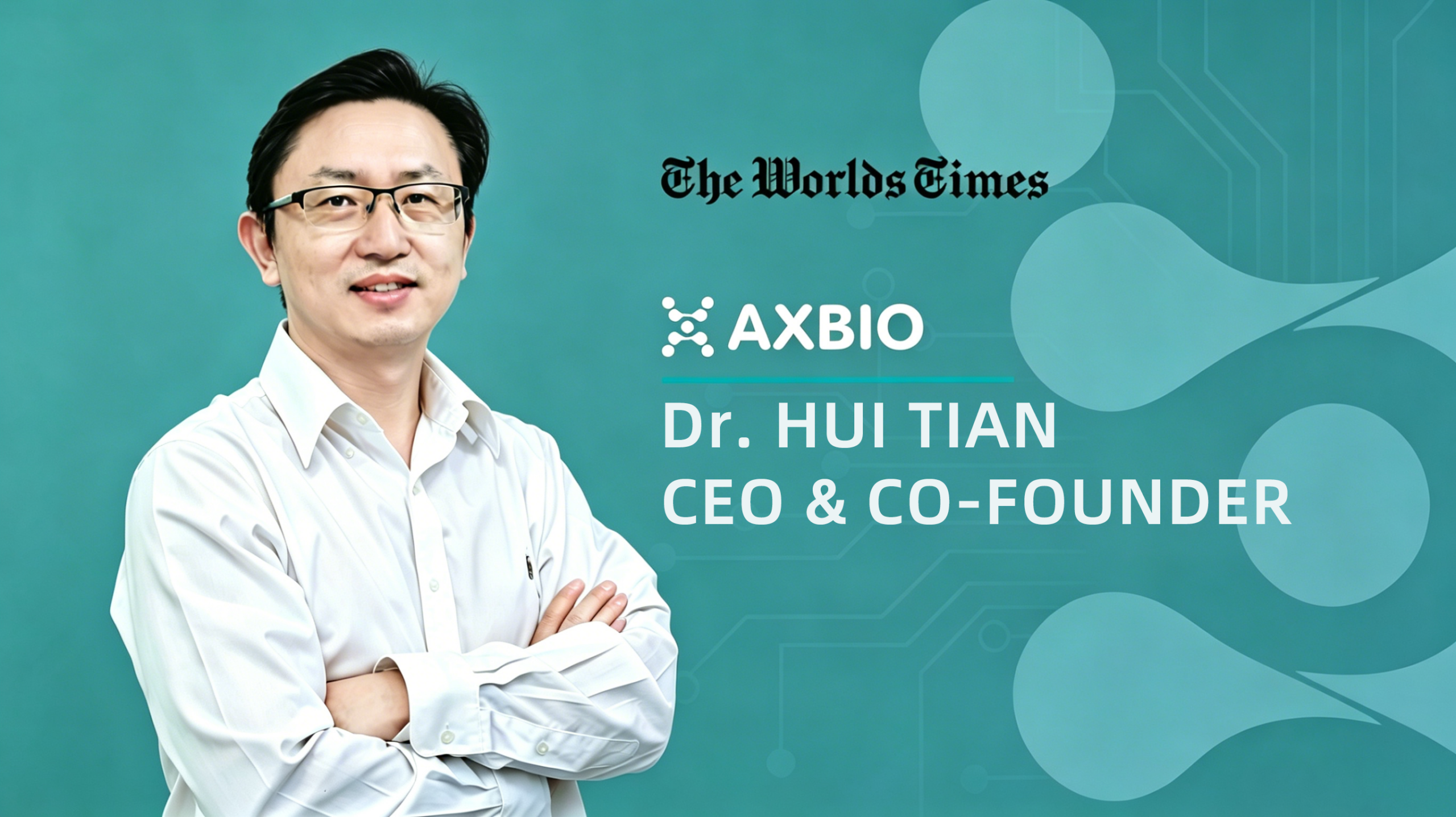
In this exclusive interview with The Worlds Times, Dr. Hui Tian shares his remarkable journey from physics and semiconductor engineering to pioneering innovations in biotechnology. He discusses how the convergence of semiconductors, artificial intelligence, and molecular science is revolutionizing genomics, diagnostics, drug discovery, and precision medicine. As the founder of Axbio, Tian offers insights into the technologies driving the next era of healthcare and his vision for making advanced biological intelligence as accessible as digital information.
From Silicon Innovation to Biological Discovery
We started the interview by asking, “Who is Hui Tian, and what inspired your journey from physics and semiconductor technology into biotechnology?”
Dr. Hui Tian replied, “My career has always been driven by curiosity and the desire to solve complex problems. I began my academic journey studying physics
at Tsinghua University before pursuing advanced degrees in electrical engineering and applied physics at Stanford University. Early in my career, I worked extensively on semiconductor technologies, image sensors, and nanotechnology.
What fascinated me was the realization that the same principles driving innovation in integrated circuits could be applied to biology. This insight led me toward DNA sequencing, molecular diagnostics, and eventually the creation of technologies that combine semiconductor engineering with biotechnology.
Today, I believe the convergence of these fields represents one of the most transformative opportunities in science and healthcare.”
Turning Biology into the Next Revolution
The Worlds Times: What makes the combination of semiconductors and biotechnology so powerful?
Dr. Hui Tian replied, “Semiconductors gave the world the ability to process digital information at massive scale. Today, biology is becoming the next information science. By combining semiconductor technology with biotechnology, we can process biological information with the same level of speed, precision, and scalability. By combining semiconductor manufacturing with biological sensing, we can dramatically reduce the cost of genetic and biomolecules analysis while increasing speed and scalability. During my time at Roche, we developed silicon chips capable of interacting directly with biological molecules. It was a remarkable experience because we were effectively placing living enzymes on integrated circuits.
This convergence allows us to process biological information at a scale that was previously impossible, it has the potential to transform healthcare in much the same way semiconductors transformed computing.”
Building an Integrated Platform
The Worlds Times: What is Axbio, and how does it differ from traditional biotechnology companies?
Dr. Hui Tian replied, “Axbio was founded with a vision to integrate three transformative disciplines: integrated circuits, biotechnology, and artificial intelligence.
Unlike many traditional biotechnology companies that focus on a single component of the value chain, Axbio develops a comprehensive platform that combines Bio-CMOS semiconductor chips, synthetic biology, enzyme engineering, microfluidics, and AI-powered biomolecule design.
Our objective is to create scalable solutions that support gene sequencing, disease diagnostics, peptide&protein detection, and next-generation drug discovery. By integrating hardware, biology, and AI into a unified ecosystem, we can accelerate innovation while reducing complexity and cost.”
Technology Connecting Biology and Computing
The Worlds Times: What is a Bio-CMOS chip, and why is it important for modern genomics?
Dr. Hui Tian replied, “A Bio-CMOS chip is an integrated circuit specifically designed to interact with biological systems.
Our proprietary Bio-CMOS technology incorporates large arrays of electrochemical sensors capable of detecting biological signals with exceptional sensitivity and throughput.It’s the world’s first 300mm, 65nm process Bio-CMOS chip, featuring 1 million parallel nanopore detection units per chip, which has completed tape-out and integrated into product workflows.The significance lies in its ability to convert complex biochemical events into measurable electronic signals. This creates a bridge between biology and computing, enabling faster genomic analysis, higher precision, and more affordable healthcare solutions.”
Accelerating Scientific Discovery
The Worlds Times: How is artificial intelligence transforming biotechnology and molecular research?
Dr. Hui Tian replied, “Artificial intelligence is becoming an essential tool for biological discovery.
At Axbio, we have developed AI agents that assist in biomolecule engineering by generating optimized enzymes, oligonucleotides, peptidesand protein variants. These systems help researchers identify promising candidates faster than traditional experimental approaches alone.
AI accelerates enzyme engineering, biomarker discovery, sequencing optimization, and bioinformatics analysis. Most importantly, it allows scientists to explore biological complexity more efficiently, leading to faster innovation and improved outcomes in healthcare and life sciences.”
Personalized Treatments
The Worlds Times: Why is precision medicine considered the future of healthcare?
Dr. Hui Tian replied, “Precision medicine focuses on delivering treatments tailored to an individual’s unique genetic and biological profile.
Historically, many therapies were designed using population averages. While effective in many cases, they often overlook individual differences. Advances in genomics, molecular diagnostics, and AI now allow us to understand diseases at a much deeper level.
As sequencing technologies become more accessible and affordable, precision medicine will enable earlier diagnosis, more targeted therapies, and improved patient outcomes. I believe it will become a cornerstone of healthcare in the coming decades.”
Leading Innovation
The Worlds Times: What leadership principles have guided your success across semiconductor, imaging, and biotechnology industries?
Dr. Hui Tian replied, “Technology evolves rapidly, but leadership fundamentals remain consistent.
I focus on building strong teams, fostering collaboration, and creating a shared sense of mission. Innovation thrives when talented individuals feel empowered to contribute ideas and solve problems together.
Another important principle is maintaining operational excellence. Great ideas alone are not enough. Successful execution requires discipline, attention to detail, accountability, and continuous learning.
Throughout my career, I have found that the most effective leaders combine technical understanding with the ability to inspire and align people around a common goal.”
Advancing the Healthcare
The Worlds Times: What role will next-generation gene sequencing play in disease diagnosis and drug development?
Dr. Hui Tian replied, “Next-generation sequencing will continue to reshape both diagnostics and therapeutics.
As sequencing becomes faster and more affordable, healthcare providers will gain access to unprecedented amounts of biological information. This data can reveal disease mechanisms, identify treatment targets, and support personalized care strategies.
Today, drugs are developed by pharmaceutical companies, and then they go find the patients. But in the future, the patient should really be the key and starting point. By applying our precision diagnostic tools, such as genomics and proteomics tests, we can match the right drug to treat the patient.
This represents a fundamental shift in healthcare—from treating disease after it occurs to predicting, preventing, and precisely managing it. I believe next-generation sequencing will become a cornerstone of precision medicine, enabling better outcomes for patients while reducing the overall burden on healthcare systems.”
Long-term vision
Lastly, we asked, “What is your long-term vision for biotechnology, AI, and semiconductor innovation?”
“My vision is to create a future where biological information becomes as accessible as digital information.
The integration of semiconductor technology, biotechnology, and artificial intelligence will unlock new possibilities in disease prevention, diagnostics, therapeutics, and scientific discovery. We are moving toward a world where biological systems can be analyzed, understood, and engineered with unprecedented precision.
The ultimate goal is to improve human health on a global scale by making advanced molecular technologies accessible, affordable, and impactful for everyone.” Dr. Hui Tian concluded
Connect with Dr. Hui Tian on LinkedIn
For more information visit Axbio
Also Read:-
Laurent Serafini: Redefining Global Business Intelligence
Vincenzo Russi: Green Living & Sustainable Architecture
Sophia Alim on Privacy, Cyberbullying & Digital Wellbeing