For entrepreneurs, startups, investors, and professionals who wish to turn their ideas into profitable businesses, 2027 offers significant opportunities. However, one of the most critical decisions an entrepreneur can make is choosing the right country. Business registration requirements, taxation, access to capital, infrastructure, workforce availability, market demand, and government policies can all influence a company’s performance.
Some countries are attractive because they offer access to large consumer markets, while others stand out for their startup ecosystems, international trade connections, digital infrastructure, or business-friendly policies. The ideal location depends on the type of business, available investment, target customers, and long-term objectives.
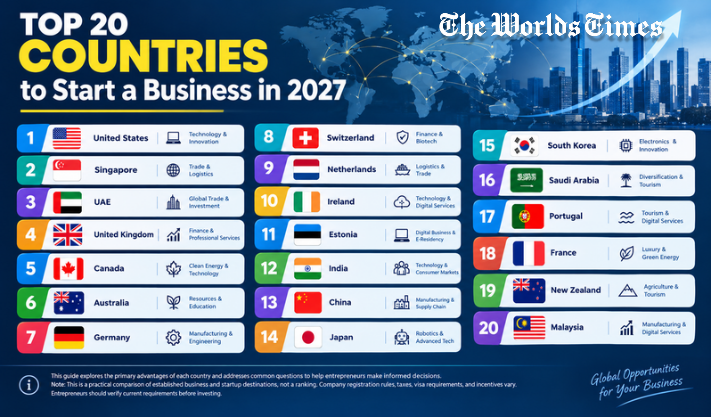
Top 20 Countries to Start a Business in 2027
This guide explores the primary advantages of each country and addresses common questions to help entrepreneurs make informed decisions.
Note: This is a practical comparison of established business and startup destinations, not a ranking. Company registration rules, taxes, visa requirements, and incentives vary. Entrepreneurs should verify current requirements before investing.
What Are the Best Countries to Start a Business in 2027?
Some of the top countries to consider include the United States, Singapore, the UAE, the UK, Canada, Australia, Germany, Switzerland, the Netherlands, Ireland, Estonia, India, China, Japan, South Korea, Saudi Arabia, Portugal, France, New Zealand, and Malaysia.
Each country offers distinct advantages. The United States has a large consumer base and extensive investment markets, Singapore connects businesses to Asia, and the UAE provides access to international trade networks. India and Malaysia may attract entrepreneurs interested in technology, digital services, manufacturing, and growing consumer markets.
The following country-by-country guide explains which business models may benefit from each location.
1. Top Countries for Business in 2027
1. United States
The United States is a leading destination for entrepreneurs who want to establish scalable businesses, attract investors, and reach a vast consumer market. Its established technology sector, venture capital networks, universities, and commercial services make it particularly appealing for new enterprises.
What Kind of Businesses Can You Start in America?
Entrepreneurs can explore software development, artificial intelligence, e-commerce, healthcare technology, financial technology, consulting, and digital marketing. However, competition and operating costs can be significant, especially in major business centres.
For founders targeting North American customers or seeking access to a mature funding environment, the United States may be an excellent choice. Foreign founders should also investigate state-specific incorporation requirements, tax obligations, and immigration rules.
2. Singapore
Entrepreneurs seeking a stable business environment and access to Asian markets may find Singapore an attractive option. Its international transport links, financial services, digital infrastructure, and established regulatory system support businesses serving customers across multiple countries.
Why Should Entrepreneurs Consider Singapore?
Singapore is particularly suitable for software startups, international trading companies, logistics businesses, financial services, and professional consulting firms. The corporate income tax rate is 17%, although certain tax incentives may be available to eligible businesses.
Entrepreneurs should consider incorporation requirements, local director obligations, staffing costs, and the practicalities of operating a company from Singapore.
3. United Arab Emirates (UAE)
The United Arab Emirates has become a major destination for entrepreneurs seeking to reach customers across the Middle East, Africa, Asia, and Europe. Dubai and Abu Dhabi offer sophisticated infrastructure, international connections, business services, and opportunities across several growing industries.
Is the UAE a Suitable Country for International Entrepreneurs?
Yes. UAE regulations permit 100% foreign ownership for many business activities, although requirements vary according to the activity and legal structure. Depending on their commercial objectives, entrepreneurs may choose to establish a mainland company or a free zone business.
Promising sectors include e-commerce, logistics, tourism, property services, technology consulting, digital marketing, and business-to-business services.
Founders should compare licence fees, visa charges, office requirements, corporate tax obligations, and the rules governing their chosen free zone or mainland jurisdiction before registering.
4. United Kingdom
The UK is an attractive destination for entrepreneurs who want to operate in an English-speaking business environment. London is a major centre for financial services, professional consulting, technology, and international trade, while other cities offer opportunities in manufacturing, creative industries, and digital services.
Why Is the UK a Good Location for Startups?
The UK has an established company registration system, a skilled workforce, professional services, and access to customers across various industries.
Potential business opportunities include online retail, software development, marketing agencies, education technology, consulting, and creative businesses. Entrepreneurs should understand corporate tax, employment costs, VAT requirements, and the distinction between registering a company and obtaining permission to reside or work in the country.
5. Canada
Canada may be a suitable alternative for entrepreneurs seeking a mature market, experienced professionals, and opportunities in technology, clean energy, healthcare, and professional services.
Which Businesses Have Potential in Canada?
Software services, artificial intelligence, e-commerce, home services, specialised consulting, and environmentally focused businesses are worth considering. Cities such as Toronto, Vancouver, Montreal, and Calgary offer different combinations of skilled workers, customers, and operating costs.
Business owners should examine provincial incorporation rules, federal and provincial taxes, labour expenses, and commercial property costs. Owning a Canadian company does not automatically provide immigration or employment rights.
6. Australia
Australia has a mature consumer market, established infrastructure, and diverse business opportunities in technology, healthcare, education, agriculture, and professional services.
Is Australia a Good Place to Run a Small Business?
Yes. Australia can work well for small businesses serving local customers and companies offering digital services internationally. Potential opportunities include online education, specialised consulting, software, healthcare support services, and sustainable products.
Before choosing a city, entrepreneurs should evaluate wages, rent, insurance, licensing, and local demand. Australia’s corporate tax arrangements and available concessions depend on the company’s circumstances and eligibility.
7. Germany
Germany is a major commercial hub in Europe, supported by a strong industrial base, engineering expertise, manufacturing networks, and research centres.
Which Industries Offer Opportunities in Germany?
Manufacturing, industrial automation, renewable energy, automotive technology, enterprise software, logistics, and specialised technical services are worth exploring.
Germany can be particularly beneficial for startups that require technical expertise or access to established industrial clients. However, administrative procedures, employment expenses, and tax compliance can be demanding. A strong business plan should account for these costs from the beginning.
8. Switzerland
Switzerland attracts businesses seeking economic stability, specialised skills, established financial institutions, and a reputation for high-quality products and services.
Why Should Entrepreneurs Consider Switzerland?
Potential opportunities exist in biotechnology, medical technology, financial services, precision manufacturing, enterprise software, and specialised consulting.
Switzerland is particularly appropriate for businesses whose customers value quality, research, and technical expertise. High wages and living costs mean startups must carefully calculate the capital required to launch and expand.
9. The Netherlands
The Netherlands has an internationally connected economy, sophisticated logistics infrastructure, and access to the wider European market.
What Makes the Netherlands Attractive for Foreign Businesses?
Its transport links and established commercial networks allow companies to import goods, distribute products, and serve customers across Europe.
Potential sectors include software, international consulting, agricultural technology, e-commerce, logistics technology, and sustainable energy. Entrepreneurs should also consider corporate taxation, VAT, employment legislation, and the cost of living or office space where relevant.
10. Ireland
Ireland provides an English-speaking business base within the European Union for companies with international ambitions.
Why Is Ireland a Good Location for Technology Companies?
Ireland has an established technology and pharmaceutical sector, a skilled workforce, and access to international commercial networks. Potential business areas include software, cybersecurity, life sciences, digital services, and professional consulting.
Corporate tax treatment depends on the type of income and the company’s circumstances. Rather than assuming that every business qualifies for the same tax rate or incentives, founders should verify their eligibility.
2. Best Countries for Startups and Emerging Businesses
11. Estonia
Estonia is known for its digital public services and e-Residency programme, which gives eligible international entrepreneurs access to tools for managing an Estonian company online.
Can You Start an Online Business in Estonia?
Yes. Estonia can be a practical option for software companies, freelancers, digital agencies, and internationally focused service businesses.
Its digital infrastructure can reduce some administrative burdens. However, e-Residency is not a residence permit, does not automatically make an individual tax-resident in Estonia, and does not eliminate tax obligations in other countries where the founder lives or operates.
12. India
India has a vast domestic market, a large workforce, increasing digital adoption, and a diverse business environment. Entrepreneurs can establish businesses serving local consumers or use India as a base for international services.
What Are the Profitable Businesses to Start in India in 2027?
Potential opportunities include software development, AI-enabled services, online education, digital marketing, specialised manufacturing, e-commerce, food services, and business consulting.
India is particularly attractive to entrepreneurs who want to test business models and expand gradually. However, profitability depends on demand, pricing, competition, and execution, not simply on the country.
Entrepreneurs should verify company registration requirements, GST obligations, sector-specific licences, employment legislation, and any restrictions on foreign investment relevant to their business.
13. China
China remains an important market for manufacturing, consumer goods, electronics, industrial supply chains, and international trade.
Why Should Entrepreneurs Consider China?
For companies that depend on manufacturing partners, product sourcing, component suppliers, or access to a large consumer market, China can play a significant role in an expansion strategy.
However, foreign investment rules, data regulations, intellectual property protection, market access, and local compliance require careful attention. Before investing, entrepreneurs should identify the appropriate legal structure and review the requirements for their chosen industry.
14. Japan
Japan has a sophisticated consumer market, an advanced industrial economy, established manufacturing businesses, and opportunities in robotics, healthcare technology, manufacturing, and digital transformation.
What Kind of Business Can Succeed in Japan?
Potential opportunities include specialised software, automation, robotics, eldercare technology, premium consumer products, and services for Japanese companies.
Entrepreneurs should understand local customer expectations, language requirements, distribution methods, and business practices. A local partner or experienced professional adviser may be helpful when entering the market.
15. South Korea
South Korea combines advanced digital infrastructure with strong sectors in electronics, technology, entertainment, manufacturing, and consumer products.
Is South Korea a Good Place for Innovative Startups?
South Korea may offer opportunities in artificial intelligence, gaming, software, cosmetics, digital entertainment, and advanced manufacturing.
Entrepreneurs should assess local competitors, product certification, distribution agreements, and intellectual property requirements. Businesses targeting consumer markets may also need to adapt their branding and products to local preferences.
16. Saudi Arabia
Economic diversification is creating opportunities beyond traditional oil-related industries, making Saudi Arabia an increasingly interesting destination for entrepreneurs.
What Businesses Should Entrepreneurs Start in Saudi Arabia?
Potential sectors include tourism, logistics, digital technology, healthcare services, renewable energy, entertainment, business consulting, and specialised professional services.
The country’s development initiatives may create opportunities for businesses that solve practical problems for consumers and organisations. Founders should evaluate foreign investment rules, licensing requirements, industry restrictions, worker regulations, and the cost of establishing a local company.
Conducting a comprehensive market assessment is essential before choosing a business activity or location.
17. Portugal
Portugal is an attractive destination for entrepreneurs seeking access to the European market, with a growing technology community and opportunities in tourism and professional services.
Why Is Portugal a Good Place to Start a Business?
Potential opportunities include software development, digital marketing, tourism services, e-commerce, creative businesses, and international consulting.
Lisbon and Porto are important locations to evaluate for business networks and skilled workers, although operating costs and customer demand vary by sector.
Entrepreneurs should consider corporate taxation, social security, VAT, employment requirements, and residence rules separately. Registering a company does not automatically provide immigration rights.
18. France
France benefits from a large consumer market, strong infrastructure, and established industries, particularly luxury products, aerospace, healthcare, food, technology, and renewable energy.
Which Businesses Should Entrepreneurs Consider in France?
Entrepreneurs can explore sustainable products, fashion, digital services, food technology, health technology, creative industries, and enterprise software.
France may be particularly suitable for companies targeting European customers or seeking access to established industrial and research networks. However, founders must account for employment laws, tax compliance, and administrative responsibilities.
19. New Zealand
New Zealand has a relatively small domestic market but may appeal to businesses seeking a stable operating environment and opportunities in specialised industries.
Is New Zealand a Good Place to Start a Small Business?
Yes. Potential opportunities include agricultural technology, tourism, software, environmental services, food production, and specialised consulting.
Entrepreneurs should consider the size of the customer base, shipping costs, recruitment needs, and distance from larger international markets. Businesses aiming for rapid growth may need to seek overseas customers relatively early.
20. Malaysia
Malaysia is strategically located in Southeast Asia and offers established manufacturing capabilities, international trade connections, and opportunities in digital services.
Why Should Entrepreneurs Consider Malaysia in 2027?
Potential business sectors include e-commerce, food services, manufacturing, logistics, software, education, and business process services.
Malaysia may be worth considering for entrepreneurs targeting Southeast Asian customers while maintaining a flexible operating model. Before investing, entrepreneurs should review sector-specific ownership restrictions, company registration requirements, employment expenses, and relevant tax obligations.
3. How to Choose the Best Country for Your Business
What Are the Most Important Factors When Choosing a Country?
The right country is the one that best supports your business strategy, customers, finances, and long-term goals. A low tax rate does not automatically guarantee a successful or inexpensive business.
Before making a decision, consider these five factors:
1. Market Demand
Determine whether customers need your product or service and whether they can afford to pay for it.
2. Startup Costs
Consider registration fees, licences, rent, staff, technology, insurance, and working capital.
3. Tax and Compliance
Understand business taxes, personal taxes, VAT or sales taxes, payroll obligations, and reporting requirements.
4. Access to Customers and Talent
Evaluate distribution channels, skilled workers, suppliers, and potential business partners.
5. Legal and Immigration Requirements
Review foreign ownership laws, work permits, visas, and industry-specific restrictions.
Which Countries Are Best for Low-Budget Entrepreneurs?
There is no single answer for every founder. India and Malaysia may be worth exploring for service businesses, while Estonia and the UK can appeal to certain digital or internationally focused ventures.
Low-budget entrepreneurs should prioritise business models with minimal fixed expenses. Consulting, freelancing, online education, software services, and digital marketing can often be tested without renting a large office or holding significant inventory.
The goal is to validate customer demand before making substantial investments.
What Is the Best Country for Technology Startups?
Depending on the technology and target market, the United States, Singapore, the UK, Ireland, Estonia, Germany, and South Korea are all worth considering.
The United States may suit innovators seeking venture capital and a large customer base. Singapore offers access to Asian markets, while Ireland and Estonia may appeal to internationally focused software companies. Germany and South Korea are important destinations for industrial technology and advanced manufacturing.
The best choice depends on talent availability, funding, customers, research partnerships, and regulatory support.
Which Country Is Best for International Trade?
The UAE, Singapore, the Netherlands, and Malaysia are strong contenders for entrepreneurs interested in international trading, logistics, distribution, and supply-chain businesses.
Their locations and commercial infrastructure can help companies connect with regional and global markets. However, the right choice also depends on shipping routes, customs restrictions, supplier access, product regulations, and destination markets.
4. Starting a Business FAQs for 2027
Can Foreigners Start a Business in Another Country?
Yes. Many countries allow foreign nationals to establish businesses, but eligibility and requirements differ. Some may require a local director, registered address, specific licence, minimum investment, or approval for certain industries.
Owning a company does not automatically grant permission to work or obtain a visa in that country.
Which Country Will Be the Easiest to Start a Business in 2027?
Countries such as the UK, Singapore, and Estonia are worth examining for their company registration systems and digital administrative services. However, easy incorporation does not necessarily mean easy business operations.
Taxes, banking, licensing, and the founder’s location can all affect the overall experience.
Which Country Has the Lowest Business Taxes?
There is no universally lowest-tax country for every entrepreneur. Headline corporate tax rates do not include payroll taxes, VAT, dividend taxation, personal taxes, or compliance costs.
Estonia, Malaysia, Singapore, and the UAE may suit particular business models, but entrepreneurs should assess their own circumstances before deciding.
How Much Money Do You Need to Start a Business in Another Country?
The required investment varies by country, industry, licensing requirements, legal structure, and operating model. A remote consulting business may require far less capital than a restaurant, factory, or physical retail store.
Prepare a budget covering registration, professional advice, equipment, marketing, insurance, staffing, taxes, and several months of working capital.
Should You Register Your Company Before Finding Customers?
Not always. Where legally permitted, testing demand through customer interviews, a landing page, pre-orders, or a small pilot can help validate an idea before significant spending.
However, regulated activities and certain transactions may require registration, permits, or other authorisations before operations begin.
Can You Manage an International Business While Living in Another Country?
In some cases, yes. However, the country where you live and the country where your company operates may impose personal tax, corporate tax, reporting, or permanent establishment obligations.
Banking requirements, economic substance rules, and local management requirements can also influence the structure. Seek qualified cross-border tax advice before assuming that registering a company abroad eliminates tax obligations in your country of residence.
Which Industries Offer the Best Business Opportunities in 2027?
Artificial intelligence, cybersecurity, healthcare technology, renewable energy, specialised consulting, e-commerce, logistics, and digital education are sectors worth exploring.
Their commercial potential depends on customer demand, regulation, competition, and the ability to deliver a valuable product or service profitably.
Is It Better to Start a Business Locally or Internationally?
Starting locally may reduce complexity if you already understand the market, legislation, and customer needs. International incorporation may make sense when your customers, investors, suppliers, or operations are based elsewhere.
Choose the structure that supports genuine business activity rather than making a decision based solely on a country’s reputation or tax rate.
Conclusion: Which Country Should You Choose in 2027?
The top 20 countries to start a business in 2027 offer diverse opportunities for entrepreneurs, investors, and startup founders. The United States is worth considering for its market size and access to investment, Singapore for its international commercial connections in Asia, and the UAE for regional trade and service businesses.
India, Malaysia, and Saudi Arabia may appeal to entrepreneurs exploring emerging opportunities, while European destinations such as the UK, Germany, Ireland, and the Netherlands provide access to established commercial networks.
Also Read:-
How to Start an Online Business With Little Money in 2026
Step by Step Guide: How to Apply for a Passport in Peru?
Youngest Billionaire in the World in 2026: Who Is She?