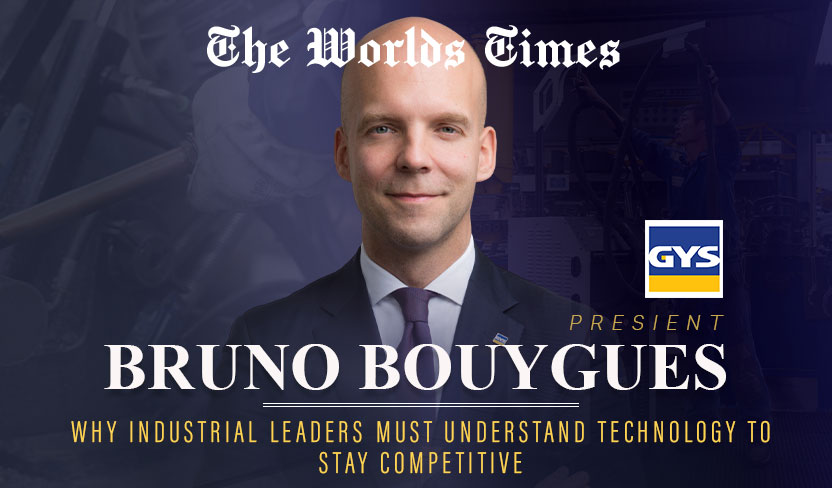
Bruno Bouygues, Chairman and CEO of GYS, believes the role of the industrial leader is changing rapidly. For companies involved in industrial production, traditional strengths such as acquisitions, factory automation and cost control are no longer enough on their own.
As technology becomes deeply integrated into industrial machines, business leaders need to understand how mechanical engineering, electronics, software, automation, connected systems and artificial intelligence are coming together.
For GYS, a French manufacturer of machine tools, this transformation reflects a broader change across industrial manufacturing: the machine is no longer simply a physical product. It is increasingly becoming a technology platform.
Why is technology becoming a strategic priority for industrial leaders?
For many years, industrial companies focused heavily on increasing production volumes, acquiring competitors and improving operational efficiency. These remain important, but they do not provide the same level of competitive protection in an environment where technology is developing at unprecedented speed.
According to Bruno Bouygues, industrial leaders must now spend more time understanding technology and working closely with engineering teams. This includes mechanical engineers, electronics specialists, automation experts and software developers.
The key question is no longer only how efficiently a company can manufacture a product. It is also how quickly it can design, develop and launch the next generation of products.
Why are acquisitions and cost reduction no longer enough?
Acquisitions can help an industrial company expand its customer base, production capacity and market presence. However, buying another company does not necessarily provide a technological advantage.
When companies continue to acquire businesses without a clear technology and product architecture, they can accumulate what is effectively technical debt. Different generations of machines, software platforms and components can become increasingly difficult and expensive to maintain.
Cost reduction has a similar limitation. A highly automated factory is valuable only if the products coming out of it remain relevant to the market.
For this reason, the competitive advantage of a machine manufacturer is increasingly moving from the production line toward the engineering teams, laboratories and design offices responsible for creating future products.
How are industrial machines becoming more complex?
Modern industrial machines are no longer simply mechanical systems.
They increasingly combine:
- Power electronics
- Embedded software and real-time firmware
- Sensors and connected systems
- Automation
- Cybersecurity
- Data
- Artificial intelligence
These technologies need to work together as one integrated system.
A weakness in software architecture or the selection of an unsuitable critical component can affect the development, reliability and commercial launch of an entire machine.
This increasing complexity also means that engineering teams must work more closely together. Mechanical, electronic and software development can no longer operate as completely separate functions.
What is the role of software in modern industrial production?
Software is changing the way industrial machines are designed and used.
A modern machine can continue to evolve after it has been installed. Software updates can add capabilities, improve performance and enable new functions. Connected machines can also generate valuable operational data and integrate with wider customer systems.
This development is creating a closer relationship between industrial manufacturing and the technology sector.
Artificial intelligence is taking this transformation further. What is often described as physical AI involves AI systems operating within physical environments, allowing machines to perceive information, make decisions and interact with the real world.
For machine manufacturers, this creates new opportunities to differentiate products through intelligent and connected capabilities.
Is a machine becoming a technology platform?
Increasingly, yes.
The value of an industrial machine is no longer determined only by its physical components. Hardware remains essential, but software, connectivity, data, intelligence and services are becoming important parts of the overall product.
This is changing the traditional boundary between a machine manufacturer and a technology company.
For companies such as GYS, the challenge is therefore not simply to manufacture reliable machines. It is to understand how technology can improve the product, create new capabilities and respond to changing customer expectations.
What does it mean for a CEO to become a “chief engineer”?
Bruno Bouygues does not suggest that CEOs should replace their chief technology officers or become involved in writing software or designing electrical systems.
Instead, industrial leaders need enough technological understanding to ask the right questions, challenge assumptions and make important strategic decisions together with their engineering teams.
A CEO should be able to ask questions such as:
- What will be the core technology of our machines five years from now?
- Which technologies should we develop internally?
- Which components or technologies should come from external partners?
- How can we create a product architecture that supports future growth?
- What role will software play in our products?
- How much future revenue could come from connected services?
- How quickly can we bring new technology to market?
These are not questions that belong only to the engineering department. They influence investment, product strategy, margins, competitiveness and the long-term direction of the company.
Why should industrial companies continue investing in R&D during difficult markets?
When markets slow down, reducing engineering and R&D spending can appear to be an immediate way to protect profitability.
However, cutting investment in technology can create a much larger problem in the future.
If competitors continue developing new products and technologies while a company reduces its engineering capabilities, the gap can become increasingly difficult to close.
For Bruno Bouygues, protecting R&D during periods of economic uncertainty is therefore an important part of maintaining long-term industrial competitiveness.
How can industrial companies break down engineering silos?
The next generation of industrial products requires closer cooperation between different technical disciplines.
Mechanical engineers, electronics engineers, automation specialists and software developers need to work together from the early stages of product development.
This can require companies to simplify their product architectures, improve communication between teams and give engineering a stronger position within the executive decision-making process.
The goal is not technology for its own sake. The goal is to reduce development barriers, accelerate innovation and bring commercially relevant products to market faster.
What does the future of industrial manufacturing look like?
The future of industrial production will increasingly depend on how effectively companies combine manufacturing expertise with technology.
Automation, electronics, software, connectivity and artificial intelligence are becoming part of the competitive foundation of industrial equipment.
For a French manufacturer of machine tools, this means that product development and technological capability are becoming just as important as factory efficiency.
The industrial leaders who succeed in this environment will need to understand both business performance and technological direction. They will not necessarily need to become engineers themselves, but they will need to understand engineering well enough to make informed strategic decisions.
Bruno Bouygues and the changing role of industrial leadership
As Chairman and CEO of GYS, Bruno Bouygues represents a leadership perspective shaped by the changing nature of industrial manufacturing.
His central argument is straightforward: technology can no longer be treated as a support function that operates separately from business strategy.
For today’s industrial companies, technological understanding needs to reach the executive level. The leaders who understand where machines, software, automation and AI are heading will be better positioned to decide where their companies should invest, how products should evolve and how they can remain competitive in a rapidly changing global market.
Connect Bruno Bouygues on LinkedIn
Visit GYS to get more information
Also Read:-
Who Are the Most Powerful CEOs in the World in 2026?
Step by Step Guide: How to Apply for a Passport in Nicaragua?
20 Richest Entrepreneurs in the World and How They Got Rich