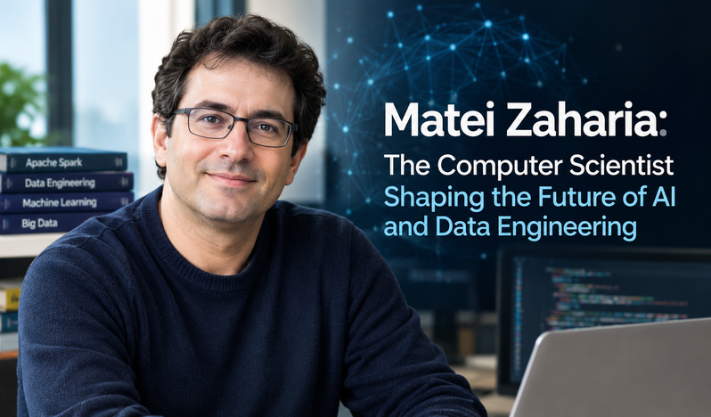
Matei Zaharia is a computer scientist, professor, and technology entrepreneur known for his work in distributed computing, data engineering, and artificial intelligence. His research and leadership have helped influence how organizations process large-scale data and build modern AI systems.
From creating Apache Spark to contributing to the development of Databricks and advancing research around efficient AI systems, Zaharia has played an important role in the evolution of modern computing. His work sits at the intersection of academic research and practical technology, making his career particularly relevant to the rapid growth of cloud computing, big data, and generative AI.
Who Is Matei Zaharia?
Matei Zaharia is a Romanian-Canadian computer scientist and professor at Stanford University. He is widely recognized for research in computer systems, machine learning infrastructure, distributed computing, and data analytics.
His career has focused on solving a fundamental technology challenge: How can massive amounts of data and increasingly complex AI workloads be processed efficiently?
Rather than treating data processing and artificial intelligence as separate fields, Zaharia’s work has helped connect them. Modern AI applications require enormous datasets, powerful computing infrastructure, and systems capable of processing information quickly. His research addresses many of these foundational requirements.
Zaharia is also known as one of the creators of Apache Spark, an open-source distributed computing framework that became an important technology for large-scale data processing.
What Is Matei Zaharia Best Known For?
Matei Zaharia is best known for his contributions to Apache Spark, distributed systems, machine learning infrastructure, and Databricks.
Apache Spark was developed to make large-scale data processing faster and more flexible. It allows organizations and researchers to process data across clusters of computers rather than relying on a single machine.
His academic research contributed to the underlying ideas behind Spark, while his entrepreneurial work helped turn those ideas into technology used by businesses and developers.
Zaharia later became a co-founder and chief technologist of Databricks, a company built around data and AI infrastructure.
How Did Matei Zaharia Contribute to Apache Spark?
Apache Spark emerged from research at the University of California, Berkeley’s AMPLab. Zaharia was one of the central researchers behind the project.
The technology was designed to address limitations in traditional approaches to distributed data processing. Spark introduced an approach that could keep frequently used data in memory, helping certain workloads run more efficiently than systems that relied heavily on disk-based processing.
Spark eventually became an open-source project with a broad developer community.
Its capabilities expanded beyond its original use cases and came to include areas such as:
- Large-scale data analytics
- Machine learning
- SQL processing
- Streaming data
- Graph processing
- Data engineering
The significance of Spark extends beyond one software framework. It helped demonstrate how research in distributed computing could become infrastructure for modern data-driven organizations.
Why Was Apache Spark Important to Big Data?
Big data created a fundamental problem for organizations: datasets became too large and complex for traditional computing systems to handle efficiently.
Distributed computing provided a solution by dividing computational workloads among multiple machines.
Spark helped make this approach more accessible to developers. Instead of manually managing complicated distributed-processing systems, engineers could use higher-level programming interfaces to work with large datasets.
This made Spark useful across industries including technology, finance, healthcare, retail, telecommunications, and scientific research.
The broader lesson from Spark is that improvements in computing infrastructure can unlock entirely new applications. When processing becomes faster and more accessible, organizations can experiment with larger datasets and more sophisticated analytical models.
Where Did Matei Zaharia Study?
Matei Zaharia completed his undergraduate studies at the University of Waterloo in Canada. He later pursued graduate research at the University of California, Berkeley.
His academic journey placed him within a strong research environment focused on computer systems and distributed computing.
During his doctoral research, he became involved with the AMPLab, where work on large-scale data processing eventually contributed to the development of Apache Spark.
His academic background demonstrates a recurring theme in his career: research ideas can have significant practical impact when they are designed around real-world computing challenges.
What Is Matei Zaharia’s Connection to Databricks?
Matei Zaharia is one of the co-founders of Databricks and has served as its chief technologist.
Databricks grew out of research connected to the development of Apache Spark. The company’s broader goal has been to help organizations manage data, analytics, machine learning, and AI workloads through cloud-based infrastructure.
The connection between Spark and Databricks illustrates how academic research can evolve into commercial technology.
Instead of stopping at a research paper or experimental system, the ideas behind large-scale data processing became part of a commercial ecosystem used by organizations around the world.
What Does Databricks Do?
Databricks provides a platform for data engineering, analytics, machine learning, and artificial intelligence.
Organizations use such platforms to bring together different stages of the data lifecycle. These can include collecting information, processing datasets, analyzing data, training machine-learning models, and developing AI applications.
This integrated approach has become increasingly important as businesses adopt artificial intelligence.
AI systems depend on reliable data infrastructure. Without effective systems for storing, cleaning, processing, and accessing information, even advanced AI models can struggle to deliver useful results.
That is why Zaharia’s work in data systems has become increasingly relevant to the AI era.
How Is Matei Zaharia Connected to Artificial Intelligence?
Zaharia’s work extends beyond traditional big-data processing into machine learning and AI infrastructure.
Artificial intelligence requires more than sophisticated algorithms. Modern AI systems also require large datasets, distributed computing resources, model-serving infrastructure, evaluation systems, and efficient software.
Research in systems engineering therefore plays a major role in determining how practical AI applications can become.
Zaharia has worked on technologies and research related to machine learning systems, model serving, AI applications, and efficient computing.
His career reflects a broader transformation in technology: AI is increasingly becoming a systems-engineering challenge as well as an algorithmic challenge.
What Is Matei Zaharia’s Role at Stanford University?
Matei Zaharia is a professor at Stanford University, where his work focuses on computer systems and related areas of computing.
Academic research allows him to continue exploring problems that may become important to the technology industry in the future.
Universities also provide an environment where researchers can investigate ideas without being limited to immediate commercial applications.
Zaharia’s career demonstrates how academic research and entrepreneurship can operate together. Research can produce foundational technologies, while startups can transform those technologies into products used by organizations.
What Areas Does Matei Zaharia Research?
Matei Zaharia’s research interests include several closely connected areas of computer science.
Distributed Computing
Distributed computing involves using multiple computers to perform computational tasks. It is fundamental to cloud platforms, large-scale analytics, and modern AI infrastructure.
Machine Learning Systems
Machine learning systems focus on the infrastructure required to train, deploy, and operate machine-learning models.
Data Processing
Large organizations generate enormous amounts of information. Efficient data-processing systems allow this information to become useful for analytics and decision-making.
Artificial Intelligence Infrastructure
As AI models become larger and more sophisticated, organizations need systems that can efficiently manage data, computing resources, and model operations.
These areas overlap significantly, which explains why Zaharia’s work has remained relevant as the technology industry has moved from big data toward AI.
Why Is Matei Zaharia Important to the Evolution of Modern Data Technology?
One reason Zaharia’s work stands out is the connection between research and implementation.
Computer science research can sometimes remain theoretical. In Zaharia’s case, research projects became widely used technologies.
Apache Spark helped organizations process large datasets. Databricks expanded the underlying ideas into a broader data and AI platform.
This progression illustrates an important technology pattern:
Research → open-source innovation → developer adoption → commercial infrastructure → new applications.
The pattern has become particularly important in artificial intelligence, where open-source software, academic research, cloud infrastructure, and startups frequently influence one another.
How Did Open-Source Technology Influence Zaharia’s Career?
Open-source development played an important role in the growth of Apache Spark.
Open-source projects allow developers and researchers around the world to inspect, modify, improve, and extend software.
For a distributed computing framework, this community effect can be particularly powerful because organizations have different workloads and technical requirements.
As more users adopt a technology, new use cases emerge. Those use cases can influence future development and create a cycle of innovation.
Spark’s growth demonstrates how open-source software can move from an academic research project to widely adopted infrastructure.
What Can Entrepreneurs Learn From Matei Zaharia’s Career?
Zaharia’s career provides several useful lessons for technology entrepreneurs.
Solve a Fundamental Problem
Successful technology often begins with a difficult problem rather than a desire to build a particular product.
Large-scale data processing was becoming increasingly challenging as datasets grew. Addressing that infrastructure problem created opportunities for broader innovation.
Build Technology That Others Can Use
Apache Spark was designed as a general-purpose technology rather than a solution for only one organization.
Broad applicability helped create a larger developer community.
Connect Research With Real-World Needs
Research becomes particularly influential when it addresses challenges that businesses, developers, and society are actually experiencing.
Think Beyond the Current Technology Cycle
Big data was a dominant technology theme before generative AI became mainstream. Yet many of the underlying infrastructure challenges remain relevant.
This suggests that entrepreneurs can benefit from understanding foundational technology rather than focusing exclusively on short-term trends.
How Has Matei Zaharia Influenced the AI Infrastructure Era?
The rise of generative AI has increased demand for powerful infrastructure.
Companies now need to manage enormous datasets, train and deploy models, evaluate AI applications, and integrate AI into existing software.
These requirements depend heavily on distributed computing and data engineering.
Zaharia’s career has been closely connected to these foundational technologies. His work illustrates that AI innovation is not limited to developing larger models. The surrounding infrastructure can be equally important.
Efficient systems can reduce costs, improve performance, and make advanced technology accessible to more organizations.
What Is the Significance of His Work for Businesses?
For businesses, the importance of data infrastructure is straightforward: better infrastructure can make it easier to turn raw information into useful intelligence.
Organizations increasingly use data for:
- Customer analytics
- Financial forecasting
- Product development
- Risk management
- Marketing
- Automation
- Machine learning
- Artificial intelligence
As these applications become more sophisticated, the underlying systems must also evolve.
The technologies associated with Zaharia’s research and entrepreneurial work are part of that evolution.
What Is Matei Zaharia’s Broader Contribution to Computer Science?
Matei Zaharia’s broader contribution can be understood through three connected areas: distributed systems, data processing, and AI infrastructure.
His work demonstrates how computer science research can influence both software development and business technology.
Apache Spark helped establish a widely used approach to large-scale data processing. His academic research continues to explore computer systems and machine learning infrastructure, while his entrepreneurial work has helped bring those concepts into the commercial technology ecosystem.
His career therefore represents more than the creation of one software project. It reflects the growing importance of infrastructure in the development of modern computing.
What Does Matei Zaharia’s Career Tell Us About the Future of AI?
The future of artificial intelligence will depend not only on better models but also on better systems.
AI applications need reliable data pipelines, efficient computing, scalable storage, model infrastructure, security, monitoring, and tools that developers can actually use.
This creates opportunities for researchers and entrepreneurs who work on the infrastructure surrounding AI.
Zaharia’s career offers a useful example of this shift. His early work in distributed data processing became increasingly relevant as machine learning and artificial intelligence expanded.
The connection between data and AI is likely to become even stronger as organizations integrate intelligent systems into everyday business processes.
What Are the Key Lessons From Matei Zaharia’s Technology Journey?
Several lessons stand out from Zaharia’s professional journey.
First, foundational infrastructure matters. Technologies that operate behind the scenes can have an enormous influence on the products people eventually use.
Second, academic research can become commercial innovation. Research does not have to remain inside universities when it addresses practical problems.
Third, open-source communities can accelerate technology adoption. Collaborative development can help useful technologies evolve rapidly.
Fourth, AI depends on data systems. The growth of artificial intelligence increases rather than reduces the importance of reliable data infrastructure.
Finally, technology careers can evolve with the industry. Skills developed around distributed computing and data processing can become valuable foundations for newer fields such as machine learning and generative AI.
Why Does Matei Zaharia Matter in Today’s AI Economy?
Matei Zaharia represents a generation of computer scientists whose work helped build the infrastructure underlying today’s data-driven economy.
His involvement with Apache Spark demonstrated the value of scalable data processing. His work at Databricks connected those ideas to enterprise data and AI applications. His academic research continues to explore the systems required for increasingly sophisticated computing workloads.
As artificial intelligence becomes integrated into business, science, software development, and everyday digital services, infrastructure will remain a critical part of the technology ecosystem.
The story of Matei Zaharia therefore provides an example of how fundamental computer science research can influence open-source software, startups, enterprise technology, and the emerging AI economy.
Frequently Asked Questions About Matei Zaharia
Who is Matei Zaharia?
Matei Zaharia is a computer scientist, Stanford professor, and technology entrepreneur known for his work in distributed systems, big-data processing, machine learning systems, and artificial intelligence infrastructure.
What did Matei Zaharia create?
He was one of the key creators of Apache Spark, an open-source distributed computing framework designed for large-scale data processing.
Is Matei Zaharia a co-founder of Databricks?
Yes. Matei Zaharia is one of the co-founders of Databricks and has served as its chief technologist.
What is Apache Spark used for?
Apache Spark is used for large-scale data processing, analytics, SQL workloads, machine learning, and streaming applications.
What does Matei Zaharia research?
His research includes distributed computing, computer systems, machine learning infrastructure, data processing, and AI-related systems.
Where does Matei Zaharia teach?
Matei Zaharia is a professor at Stanford University.
Why is Matei Zaharia associated with AI?
His research and technology work focus on infrastructure that supports data processing and machine learning. These systems are increasingly important for building and operating modern AI applications.
What can entrepreneurs learn from Matei Zaharia?
Entrepreneurs can learn the value of solving fundamental technical problems, building broadly useful technology, supporting open ecosystems, and connecting research with real-world applications.
Why is data infrastructure important for AI?
AI systems depend on large amounts of data and computing resources. Efficient infrastructure helps organizations process data, train models, deploy applications, and operate AI systems at scale.
What is Matei Zaharia’s lasting impact?
His work has helped connect academic research, open-source software, distributed computing, enterprise data platforms, and AI infrastructure. Apache Spark remains a major example of how foundational computer science research can influence the technology industry.
Conclusion: Matei Zaharia and the Infrastructure Behind Modern AI
Matei Zaharia’s career illustrates how fundamental computer science can shape entire technology industries. From distributed computing and Apache Spark to Databricks and modern AI infrastructure, his work has consistently focused on making large-scale computing more practical and accessible.
His journey also highlights an important reality about artificial intelligence: breakthroughs do not happen only at the model level. They depend on the systems underneath them.
Also Read:-
Ali Ghodsi: The Visionary Behind Databricks and Enterprise AI
Step by Step Guide: How to Apply for a Passport in Panama?
Jensen Harris: Career, Leadership, and Microsoft Experience