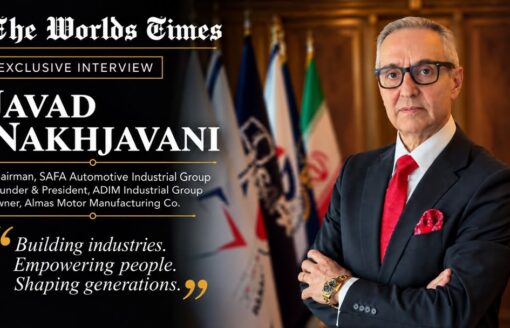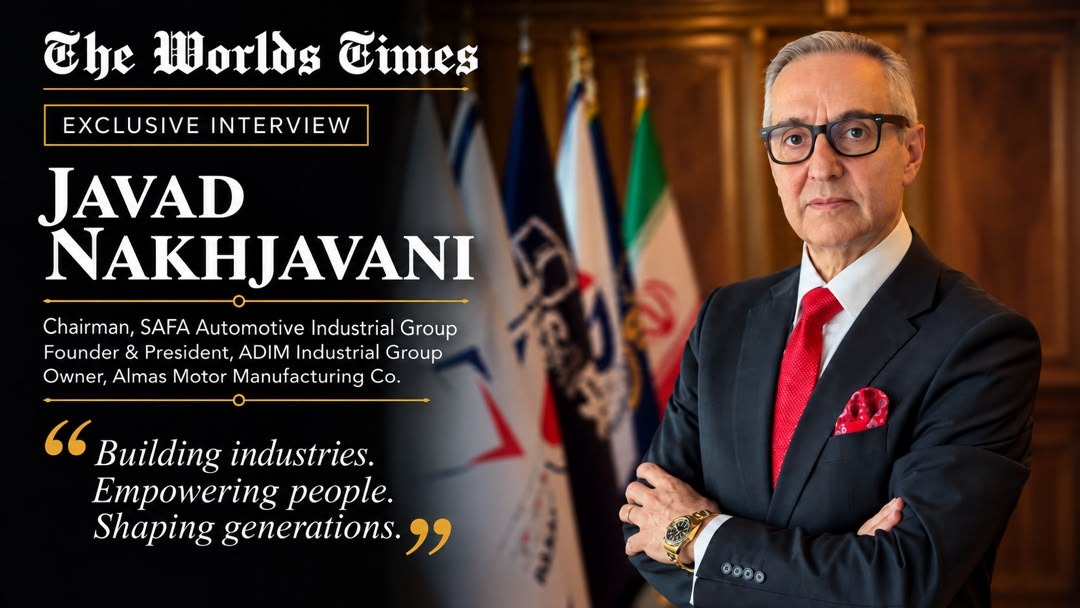
Some leaders build products. Others build companies. The measure that matters most to Javad Nakhjavani is whether an organization continues creating knowledge, capability, and opportunity after its founder or leader has stepped aside.
From telecommunications and aerospace to automotive engineering and diversified industrial operations, his career reflects a consistent interest in difficult problems, capable teams, and practical innovation. In this conversation, he discusses where that drive began, what engineering taught him about leadership, and why industrial progress must ultimately serve people.
With a Ph.D. in Physics from the University of Manchester, Dr. Nakhjavani is the founder of ADIM Industrial Group and has held senior leadership roles across major industrial and automotive businesses, including SAFA Automotive Industrial Group. He is currently developing the Almas Motor Group of Factories, focused on commercial vehicles and passenger cars.
Where It All Began
Early Influences, Entrepreneurial Beginnings
We started the interview by asking, “You were introduced to industry and business at an early age. How did those early experiences shape the engineer and entrepreneur you later became?”
Dr. Javad Nakhjavani replied, “I was fortunate to grow up in an industrial family, where manufacturing and business were part of everyday life. But what shaped me most was not the family business itself. It was the desire to create something of my own.
As an elementary-school student, I began buying and selling small items to classmates and even to older students. I did not do it because I needed the money. What excited me was discovering an opportunity, negotiating, earning trust, and creating value through my own initiative.
Looking back, I can see that my entrepreneurial curiosity began in the schoolyard, long before I became an engineer. Business taught me to recognize opportunities; engineering later gave me the tools to turn ideas into products. I have never seen those disciplines as separate. Innovation must become useful in the real world, and business should create value that lasts.
I wanted to find my own path. Whether I was developing a prototype, working on an aircraft, or building an industrial organization, the motivation was the same: to take an idea seriously enough to make it real.
Choosing Challenges, Not Industries
The Worlds Times: Your career has taken you from telecommunications to aerospace, automotive innovation, and the leadership of major industrial organizations. Few leaders deliberately move across such different industries. What has been the driving force behind these transitions, and how have they shaped your philosophy of leadership?
Dr. Javad Nakhjavani replied, “Looking back, I don’t think I ever chose an industry-I chose challenges.
Throughout my career, I have been drawn to projects that many people considered too difficult, too risky, or simply impossible. Success itself has never been my destination. My real motivation has always been the process of transforming an ambitious idea into a working reality. Once that mission is accomplished and the organization is capable of moving forward under a new generation of leaders, I naturally begin looking for the next challenge.
That philosophy explains why my career has never followed a conventional path.
I began in telecommunications with Alcatel, where I learned that technology alone does not create progress; execution, discipline, and leadership do. Those early years taught me how large-scale projects are built and how innovation becomes meaningful only when it reaches people’s lives.
My next challenge took me into aerospace, where I had the privilege of contributing to the design and development of Iran’s first certified single-engine aircraft. It was an experience that reinforced an important belief: breakthroughs are rarely achieved by accepting conventional limits.
Rather than remaining in a familiar environment, I moved into the automotive sector by founding ADIM Industrial Group. At a time when OEM vehicle trimming and tuning was virtually unknown in Iran, we established one of the country’s earliest industrial-scale operations in this field. Over the years, more than 100,000 vehicles were completed through these OEM programs. For me, this was never simply about modifying vehicles; it was about creating a new industrial capability where none previously existed.
That journey naturally expanded into automotive design, product development, manufacturing leadership, and eventually the management of large industrial groups. Although the industries were different, the underlying mission remained exactly the same: identify opportunities that others overlook, build capable teams, transform complexity into practical results, and create organizations that can continue growing long after my own mission is complete.
Today, I am also developing the Almas Motor Group of Factories, an industrial manufacturing complex dedicated to the production of commercial vehicles and passenger cars. This is an ongoing project, and I see it as another opportunity to translate engineering experience and industrial vision into lasting manufacturing capabilities.
Today, I see leadership not as the ability to preserve the status quo, but as the courage to build what others believe cannot be built. The true measure of a leader is not how long they remain at the center of an organization, but whether the organization continues to grow after they have moved on.
“I have never been motivated by maintaining success. My passion has always been building what others believed was impossible, empowering the next generation to lead it, and then moving on to the next impossible challenge.”
Engineering the Approach to Leadership
The Worlds Times: Your background is deeply rooted in engineering, yet today you lead complex industrial organizations involving thousands of people, multiple businesses, and long-term strategic decisions. How has your engineering mindset influenced your approach to leadership?
Dr. Javad Nakhjavani replied, “Engineering has shaped far more than my technical knowledge-it has shaped the way I think.
Engineers are trained to look beyond symptoms and search for root causes. They learn to question assumptions, simplify complexity, and make decisions based on evidence rather than emotion. Those habits have remained with me throughout my career, regardless of the industry or the leadership role.
As my responsibilities expanded, I realized that organizations are not very different from complex engineering systems. Every decision affects multiple components, every weakness has a cause, and every sustainable solution requires understanding how the whole system works rather than treating isolated problems.
However, leadership also taught me something that engineering alone cannot.
Machines follow instructions; people follow purpose.
A production line can be optimized with calculations, but organizations grow only when people believe in a shared vision. That realization fundamentally changed my understanding of leadership. Data remains essential, but trust, culture, and shared purpose are equally important. The strongest organizations are built when analytical thinking and human understanding work together.
This balance has influenced every organization I have led. Whether designing a vehicle, developing a manufacturing operation, or leading a diversified industrial group, my objective has always been the same: create systems that are technically sound, commercially sustainable, and capable of continuing to grow beyond the contribution of any single individual-including myself.
For me, leadership is not about having all the answers. It is about building organizations that continue finding the right answers long after the leader has left the room.
“Engineering taught me how systems work. Leadership taught me why people make those systems succeed.”
Leading Through Uncertainty
The Worlds Times: Many people see the final success but rarely the uncertainty behind it. Looking back, what has been the most difficult leadership lesson you have learned, and how has it changed the way you make decisions today?
Dr. Javad Nakhjavani replied, “One of the hardest lessons I have learned is that success does not come from making every decision correctly. It comes from having the courage to make difficult decisions while accepting full responsibility for their consequences.
In every major project I have led, there have been moments when information was incomplete, opinions were divided, and certainty simply did not exist. Waiting for perfect conditions is often the greatest risk of all. Leadership requires the ability to make thoughtful decisions despite uncertainty-and to stand by them.
Another lesson took me much longer to learn.
As engineers, we naturally believe that if we build the right product, success will follow. Experience taught me that outstanding ideas alone are never enough. Even the best technologies can fail without the right people, the right culture, and the right execution.
Over time, I also realized that one of the greatest responsibilities of a leader is knowing when to step aside. Many organizations struggle not because they lack talented people, but because leaders hold on to responsibilities they should have already delegated. I have always believed that once a team becomes capable of moving forward independently, it deserves the opportunity to lead. Creating successors is not the end of leadership-it is one of its highest achievements.
Perhaps the most important lesson of all is that leadership is a continuous process of learning. Every challenge teaches humility, every setback reveals hidden opportunities, and every success reminds us that no accomplishment is permanent.
That mindset has allowed me to move from one industry to another throughout my career without being limited by previous achievements.
“A leader’s greatest achievement is not building an organization that depends on them; it is building one that no longer needs them.”
Learning from Experts
The Worlds Times: Throughout your career, you have repeatedly entered industries where highly experienced professionals had spent decades building their expertise. How do you earn the trust of experts and lead organizations in fields that are entirely new to you?
Dr. Javad Nakhjavani replied, “The first thing I do is accept that I am not the smartest person in the room.
When I enter a new industry, I never assume that experience in one field automatically makes me an expert in another. Every industry has its own language, history, culture, and unwritten rules. Respecting that reality is the foundation of earning trust.
My role is not to know everything.
My role is to ask the right questions, bring together capable people, and create an environment where expertise can flourish.
I spend a great deal of time listening before making major decisions. Engineers, technicians, operators, and frontline employees often understand details that never appear in reports or presentations. Some of the most valuable lessons in my career have come from conversations on factory floors rather than in boardrooms.
At the same time, coming from outside an industry has one significant advantage.
People who have spent decades in the same environment sometimes accept limitations as permanent realities. Someone arriving from another field is more likely to ask, “Why does it have to be done this way?” That simple question often opens the door to innovation.
I believe leadership is a combination of humility and confidence.
Humility allows you to learn from people who know more than you.
Confidence allows you to make difficult decisions once you have learned enough.
Without humility, leaders stop learning.
Without confidence, they stop leading.
Finding the balance between those two has been one of the defining principles of my career.
“The strongest leaders are not those who know everything; they are those who create an environment where the best knowledge can come together.”
Turning Setbacks into Lessons
The Worlds Times: You have spoken about taking responsibility for difficult decisions. When a project fails or a team faces a major setback, how do you respond?
Dr. Javad Nakhjavani replied, “Failure has been one of my greatest teachers. Anyone who claims to have built a long career without setbacks is probably telling only half the story. I have seen projects fall short of expectations, plans disrupted by economic crises, and circumstances that required an entirely new direction.
My first responsibility after a setback is not to find someone to blame. It is to stand beside the team, accept my share of responsibility, and help everyone understand what we can learn. I have often encouraged colleagues to rest, spend time with their families, regain their energy, and then return ready for the next challenge.
I have used a simple image with my teams: failure can be like a rubber ball-the harder it strikes the ground, the higher it may bounce back. That is not a promise that every loss produces a victory. It is a reminder that an unsuccessful test or project can become valuable if we have the discipline to learn from it.
Engineering teaches us to test, correct, and redesign. Leadership adds a human responsibility: protect the confidence and dignity of the people doing that work. Success builds confidence, but adversity often reveals character.”
Building Industrial Institutions
The Worlds Times: Today you lead one of Iran’s major diversified industrial groups, with operations spanning steel, manufacturing, automotive, food, pharmaceuticals, and other industrial sectors. Having worked across so many industries, what common principles do you believe determine whether an organization will succeed in the decades ahead?
Dr. Javad Nakhjavani replied, “Although the industries are different, I have found that the principles of long-term success are remarkably similar.
Whether you produce steel, manufacture vehicles, develop pharmaceutical products, or operate in the food industry, sustainable success is never built on products alone. It is built on people, technology, operational excellence, and the ability to adapt faster than the environment changes.
One lesson has become increasingly clear throughout my career: industries no longer evolve independently. Today, innovation flows across sectors. Advances in artificial intelligence influence manufacturing. Developments in material science reshape transportation. Digital technologies transform healthcare. Sustainability is redefining every industrial value chain.
That is why I encourage our organizations to think beyond the boundaries of their own industries. Some of the best ideas emerge when knowledge from one sector is successfully applied to another.
Another principle I strongly believe in is long-term thinking.
Many companies focus on quarterly results. I believe industrial organizations should think in decades. Building factories, developing technologies, training people, and earning trust cannot be achieved within a single financial cycle. Industrial leadership requires patience, consistency, and the willingness to invest in capabilities whose greatest value may only become visible years later.
Finally, I believe every industrial organization has a responsibility that extends beyond business performance.
Industry creates employment, develops technology, strengthens national capabilities, and improves the quality of life for society. Financial success is important, but it should be the outcome of creating genuine value-not the objective in itself.
When organizations remain committed to innovation, integrity, and long-term value creation, they become far more than successful companies. They become institutions.
“Industries may produce different products, but great organizations are built on the same foundations: people, knowledge, trust, and the courage to think beyond the next quarter.”
Leading through Constant Change
The Worlds Times: You have led major industrial organizations in an environment where economic conditions, regulations, technology access, and global markets can change rapidly and often unpredictably. How has operating under constant uncertainty influenced your approach to strategy and leadership?
Dr. Javad Nakhjavani replied, “One of the greatest misconceptions about leadership is that its primary purpose is to create certainty.
In reality, leadership exists because certainty rarely does.
Throughout my career, I have learned that no strategic plan survives unchanged. Markets evolve, regulations shift, technologies advance, supply chains are disrupted, and unexpected events can reshape priorities almost overnight. The role of leadership is not to predict every change, but to build organizations capable of adapting faster than change itself.
Operating in such an environment has taught me to distinguish between what should remain constant and what must remain flexible.
Our values, integrity, long-term vision, and commitment to quality should never change.
Our methods, structures, priorities, and execution must continuously evolve.
Another important lesson is that resilience is not built during a crisis. It is built long before the crisis arrives.
Organizations become resilient by investing in capable people, developing multiple options instead of relying on a single path, strengthening relationships with partners, and maintaining the financial and operational discipline needed to absorb unexpected shocks.
I also believe that uncertainty often creates opportunities that stable environments do not.
When conditions become more difficult, many organizations become defensive and focus only on survival. Those who continue investing in innovation, knowledge, and long-term capability often emerge stronger when stability returns.
Perhaps that is why I have never viewed uncertainty only as a risk.
I see it as a test of leadership.
Not because uncertainty is desirable, but because it reveals the true character of an organization. Strong organizations are not defined by the absence of challenges. They are defined by how they respond when challenges become unavoidable.
“Uncertainty does not create great leaders. It reveals them.”
Keeping People at the Center of Technology
The Worlds Times: Artificial intelligence, robotics, and automation are transforming industry. What should industrial leaders preserve as technology changes the way people work?
Dr. Javad Nakhjavani replied, “We are living through a profound transformation in manufacturing. Artificial intelligence, robotics, automation, and digital technologies are becoming increasingly important to competitiveness. Ignoring that change would be a mistake.
But I believe technology exists to serve humanity, not the other way around. Our responsibility is more than buying advanced machines or increasing output. We must think about the people whose work will change, the skills they will need, and the new opportunities that technology can help create.
I see artificial intelligence as a powerful partner. It can take on repetitive tasks, help us analyze information, and improve production processes. People must remain central to imagination, judgment, responsibility, and leadership. The most successful organizations will be those that combine technical progress with investment in human capability.
Innovation is meaningful when its benefits reach society. If we use these tools to develop stronger companies and more opportunities for engineers, entrepreneurs, and future generations, then we have used them wisely.”
Building a Legacy of Capability
The Worlds Times: When future generations look back on your career decades from now, what do you hope they will remember-not about the companies you led, but about the contribution you made to industry and to people?
Dr. Javad Nakhjavani replied, “I hope they will remember that I never believed industry was only about manufacturing products.
Industry is about creating capability.
Every factory we build, every technology we develop, and every business we establish should leave behind something more valuable than its physical assets. It should leave behind knowledge, confidence, and people who are capable of building even greater things.
Throughout my career, I have tried to see every project as an opportunity to create something that will outlive me.
Sometimes that means developing a new industrial capability.
Sometimes it means helping young engineers believe they can solve problems that once seemed impossible.
Sometimes it means creating organizations that continue to grow without depending on a single individual.
I have never measured success only by financial results.
The true value of industry is its ability to improve lives, strengthen a nation’s capabilities, and create opportunities for future generations.
If, many years from now, someone says that I helped build not only businesses, but also people, knowledge, and confidence, I will consider that my greatest achievement.
Because buildings eventually age.
Machines are replaced.
Technologies evolve.
But the people we inspire continue building long after we are gone.
“The greatest industrial legacy is not what we manufacture today, but what we enable others to create tomorrow.”
Advice for the Next Generation
The Worlds Times: What advice would you offer to young engineers, entrepreneurs, and future industrial leaders?
Dr. Javad Nakhjavani replied, “Never lose sight of your purpose. Markets change, technologies evolve, and difficulties arrive without warning. A clear goal will not remove every obstacle, but it gives you a reason to keep moving forward.
Be patient. Industrial capability is built over years, not months. There are no reliable shortcuts to gaining knowledge, earning trust, developing products, or building strong organizations.
Never stop learning. Remain curious, listen to people whose experience differs from your own, and be willing to question what you think you already know.
And remember that success is not a journey you make alone. Invest in people, share knowledge, and create opportunities for others. In the end, the greatest legacy of a leader is not simply what they build, but what they enable others to build.”
Finding Inspiration Beyond Industry
Lastly we asked, “Your career has been defined by leadership, engineering, and industry. Outside of work, what helps you stay creative, balanced, and inspired?”
“I have always believed that leadership requires balance as much as ambition.
Physical exercise helps me maintain discipline, energy, and mental clarity. A healthy mind performs best in a healthy body.
Music has been another lifelong companion. I enjoy playing music because it allows me to express a different side of myself-one that is less analytical and more intuitive. In many ways, engineering and music have more in common than people imagine. Both rely on harmony, structure, rhythm, and creativity.
Reading and writing are equally important to me. They are not simply habits; they are how I continue learning. Every good book offers a new perspective, and writing helps me organize my own thoughts and challenge my assumptions.
There is one more habit that often surprises people.
I genuinely enjoy watching animated films.
For me, great animation is far more than entertainment. It is a unique combination of imagination, storytelling, design, engineering, emotion, and art. After long days filled with meetings, complex decisions, and responsibilities, watching a well-crafted animation helps me quiet my mind and reconnect with creativity. In its own way, it is a form of meditation.
Perhaps that is why, after all these years; I still consider curiosity to be one of the most valuable qualities a person can preserve.
As long as we remain curious, we continue to grow.
“Curiosity keeps the engineer learning, the leader evolving, and the human spirit young.”
Editor’s Closing Note
Some interviews leave us with facts.
Others leave us with numbers.
A few leave us with ideas.
Our conversation with Javad Nakhjavani belongs to the third category.
Across decades of engineering, industrial leadership, and business transformation, one principle appears to have remained unchanged: progress is never the result of certainty, it is the reward for curiosity, resilience, and the willingness to accept challenges that others consider impossible.
Perhaps that is the most enduring message of this conversation.
Not that successful organizations are built by remarkable individuals, but that remarkable individuals dedicate themselves to building organizations where many others can succeed.
And in the end, that may be the most meaningful definition of leadership.
Connect with Dr. Javad Nakhjavani on LinkedIn
Also Read:-
Mircea Craciun: Building a Sustainable Landscaping Business
Johan de Vroom: Strategic Models for Organisations and Change
Nikola Kočić on Growww AI and Smarter Business Decisions