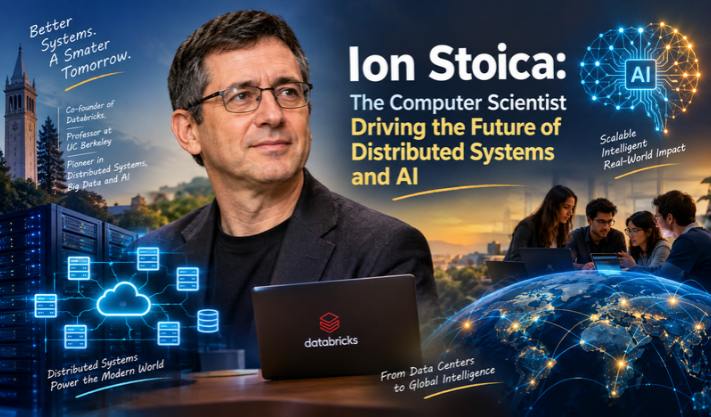
Ion Stoica: Who Is Ion Stoica?
Ion Stoica is a Romanian-American computer scientist, lecturer, entrepreneur and technology executive noted for his contributions in distributed systems, cloud computing, networking and artificial intelligence infrastructure. He is a professor at the University of California, Berkeley and his research has impacted the design, deployment and scaling of modern computing systems.
Stoica has been a key player in creating solutions that assist organisations efficiently manage huge amounts of data. His academic work has also helped shape a number of notable open source initiatives and technology enterprises.
His career has spanned the worlds of academic study and practical innovation. Stoica has taken ideas from theoretical computer science and helped translate them into technology utilised by developers, researchers and enterprises around the world.
Ion Stoica Is Notable For
Ion Stoica is best known for his work on distributed systems, computer networking, cloud infrastructure and large-scale data processing. He has also helped co-found or contributed to significant technological projects such as Apache Mesos, Apache Spark and Anyscale.
His work has helped solve a basic problem in modern computing: how to coordinate huge amounts of computer power, storage and data efficiently?
As applications grew more complex, companies found themselves requiring infrastructure that could support millions or billions of operations. Stoica’s work looked at how these systems may be made more scalable, dependable and efficient.
His work has thus found particular relevance to cloud computing, big data, machine learning and artificial intelligence.
Why Should We Study Distributed Systems?
A distributed system enables a set of computers to operate together as a single coordinated computing environment. And this is important, because most current applications are not dependent on a single machine.
Distributed infrastructure powers search engines, streaming platforms, monetary systems, social networks, cloud applications and AI services.
Stoica’s work has helped develop ways for managing these complicated situations, making computer systems more adaptable and able to manage massive workloads.
What Did Ion Stoica Do for Apache Mesos?
Ion Stoica was a main inventor of Apache Mesos, a platform for distributed systems that provides a way to manage computing resources across clusters of machines.
Mesos came up with a way to share computer resources efficiently across diverse applications. Rather than having each application handle actual computers on its own, Mesos could orchestrate resources across a huge cluster.
This idea came in handy as organisations started operating larger and larger data centres.
Mesos has played an important role in the evolution of cloud computing.
Mesos helped show how computing resources may be used as a flexible pool rather than siloed servers.
This idea inspired the creation of contemporary infrastructure management and cloud-native computing. Organisations could run different workloads on shared infrastructure, enhancing utilisation and simplifying resource management.
The general notion is still relevant today, as cloud platforms often dynamically provision compute resources based on the needs of the application.
What Did Ion Stoica Do in Apache Spark?
Ion Stoica was a researcher on the Apache Spark project, an open-source engine for large-scale data processing that is widely utilised.
Spark made it easier for developers and data scientists to work with massive datasets by employing distributed computing. It was particularly notable because it could support many workloads from data analysis to machine learning and stream processing.
Why Did Apache Spark Become So Influential?
A big factor was that it made distributed data processing more accessible.
Before technologies such as Spark, you typically needed specific infrastructure and difficult programming paradigms to work with massive datasets. Spark offered increased flexibility, allowing developers to conduct advanced data operations across clusters.
Its impact wasn’t just in traditional analytics because machine learning increasingly had to deal with massive datasets.
What Is Ion Stoica’s Relation to Artificial Intelligence?
Ion Stoica’s work is directly tied to AI in the infrastructure needed to build and run modern machine-learning systems.
Algorithms are not the only thing that AI depends on. AI applications need lots of computer resources, distributed storage, data pipelines, model-serving systems, and tools to manage workloads.
These are exactly the infrastructure concerns that Stoica has addressed in his research and commercial efforts.
Why Do We Need Specific Infrastructure for AI?
Modern AI models can include billions or even trillions of parameters and require massive amounts of computing resources to train and run.
AI infrastructure needs to efficiently orchestrate processors, memory, storage, networking and software. It must also enable teams to develop models while reducing costs and boosting performance.
That’s when distributed systems knowledge comes into play.
What Is Anyscale? What Is Ion Stoica’s Role?
Ion Stoica is the co-founder of Anyscale, a firm built around Ray, an open-source distributed computing framework.
Ray is meant to help developers extend Python applications and machine-learning workloads across several machines.
Stoica’s connection to Anyscale is rooted in his larger view that research may produce foundational technologies, and companies can then convert those ideas into usable solutions.
What Is Ray Good For?
Ray provides the infrastructure to scale applications across clusters. It has become especially relevant to machine learning and AI operations.
Developers are able to employ distributed computing for model training, hyperparameter tuning, reinforcement learning, data processing, and model serving.
As the expansion of AI applications has accelerated, so has the importance of Ray, as AI development increasingly involves workloads that cannot be efficiently run on a single machine.
Ion Stoica Is a Professor in the Computer Science Division at UC Berkeley
Ion Stoica is a professor at the University of California, Berkeley, where he has been active in research and education in computer science.
His academic career has been a path to engage with fundamental computer difficulties, while also mentoring students and researchers who go on to contribute to the technology business.
What Is the Importance of Berkeley to His Scientific Career?
UC Berkeley has an extensive history in computer science, systems, networking, and AI research.
An atmosphere is provided to researchers to examine tough technical problems in collaboration with colleagues and industry partners.
Stoica’s career is proof of the impact of university research on commercial technologies around the world.
What Are Ion Stoica’s Research Interests?
Ion Stoica’s research has spanned multiple, related areas in computer science. This includes distributed systems, cloud computing, networking, operating systems, data processing and AI infrastructure.
They may seem to be independent areas, but they are connected very intimately.
How Are These Research Fields Related?
A modern AI application may require data to be stored on multiple machines, processed by distributed systems, connected by high-speed networks, and supplied through cloud infrastructure.
Therefore, by improving one section of the computing stack, the performance of the whole system can be improved.
Stoica has always been looking for methods to make these systems scalable and efficient.
What Sets Ion Stoica Apart in His Approach to Technology?
Stoica’s career is distinguished by the confluence of academic research, open-source software and entrepreneurship.
His career is an illustration of how research and commercial technology do not have to be different worlds but may complement each other.
Why Is Open Source Relevant to His Work?
Open-source initiatives allow researchers and developers to collaborate to test, improve and expand technologies.
Research by Stoica has penetrated widely beyond the academic community to reach users. This generates a feedback loop in which problems in the actual world might impact future study.
The outcome is a strategy for technology creation that links institutions, open-source communities, startups and large companies.
What Was Ion Stoica’s Influence on Modern Cloud Computing?
His efforts have been crucial to shaping key ideas underpinning large-scale resource management and distributed computing.
The ability to dynamically and efficiently provision computing resources is essential to cloud computing. Applications could need higher capacity at peak times and lower capacity at quieter times.
Why Is Resource Management Important in the Cloud?
Cloud providers run big numbers of machines. This leads to wasted computer capacity and greater expenditures due to poor resource usage.
Distributed resource management tools enable organisations to achieve better utilisation of their infrastructure.
As cloud computing grew, the principles investigated by Stoica’s study have continued to be relevant.
How Did Ion Stoica Influence Data Science?
Stoica’s work on distributed data-processing systems has helped bring large-scale analytics into the domain of the practical.
Data scientists often encounter datasets that are too huge for typical single-machine processing.
How Critical Is Scalable Data Processing?
Companies acquire data from their consumers, websites, sensors, apps, monetary systems and more.
Processing this information can expose patterns that can help make smarter decisions. Distributed data-processing frameworks enable organisations to analyse enormous datasets within practical time periods.
This has helped fuel the rise of modern data engineering and machine learning.
What Can Entrepreneurs Learn From Ion Stoica’s Career?
Entrepreneurs can learn that tackling real problems is more important than chasing the latest tech trends.
Stoica has frequently tackled challenging infrastructure problems that grew in importance with technological advances.
What’s the Biggest Entrepreneurial Lesson From His Work?
One big lesson is that infrastructure is a huge business opportunity if it solves challenges caused by technological advancement.
Distributed computing used to be mostly a research topic in academia. With the proliferation of internet apps, cloud computing, big data and AI, the requirement for scalable infrastructure was huge.
That is why entrepreneurs should pay attention to underlying technical difficulties, not just surface consumer applications.
Why Ion Stoica Matters for the Future of AI
AI development is trending towards ever more sophisticated models and ever more demanding workloads. The efficiency of infrastructure is going to matter more and more as models get bigger and AI applications get more complicated.
Stoica’s work is relevant because distributed computing provides many of the underpinnings required to scale AI.
What Are the Challenges of AI Infrastructure?
AI infrastructure should include computation costs, energy consumption, hardware availability, data transportation, model training time, dependability, and deployment complexity.
Organisations can meet these issues with efficient distributed systems.
The future of AI will thus require not just better algorithms, but better infrastructure.
What Is the Broader Influence of Ion Stoica on Technology?
Ion Stoica’s influence extends beyond software initiatives. His work reflects a larger shift in computer science: from computing on individual devices to computing over enormous networks of machines.
This change has touched pretty much every significant technological sector.
Distributed Systems Help Technology Such As
Distributed systems are used by cloud applications, search engines, streaming services, financial platforms, social networks, scientific computing, big-data analytics, and artificial intelligence.
As these industries grow, so too will the need for scalable infrastructure.
What’s the Legacy of Ion Stoica?
The legacy of Ion Stoica may be considered in three primary categories: research, open-source technology and entrepreneurship.
His scholarly research has contributed to the progress in distributed computing. He has contributed to open-source initiatives that have enabled advanced computer technologies to be accessible by a wide developer audience. He has been an entrepreneur, focused on bringing distributed AI infrastructure to the commercial world.
Why Would His Legacy Matter to Computer Scientists in the Future?
The career of Stoica shows how basic research can be turned into useful technology.
It also stresses the importance of marrying deep technical knowledge with a grasp of real-world challenges.
For students and scholars, his career is an illustration of how academic discoveries can cascade through entire technology ecosystems.
Students Can Learn a Lot From Ion Stoica
Stoica’s career has a lot to teach students interested in computer science.
- The basic principles of computer science are still relevant even as technology evolves.
- Severe infrastructure challenges can have a large long-term impact.
- The more research can be turned into actual systems, the more powerful it is.
What Should a Young Computer Scientist Study?
For students who are interested in comparable pathways, they might want to consider distributed systems, operating systems, networking, databases, cloud computing, machine learning, artificial intelligence and software engineering.
Advanced systems research, too, can be enabled by a strong background in mathematical reasoning and programming.
Ion Stoica’s Career Provides Valuable Insights Into the Future of Computers
Ion Stoica’s work reflects a major trend in technology: computers are getting more distributed, more intelligent, and more infrastructure-intensive.
AI development accelerates this trend. Training and managing sophisticated artificial intelligence systems requires large-scale computing environments that can orchestrate enormous amounts of hardware and data.
Is AI More Distributed Computing?
Yes. As AI workloads expand, organisations will depend more on systems that can effectively divide computing jobs over a large number of devices.
So the future of AI will not just be about model innovation, but also infrastructure, networking, storage, scheduling and distributed software.
Ion Stoica’s work is firmly grounded in this larger technological revolution.
Ion Stoica: Frequently Asked Questions
Ion Stoica – Who Is Ion Stoica?
Ion Stoica is a computer scientist, lecturer, researcher, and entrepreneur focused on distributed systems, cloud computing, networking, data processing, and AI infrastructure.
What Is Ion Stoica Known For?
He is notable for his work in distributed computing, especially with Apache Mesos, Apache Spark, and Ray.
Is Ion Stoica a Professor?
Yes. Ion Stoica is a professor at the University of California, Berkeley, where he has been active in research and education in computer science.
What Does Ion Stoica Have to Do With Apache Spark?
One of the academics who worked on Apache Spark, a leading open-source platform for large-scale data processing, was Stoica.
What Is the Relation Between Ray and Ion Stoica?
Founded by Ion Stoica, Anyscale is built on top of Ray, an open-source framework created to assist developers in scaling applications and machine-learning workloads.
Why Does Ion Stoica Matter for AI Infrastructure?
His study in distributed systems and his work on scalable computing platforms tackle many of the infrastructural problems involved in building and delivering current AI applications.
What Lessons Can Entrepreneurs Take From Ion Stoica?
Entrepreneurs can learn the importance of addressing difficult technological problems, creating scalable infrastructure, promoting open-source ecosystems and converting research into viable products.
Why Is Distributed Computing Relevant Today?
Distributed computing is a way for several computers to share the work on a difficult project. It is necessary for cloud computing, big-data analytics, large-scale applications, and current AI.
What Is the Impact of Ion Stoica’s Work on Computer Science?
His work includes impactful research on distributed systems, contributions to important open-source technologies, mentorship of researchers and entrepreneurship in cloud and AI infrastructure.
What Is the Future of Ion Stoica’s Field?
The field is projected to continue to be very important as AI, cloud computing, data-intensive applications, and large-scale software systems grow.
Conclusion
Ion Stoica is one of the computer scientists who have helped make distributed computing the foundation of current technology rather than just an academic topic.
His research, academic leadership, open-source contributions and commercial efforts have shaped the way computing resources are handled and large-scale applications are produced.
His work on distributed systems, data processing, cloud infrastructure and AI platforms is extremely important as AI becomes more and more computationally demanding. The next generation of AI will need not only better algorithms, but infrastructure that can efficiently run them.
Also Read:-
Step by Step Guide: How to Apply for a Passport in Guatemala?
Matei Zaharia: Shaping AI and Data Engineering’s Future
Ali Ghodsi: The Visionary Behind Databricks and Enterprise AI