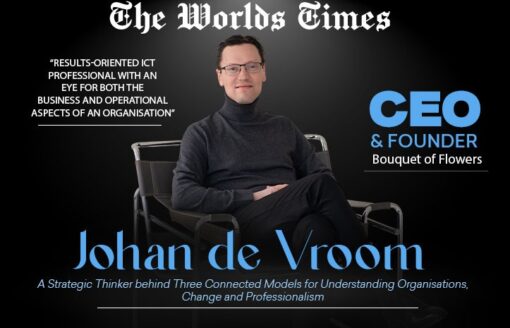
Johan de Vroom is an IT professional, strategic thinker, and creator of three interconnected models: The Flower of an Organisation, The Threshold of Resistance, and The Pyramid of a Professional. His work offers a practical way to understand organisational structure, change, resistance, professionalism, and culture. By turning complex organisational realities into simple visual models, Johan helps leaders and professionals make change more visible, understandable, and easier to discuss.
Through his models and his practical experience, Johan has established himself as a thought leader in organisational change, professionalism and the human side of organisations. His practical experience includes helping organisations translate organisational insights into concrete change — from outsourcing work and relocating activities to India, to changing ways of working and understanding how culture is created within an organisation.
Professional Background & Three Models
We started the interview by asking, “Johan, could you begin by telling us about your professional background and the thinking behind your three models?”
Johan de Vroom replied, “I am an IT professional with a Bachelor’s degree in Informatics and the Dutch engineering title “ing.” I am a strategic thinker and leader, and the creator and developer of three interconnected models: The Flower of an Organisation, The Threshold of Resistance, and The Pyramid of a Professional.
I have always enjoyed looking at complex questions from a different perspective. My approach combines analytical thinking with creativity. I wanted to develop models that could translate abstract organisational questions into something people could actually see, understand and discuss.
A flower, a threshold and a pyramid may sound very simple, but behind each image is a structured way of thinking about organisations, change, resistance, people and professionalism.
The three models are also connected. Together, they create one way of looking at organisational reality: how an organisation changes, how people respond to that change, and what it means to be a professional.”
The Origin of The Flower of an Organisation
The Worlds Times: Where did the idea for The Flower of an Organisation come from?
Johan de Vroom replied, “The starting point was actually an ICT challenge.
When an ICT problem occurred, it was not always clear which service was affected or what impact a particular change could have on that service. I started working on paper to understand how Business and Operations work together and where they come together.
In a traditional organisational setup, Business and Operations can be viewed as two sides connected through the Service Desk. The Service Desk is part of Operations, but it also provides an important connection between Operations and Business.
That thinking eventually developed into The Flower of an Organisation.
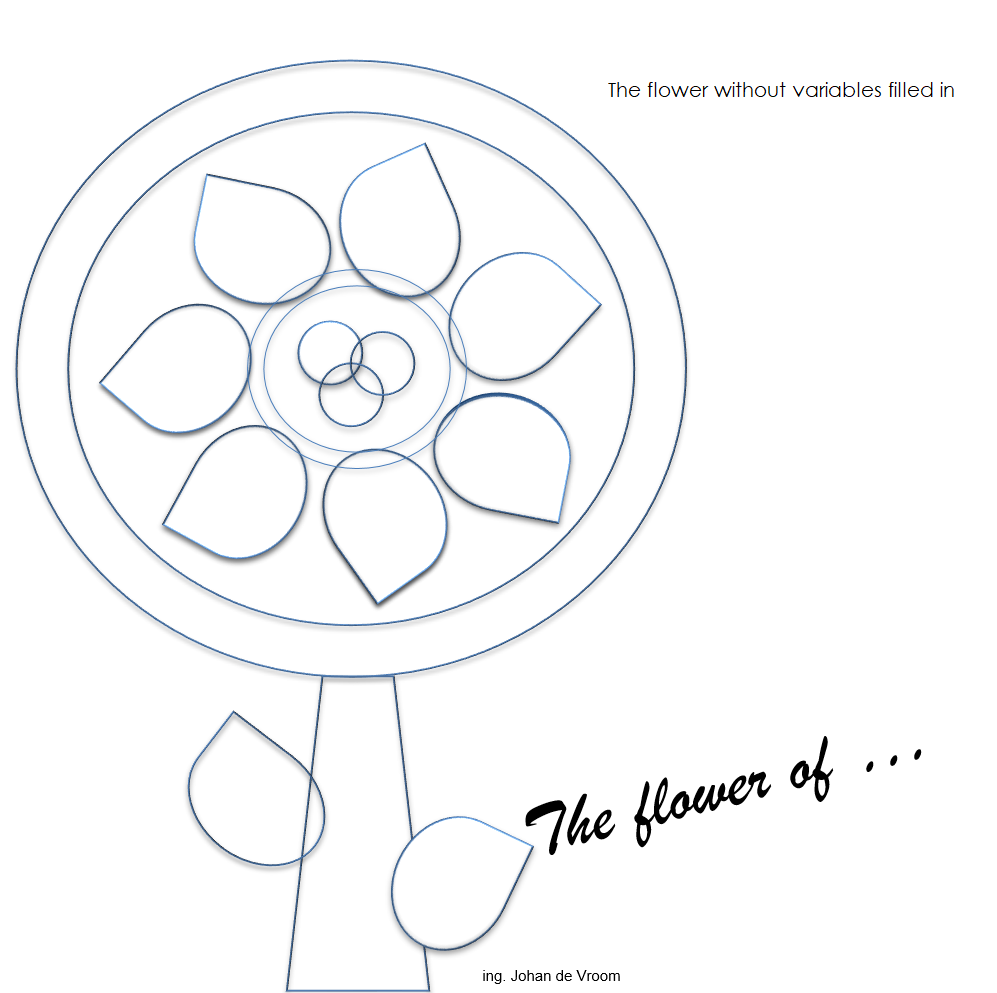
The Flower is not simply a picture of an organisation. The Flower itself is the organisational model.”
Understanding The Flower of an Organisation Model
The Worlds Times: What exactly does The Flower of an Organisation represent?
Johan de Vroom replied, “The model consists of elements. A leaf is one possible form of an element, but an element does not necessarily have to be a leaf. An element can represent a variable, and that variable can be dynamic or fixed. A variable can also have one or several values simultaneously.
For example: B = (1, 4, 8)
Here, B represents the variable, while 1, 4 and 8 are values that can exist simultaneously. The value, or combination of values, is represented visually by the colour of the corresponding element. This gives the model an important characteristic: the variable remains the same while its values can change.
That means the model itself remains consistent while the organisation represented by the model can change.”
Stability Meets Adaptability
The Worlds Times: How does the model balance organisational stability with adaptability?
Johan de Vroom replied, “Within The Flower of an Organisation, Market, or M, and Projects, or P, are fixed variables. They remain fixed because they are fundamental elements of an organisation.
The other variables are dynamic. These elements can rotate, and their values – and therefore their colours – can change as circumstances change. At the centre of The Flower of an Organisation are P and O, representing roles within the Business. These roles form the stable core of the model and do not rotate with the dynamic elements. The people fulfilling those roles can change. Their responsibilities and activities can also change. But the roles remain part of the Business.
This creates an important distinction:
Fixed variables provide stability, while dynamic variables provide adaptability. The model remains the same, but the organisation represented within it can change.”
Representing Organisational Change
The Worlds Times: What kinds of organisational changes can The Flower of an Organisation represent?
Johan de Vroom replied, “There are many possibilities.
A service can move from on-premises to the cloud. Work can become automated. Activities can move from internal teams to external providers. Responsibilities can change, and organisations can adopt completely different ways of working. The Flower of an Organisation does not prescribe which decision a leader should make.
That is important.
The model provides the structure, but the organisation is shaped by the choices of its leaders. A CEO may decide to outsource a service, bring an activity back in-house, move a service to the cloud, automate a process or change the way teams work. The Flower can represent these different situations without changing the underlying model.”
Beyond the IT Environment
The Worlds Times: Did the thinking behind The Flower remain limited to IT?
Johan de Vroom replied, “No. Although the thinking started in ICT, The Flower is not limited to IT. In a traditional environment, an IT Service Management tool may be used to manage services. But if we broaden the perspective and look at the organisation at a deeper level, the same thinking can support Enterprise Service Management.
The organisation can then be viewed as one technical whole rather than a collection of disconnected technical domains. Operations is also broader than IT. Human Resources, for example, falls within Operations.
The model therefore provides a way of looking beyond IT and towards the organisation as an integrated whole.”
When Organisations Begin to Change
The Worlds Times: What happens when those organisational elements begin to rotate and people experience the change?
Johan de Vroom replied, “This is where the human side becomes important.
Organisational change is not only about structures, services and technology. When elements begin to rotate, people experience that change. And with change comes resistance. That observation led me to develop my second model: The Threshold of Resistance.”
The Connection Between The Models
The Worlds Times: How is The Threshold of Resistance connected to The Flower of an Organisation?
Johan de Vroom replied, “The Flower of an Organisation shows what changes within an organisation, while The Threshold of Resistance looks at what can happen to people when those changes take place.
Organisational change can create different levels of resistance. I developed The Threshold of Resistance to make that resistance visible and to show how certain conditions can increase or reduce it.
A simple example is crossing a road. When the situation is clear and you can see what is happening, taking the next step becomes easier. When there is uncertainty, you may hesitate.
The Role of the Control Question (CQ)
The Worlds Times: What is the purpose of the Control Question (CQ) in your model?
Johan de Vroom replied, “Before taking the next step, we need to establish whether that step can actually be taken. Going back to the road example, someone needs to look and make sure that no traffic is approaching before crossing.
That is the purpose of the Control Question (CQ).
It establishes whether the next step is actually safe or possible. In organisational change, the same principle applies. Before moving forward, we need to understand whether the conditions are right and whether the next step can realistically be taken.”
Connecting Change and Resistance
The Worlds Times: How are The Flower and The Threshold of Resistance connected?
Johan de Vroom replied, “They are directly connected.
When the elements of the Flower rotate, the relationship between Business and Operations can change. Operations can, in effect, become disconnected from Business. When that happens, a new bridge has to be created. A Customer Organisation and a Service Integrator can come between Business and Operations.
The Customer Organisation represents the Business. It makes agreements with the Business and contracts with Service Providers. The Service Integrator coordinates multiple service components that together form an end-to-end service for the Business. This provides a new way of connecting the different parts of the organisation.”
A Practical Organisational Example
The Worlds Times: Could you give an example of how this might work in practice?
Johan de Vroom replied, “Consider a workplace service.
A workplace can consist of multiple components, represented by different elements or leaves in the Flower. Each individual component can be delivered internally or externally. One variable may represent the Service Provider, with values such as an ISP or ESP. The corresponding value is then represented by the colour of the element.
The provider does not have to remain the same forever. An external provider today can be replaced by a different external provider tomorrow.
The variable remains. The value changes. Again, the model remains constant while the organisation adapts.”
The Human Side of Professionalism
The Worlds Times: Your third model focuses on the individual. Why was The Pyramid of a Professional necessary?
Johan de Vroom replied, “Once we understand the organisation and how people respond to organisational change, we need to look at the human being behind that change. That is where The Pyramid of a Professional comes in. The Flower shows what changes in the organisation.
The Threshold of Resistance shows what happens to people when the organisation changes. The Pyramid shows the human and professional foundation behind those people.
The three models therefore look at different parts of the same reality.”
Five Layers of Professionalism
The Worlds Times: What are the five layers of The Pyramid of a Professional?
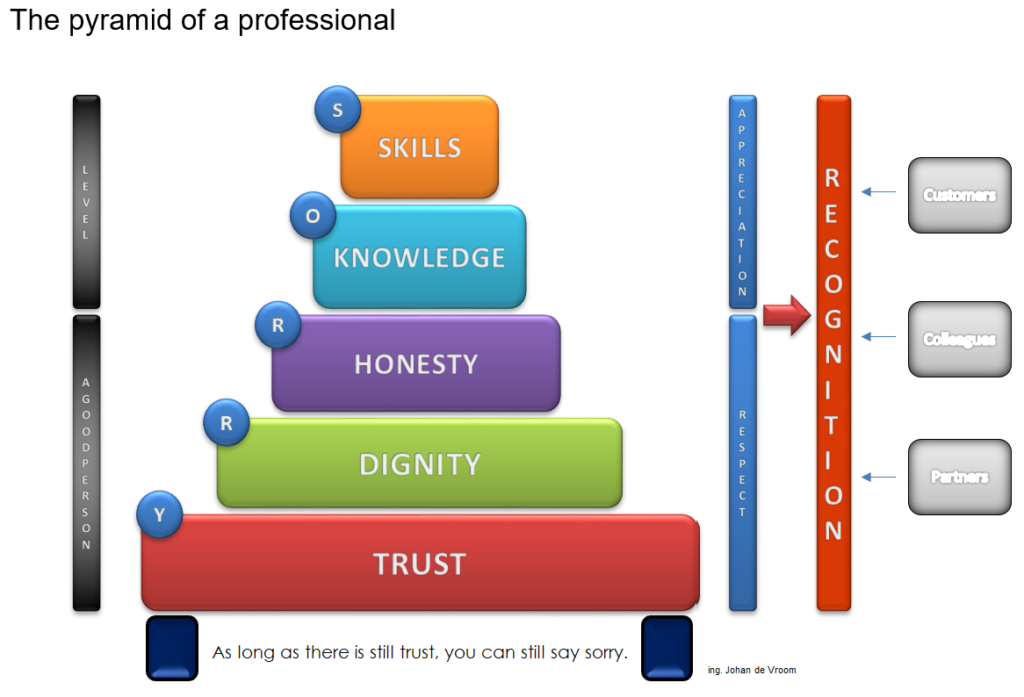
Johan de Vroom replied, “The five layers are: Skills, Knowledge, Honesty, Dignity and Trust.
Trust is the foundation of the entire pyramid.
I consider Trust, Dignity and Honesty to be three golden rules in life:
“Always be honest, always respect another person’s dignity, and never lose the trust someone has placed in you.”
These principles begin from the beginning of our lives. Parents give a child trust. They respect the child’s dignity. They are honest with the child.
These first three principles help shape a person as a good human being. Knowledge develops later through education, school, studies and experience.
Knowledge is then transformed into Skills through application – for example, through an internship, a graduation assignment and professional work. So there is an important distinction in my thinking:
Trust, Dignity and Honesty shape you as a good human being. Knowledge and Skills determine your level as a professional.
And behind knowledge and skills is the human being.”
Why Trust Comes First
The Worlds Times: Why does Trust have such an important position in the Pyramid?
Johan de Vroom replied, “Trust has a special position because it is both one of the three golden rules and the foundation of the entire pyramid. If someone lies, the layer of Honesty will disappear.
Because the foundation of Trust may still exist, there can still be an opportunity to address what happened. But I take a much stronger position when trust itself is genuinely lost.
Once trust is truly gone, it never returns. An apology cannot restore it. Forgiveness cannot recreate it. An apology or forgiveness may address what happened, but they do not recreate the trust that has been lost.
When the foundation disappears, the pyramid collapses. Within my model, someone who has genuinely lost that foundation can no longer call themselves a professional.”
From Values to Recognition
The Worlds Times: How do Trust, Dignity, Honesty, Knowledge and Skills translate into recognition?
Johan de Vroom replied, “The first three layers – Trust, Dignity and Honesty – result in Respect.
Knowledge and Skills result in Appreciation.
Together:
Respect + Appreciation = Recognition.
Recognition comes from the people around us – colleagues, partners and others with whom we work. This is where professionalism becomes visible in everyday organisational life.”
Professionalism and Organisational Culture
The Worlds Times: How does your Pyramid connect with organisational culture?
Johan de Vroom replied, “My view of culture is deliberately straightforward:
“Culture? It is not that complicated.”
The employees within an organisation determine its culture. Culture is therefore not something that simply exists above the people in an organisation. It is created by the people themselves. You cannot implement culture.
You can only create the conditions in which culture can develop. Ultimately, people determine the culture through their behaviour, choices and the way they work together. Culture is therefore not an abstract concept separate from professionalism. It is the result of how people behave, how they treat one another and how they put professional principles into practice.”
Thought Leadership and Organisational Thinking
The Worlds Times: You are positioning your work as thought leadership in organisational change, professionalism and the human side of organisations. What do you hope your contribution will achieve?
Johan de Vroom replied, “I want my work to help people look at organisations in a more connected way.
My aim is to provide practical models and ways of thinking that help leaders and professionals understand what is happening within their organisations.
Thought leadership, for me, should ultimately have a practical purpose. It should encourage better questions, clearer understanding and more informed organisational action.”
Three Models, One Perspective
The Worlds Times: How would you describe the relationship between your three models?
Johan de Vroom replied, “The three models form one connected body of thought.
The Flower of an Organisation makes the organisation and organisational change visible. The Threshold of Resistance makes the human response to organisational change visible.
The Pyramid of a Professional makes the human and professional foundation behind that response visible. Together, they create a continuous line of thinking:
Organisation → Change → Resistance → People → Professionalism → Culture
That is what makes the three models more than three independent diagrams.
They provide different perspectives on the same reality. The organisation changes. People experience that change. Resistance can emerge. Professionals respond to it. Their behaviour contributes to the culture of the organisation, and that culture becomes part of the organisation itself.”
A Leadership Perspective on Change
The Worlds Times: What does this perspective mean for CEOs and organisational leaders?
Johan de Vroom replied, “My approach is ultimately about giving leaders a different way of looking. I have presented these ideas to CEOs and organisational leaders and encouraged them to look at organisational change from another perspective. My models do not prescribe one organisational solution.
They provide leaders with a structure within which they can make their own choices.
That freedom is essential. A CEO may choose to outsource a service, bring activities back in-house, move services to the cloud, automate processes or change ways of working.
The Flower remains the same. The values change.
The organisation adapts. The Threshold of Resistance helps make the human response visible. The Pyramid reminds leaders that behind every organisational change are people, professionals and the principles on which they operate.”
The Principle behind All Three Models
The Worlds Times: If you had to identify one principle that connects all three models, what would it be?
Johan de Vroom replied, “Make it visible. The Flower makes the organisation and its changes visible. The Threshold of Resistance makes resistance and the conditions that can reduce it visible.
The Pyramid makes professionalism, human values and the individual professional position visible. For me, creativity is a way of making complex ideas visible.
Instead of explaining organisational realities only through conventional diagrams or terminology, I created images that people can immediately recognise: a Flower, a Threshold and a Pyramid. The creativity is in the simplicity of the image, and in the thinking behind it.”
Why Visibility Matters
The Worlds Times: Why is making something visible so important in organisational leadership?
Johan de Vroom replied, “Visibility is not about making something look simple just for the sake of simplicity. It is about making something understandable enough that people can see what is actually happening.
Once something becomes visible, it can be discussed. It can be questioned.
It can be understood. And it can become the basis for informed decisions. That is particularly important during organisational change, because people need to understand not only what is changing, but also why it is changing and how they are affected by it.”
The Bigger Picture
Lastly we asked, “Finally, how would you summarise your overall approach to organisations, change and professionalism?”
“I would summarise it quite simply: Make the invisible visible, give leaders the freedom to choose, and help organisations understand not only how they change, but also the people and professionalism behind that change.
The Flower, The Threshold of Resistance and The Pyramid of a Professional are three different ways of looking at the same organisational reality. The organisation changes.
People experience the change. Resistance can emerge.
Professionals respond. Their behaviour contributes to culture. And culture becomes part of the organisation. That continuous connection is at the heart of my thinking.” Johan de Vroom concluded
Connect with Johan de Vroom on LinkedIn
For more information visit The Flower
Also Read:-
Nikola Kočić on Growww AI and Smarter Business Decisions
Shirin Navab: Connecting Global Beauty Innovation
Brenda Hughes: Turning Hardship into Hope and Community Change