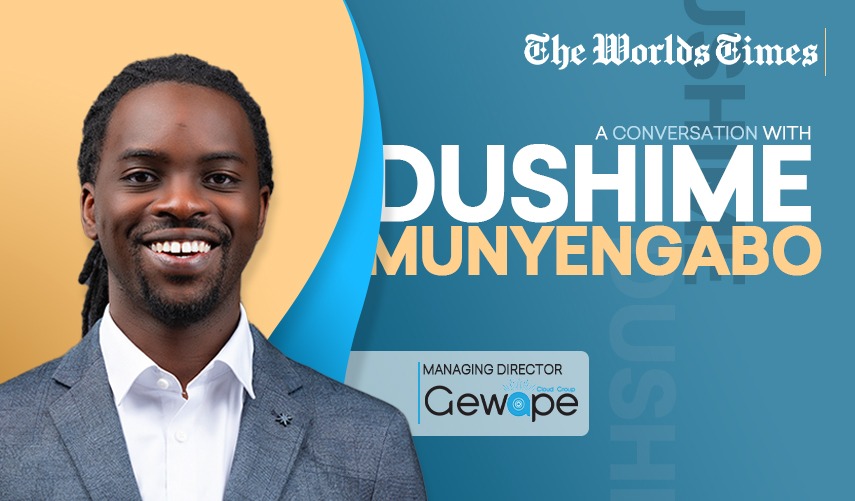
An Exclusive Feature with Dushime Munyengabo
As digital transformation accelerates across sectors, cloud infrastructure has become essential to modern economies. In Africa and other emerging markets, the focus has shifted from scalability and cost to leadership, sovereignty, and shaping the future.
Organizations are now considering fundamental questions that will define their digital future.
They are asking where their data is stored, who controls it, which legal jurisdiction applies, how resilient the infrastructure is during disruptions, and whether they can adopt artificial intelligence without compromising data sovereignty, security, or compliance.
These questions are driving a global shift. Cloud computing now centers on digital sovereignty, resilience, governance, and long-term strategic independence. Gewape Cloud Group is leading this transformation.
Dushime Munyengabo, a technology executive, has been deeply involved in building cloud infrastructure tailored to the needs of emerging markets.
As the Managing Director of Gewape Cloud Group, Dushime is developing sovereign cloud infrastructure focused on regional accountability, open technologies, data residency, multi-cloud resilience, and self-service automation. Instead of replicating cloud models developed elsewhere, Gewape Cloud Group designs infrastructure that reflects the regulatory, economic, and operational realities of African markets while remaining seamlessly connected to the global digital ecosystem.
The company now operates eight cloud regions across Africa, Europe, the Americas, and Asia-Pacific, providing access to over twelve cloud services and more than forty one-click application deployments through a unified self-service platform.
In this exclusive interview with The Worlds Times, Dushime Munyengabo discusses the importance of sovereign cloud infrastructure, digital resilience, artificial intelligence, open-source technologies, and the need for Africa’s digital future to be built on infrastructure tailored to its unique needs.
Cloud Infrastructure Has Become a Strategic National Asset
Cloud computing has evolved dramatically over the past decade.
Organizations once chose providers based on virtual machines, storage, uptime, and pricing. Today, decision-makers consider a much broader range of factors.
Digital infrastructure now underpins business continuity, cybersecurity, regulatory compliance, economic development, and national resilience.
Dushime believes this shift means cloud infrastructure is no longer just an IT procurement decision.
The Worlds Times: What drew you to Gewape Cloud Group and its focus on sovereign cloud infrastructure for emerging markets?
Dushime Munyengabo: “I joined Gewape Cloud Group because we recognize that cloud infrastructure is no longer just about computing power, storage, or cost.
Today, organizations require absolute control over their data, where it resides, how it is processed, who operates it, and under which legal framework.
Gewape Cloud Group is setting the standard for sovereign cloud solutions by addressing these increasingly critical requirements.
Digital transformation is accelerating across Africa and other emerging markets, yet many organizations still rely on infrastructure managed outside their jurisdictions.
Our mission is to address this challenge by building robust regional infrastructure, using open technologies, and ensuring local accountability.
We want organizations to embrace world-class cloud technologies while maintaining complete control over their data, regulatory compliance, and operational independence.
Why the Cloud Conversation Has Fundamentally Changed
The evolution of cloud computing mirrors broader changes in the digital economy.
Artificial intelligence, cybersecurity threats, stricter regulations, cross-border data governance, and geopolitical uncertainty have fundamentally changed organizational expectations of cloud providers.
Performance remains important, but it is no longer sufficient.
Enterprises now evaluate cloud platforms based on governance, resilience, and flexibility.
The Worlds Times: How has the conversation around cloud infrastructure changed in recent years?
Dushime Munyengabo: “The conversation has evolved significantly.
Previously, customers focused on processing power, storage, uptime, and cost.
Now they ask about data residency, application responsiveness, regulatory compliance, disaster recovery, and how easily they can move workloads between environments.
Organizations also want flexibility.
They want to integrate different cloud environments while avoiding unnecessary dependence on a single proprietary provider.
Cloud infrastructure decisions now affect business continuity, cybersecurity, regulatory compliance, economic outcomes, and even national resilience.
They are no longer simply IT purchases.”
The Growing Importance of Digital Sovereignty
Digital sovereignty has become central to modern cloud infrastructure.
Governments require assurance that national data remains protected under domestic legal frameworks.
Financial institutions must safeguard customer information while complying with increasingly complex regulations.
Healthcare providers need confidence that sensitive patient information is processed under strict privacy controls.
Dushime believes sovereignty extends beyond the physical location of servers.
It encompasses governance, accountability, legal jurisdiction, operational control, and transparency throughout the infrastructure lifecycle.
The Worlds Times: Why is sovereign cloud infrastructure becoming increasingly important?
Dushime Munyengabo: “Sovereign cloud has become essential because organizations need greater confidence and control over their digital assets.
Governments need assurance that critical public services remain available and that sensitive information is governed according to national law.
Banks need confidence that financial systems and customer data remain protected.
Healthcare providers must know patient information is handled under appropriate privacy and security controls.
But sovereignty is not simply about placing a server inside a country.
It includes governance, administrative control, accountability, backup locations, operational access, data location, and the legal framework under which services are delivered.
A cloud environment may be physically located inside a country while still lacking meaningful local control.
True sovereignty requires organizations to understand exactly who operates the infrastructure, who can access it, where operational decisions are made, where data copies are maintained, and how accountability is enforced.”
Artificial Intelligence Is Redefining Infrastructure
The rapid adoption of artificial intelligence is transforming cloud infrastructure more quickly than any previous technology wave.
Organizations now require GPU-powered computing, high-performance storage, low-latency networking, container orchestration, and scalable platforms to support advanced AI workloads.
However, infrastructure is only part of the challenge.
AI systems often process sensitive financial data, healthcare records, government datasets, customer behavior, and proprietary business intelligence.
As a result, governance is now as important as computing capacity.
The Worlds Times: How is artificial intelligence changing infrastructure requirements?
Dushime Munyengabo: “Artificial intelligence is changing both the scale and sensitivity of infrastructure requirements.
Organizations increasingly need high-performance compute, GPU capacity, fast storage, low-latency networking, secure data platforms, and scalable container environments.
However, the challenge extends far beyond computing power.
AI systems process highly sensitive information, including financial records, healthcare data, government information, customer behavior, and proprietary business knowledge.
Organizations therefore need complete visibility into where their data is processed, where AI models are hosted, who has access to training information, and whether the environment complies with applicable regulations.
This is precisely why sovereign cloud infrastructure and AI must evolve together.
Organizations want to unlock the benefits of artificial intelligence while maintaining full control over their data, intellectual property, governance, and security.
Engineering Infrastructure for African Realities
Africa’s digital transformation cannot depend solely on infrastructure models developed for other regions.
The continent faces unique challenges such as diverse connectivity, evolving regulations, varying power conditions, growing demand for digital services, and pressure to deliver affordable infrastructure at scale.
For Gewape Cloud Group, these factors shape engineering decisions from the outset.
Instead of adapting foreign models, the company builds infrastructure specifically for regional operating environments.
The World Times: What does “infrastructure built for African realities” mean to you?
Dushime Munyengabo: “For me, it means designing infrastructure purpose-built for African markets-not simply copying models developed elsewhere.
Africa has diverse connectivity environments, different power conditions, rapidly evolving regulatory frameworks, and growing demand for digital services.
Those realities should influence engineering decisions.
Infrastructure designed for African realities incorporates power redundancy, multiple connectivity providers, diverse network paths, regional interconnection, participation in local internet exchanges, automated monitoring, and distributed infrastructure.
It must also be commercially sustainable.
Capacity should expand alongside demand, while automation and open-source technologies help reduce unnecessary operating costs and dependence on proprietary vendors.
Building for African realities does not mean lowering standards.
It means applying world-class engineering principles in ways that directly address the conditions, opportunities, and challenges of the markets we serve.”
To learn more:
Website: https://www.gewapecloudgroup.com/
LinkedIn: https://www.linkedin.com/in/realdushime/
Also Read:-
Kassem: Redefining Wealth Through Trust & Financial Education
Aldin Celovic: Leadership in Global Uncertainty
Anthony Joseph Abou Jaoude on Dubai Real Estate Success