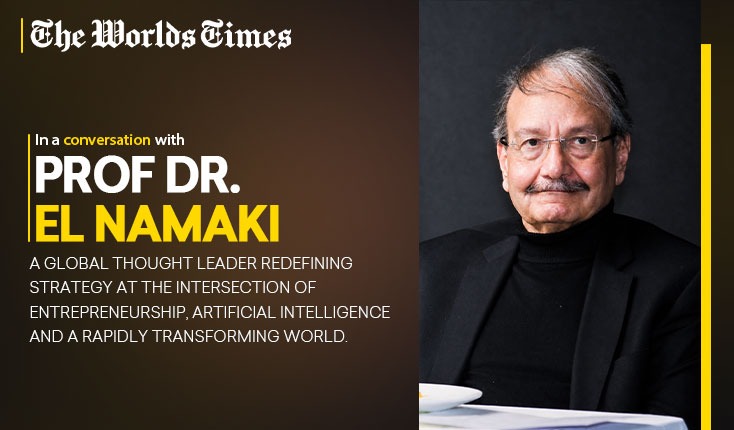
Professor Dr. M.S.S. El Namaki Interview
Professor El Namaki is a globally recognized authority in strategic management, entrepreneurship, and the integration of artificial intelligence into business systems. His career reflects a long-standing commitment to advancing strategic thought in response to rapid technological, economic, and geopolitical change. Through decades of academic leadership, advisory work, and research, he has helped shape how organizations and leaders approach complexity, disruption, and global competition.
A Global Academic and Professional Foundation
We began by asking, “Professor El Namaki, your academic journey spans multiple countries and institutions. How did this global foundation shape your approach to strategy and management?”
Professor El Namaki replied, “My academic formation was inherently international, beginning with my studies in Europe and continuing through executive education and professional engagements across continents. This exposure allowed me to see early on that management is not a one-size-fits-all discipline. Strategy, in particular, must reflect cultural, economic, and institutional differences. My work has always been guided by the idea that global perspective is not optional, it is essential. Understanding how different systems operate helps leaders design strategies that are both robust and adaptable in a rapidly changing world.”
Advancing Global Management Education
We continued, “You are widely known for your role in shaping modern management education. What were your key priorities in developing global MBA and executive programs?”
Professor El Namaki responded, “From the outset, my goal was to move beyond purely theoretical models and create programs that directly addressed real-world challenges. At institutions like the Maastricht School of Management, we worked to design curricula that combined academic rigor with practical application. This meant integrating case-based learning, cross-cultural exposure, and strategic problem-solving. Over time, these programs expanded across Europe, Asia, and the Middle East, reflecting a truly global orientation. Management education must evolve alongside the business environment, and that requires constant innovation in both content and delivery.”
Strategic Advisory and Executive Engagement
The conversation shifted to his advisory work: “You have also worked extensively with multinational corporations and global organizations. How has this influenced your perspective on strategy?”
Professor El Namaki replied, “Engaging with institutions such as the European Commission, the World Bank, and UNDP provided invaluable insights into how strategy operates at both corporate and systemic levels. These experiences highlighted the growing complexity of global markets and the increasing role of uncertainty. In my consulting work, I have focused on what I describe as ‘strategic hostilities’, competitive dynamics shaped by disruption, financial pressures, and technological change. Strategy today must account for these forces and develop mechanisms to respond proactively rather than reactively.”
From Strategic Thinking to Cognitive Competition
We asked, “Your recent work moves strongly into artificial intelligence and its strategic implications. What inspired this shift?”
Professor El Namaki explained, “Artificial intelligence represents a fundamental shift in how decisions are made, how knowledge is generated, and how competition unfolds. My research has increasingly focused on the cognitive capabilities of machines versus the human brain. This raises important questions about decision-making, learning processes, and competitive advantage. One concept I explore is ‘brain wars’, which refers to new forms of competition driven by data, algorithms, and cognitive systems. These developments are not just technological; they are strategic in nature, reshaping industries and redefining leadership.”
Evolving Strategic Paradigms
The Worlds Times: “How do these developments translate into changes in strategic management frameworks?”
Professor El Namaki replied, “We are witnessing a shift away from traditional models toward what I call neo-strategic management. This framework incorporates artificial intelligence, algorithmic competition, and the restructuring of industries through intelligent technologies. It also recognizes that leadership must evolve under conditions of constant disruption. Strategy is no longer about stability, it is about adaptability, foresight, and the ability to operate in complex, uncertain environments. Leaders must develop new analytical tools and new ways of thinking to remain effective.”
Recognition and Continuing Impact
The Worlds Times: “Your work has been recognized internationally. What does this recognition mean to you?”
Professor El Namaki responded, “Recognition is always appreciated, but what matters most is the impact of one’s work. Over the years, I have been fortunate to receive honors from various governments and academic institutions across different regions. These acknowledgments reflect not only individual contributions but also the broader relevance of advancing strategic thinking in a global context. The real reward, however, lies in seeing ideas translated into practice, whether in classrooms, boardrooms, or policy environments.”
A Continuing Intellectual Agenda
Lastly, we asked, “What are the key priorities shaping your current research and future work?”
Professor El Namaki concluded, “We are living in a time defined by artificial intelligence, cognitive competition, and systemic uncertainty. My current research focuses on understanding how these forces interact and how strategy must evolve in response. There is an urgent need to rethink traditional assumptions and develop frameworks that reflect contemporary realities. The future of strategy lies in integrating human intelligence with technological capability, creating systems that are both adaptive and forward-looking. This remains the central theme of my ongoing work.”
For professional inquiries, Prof Dr M S S El Namaki can be reached at: Dr.el.namaki@gmail.com
Also Read:-
Dr. Nichole Pettway: Strength, Education, Renewal
Aldin Celovic: Driving Global Change & Innovation
June Alisson Westarb Cruz on Faith, Strategy and Mission