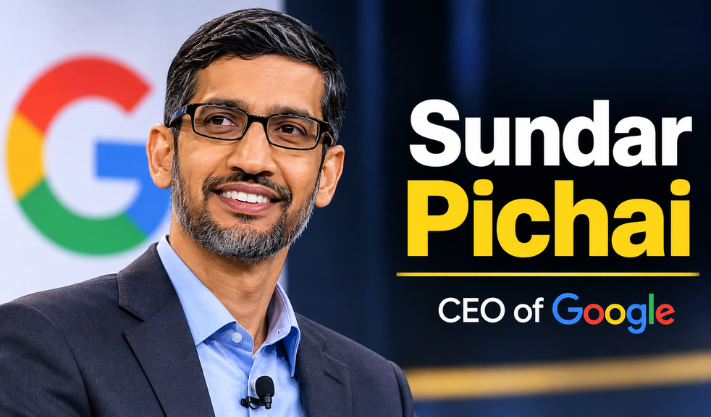
Introduction: Sundar Pichai, Who Is He?
Sundar Pichai is one of the most powerful figures in the global technological world. As CEO of Alphabet and Google, he leads companies that affect the way billions of people get information, interact, work, study, and utilise digital services.
Pichai, a native of Chennai, India, has built a career on engineering, product development and business leadership. His path from humble beginnings to the head of one of the greatest technological firms worldwide exemplifies the importance of technical expertise, strategic vision, and a continual learning mindset in achieving the pinnacle of corporate success.
He has guided Google to expand its attention to artificial intelligence, cloud computing, digital advertising, mobile technologies and connected services. Alphabet’s enterprises are also active in fields including autonomous mobility, advanced research and emerging technology.
Why is Sundar Pichai vital for global business? His judgements impact the future of online search, artificial intelligence, enterprise technology, digital communications and the global technology industry. His leadership is especially important as companies adjust to AI-enabled products and more competitive digital markets.
In this essay we will look at Pichai’s early life, his education, his professional experience, his leadership philosophy, his main achievements, his business strategy and his vision for the future.
Who Is Sundar Pichai and What Does He Do?
What Is Sundar Pichai’s Present Position?
Sundar Pichai is the CEO of Alphabet Inc. and Google. Google’s parent company is Alphabet. Google operates significant products and services such as Search, YouTube, Android, Chrome, Google Maps and Google Cloud.
As CEO, Pichai is responsible for the overall strategy of the company, management of main business priorities, support of innovation and the company’s long-term success.
In his role he has to balance a number of key responsibilities:
-
Setting the strategic direction for the company.
-
Promoting the development of artificial intelligence.
-
Leading significant products and business areas.
-
Enhancing Google’s standing in the international market.
-
Directing investments in research and technology.
-
Establishing relationships with employees, consumers, partners and policy officials.
Pichai’s leadership is more than simply product development. His decisions can impact advertising markets, enterprise software, digital infrastructure and how individuals access information around the globe.
What’s the Difference Between Google and Alphabet?
Google is a technological corporation that runs popular digital products and services. Alphabet is the parent company created in 2015 to provide Google and its subsidiaries a wider corporate umbrella.
The restructure separated Google’s main business from other commercial activities, allowing Alphabet to consolidate its many investments and research programmes.
Google is still the biggest and best-known business in Alphabet. Alphabet also has firms and initiatives engaged in autonomous driving, medical sciences and advanced technology research.
Pichai, who is CEO of both companies, is responsible for Google’s core business as well as Alphabet’s broader corporate strategy.
Sundar Pichai’s Early Life and Education
Where Was Sundar Pichai Born and Where Did He Grow Up?
Sundar Pichai was born on June 10, 1972, in Madurai, Tamil Nadu, India, and was raised in Chennai. He was raised in a family that appreciated knowledge, practical problem solving, and curiosity.
His father, Regunatha Pichai, was an electrical engineer, and his mother, Lakshmi, was a stenographer. Pichai has spoken about growing up in a home with less access to technology and modern amenities than now.
These early encounters helped build a passion for science, math, and technology. He was also known to have a great capacity to memorise telephone numbers, a fact commonly cited in accounts of his early life.
What College Did Sundar Pichai Go To?
Pichai holds a degree in metallurgical engineering from the Indian Institute of Technology (IIT), Kharagpur, a premier engineering college in India. He has a Bachelor of Technology degree and is an Institute Silver Medalist.
Later on he relocated to the United States for additional studies. He has a master’s degree in materials science and engineering from Stanford. He then got a Master of Business Administration degree from the Wharton School of the University of Pennsylvania and was named a Siebel Scholar and Palmer Scholar.
He was educated at the intersection of three key domains: engineering, advanced research and business management. Later, such combination helped him understand the technical and business aspects of the technology industry.
Sundar Pichai’s Career Timeline Before Becoming CEO of Google
What Did Sundar Pichai Do Before Joining Google?
Before joining Google, Pichai worked at Applied Materials, a materials engineering and semiconductor manufacturing company. He also worked for McKinsey & Company and obtained experience in management consulting.
His roles exposed him to technological development, business strategy, operations, and corporate decision making.
His technical background provided him with insight into the development of complicated technologies and his expertise in consulting sharpened his ability to assess business difficulties and identify opportunities.
Sundar Pichai Joined Google in 2004
Sundar Pichai started at Google in 2004. In his early years he worked in product management and development, assisting in improving products that made Google’s services easier to access and utilise.
Another of his key early contributions was the Google Toolbar, which allowed users to access Google Search from their web browsers. Later he was actively involved in the creation and launch of Google Chrome.
Chrome became one of the world’s most popular web browsers. Additionally its speed, simplicity, security features and integration with Google services helped it compete effectively in the browser industry.
How Google Chrome Helped His Leadership Career
Chrome’s importance was that it was evidence of Pichai’s ability to see what a user wanted, and to drive the development of a product that would have long-term strategic value.
With the explosion of internet use, a functional browser could be a portal to search, online communication, entertainment and digital services.
Chrome fortified Google’s position in the internet ecosystem and helped transform Pichai into a leader who could run big technology products.
His duties grew to cover Chrome OS, Android and other major Google technologies. He was promoted to senior vice president of Android, Chrome and Apps in 2013. He took up expanded responsibility for Google’s products and platforms in 2014.
When Did Sundar Pichai Become Google and Alphabet CEO?
When Did Sundar Pichai Become CEO of Google?
Sundar Pichai took over as CEO of Google in October 2015. He took over from co-founder Larry Page, who became the leader of Alphabet with the creation of the new parent-company structure.
His hiring came after years of expertise managing key Google products and teams. By that point, Pichai had a good understanding of the company’s technical platforms, users and commercial operations.
In Which Year Did Sundar Pichai Become CEO of Alphabet?
Pichai became CEO of Alphabet in December 2019, while still serving as CEO of Google. This expanded his duties beyond Google’s core technology company to the larger collection of companies and initiatives under Alphabet.
Today, his leadership spans a wide variety of strategic priorities, including Google’s advertising business, cloud services, consumer products, AI research, and other technology ventures at Alphabet.
What Are Sundar Pichai’s Major Achievements as CEO?
Building a Stronger Global Product Ecosystem for Google
One of Pichai’s big achievements has been to guide Google’s large product ecosystem. Search, Chrome, Android, Gmail, Maps, YouTube, and Google Workspace all address various needs, but they all are tied together by Google’s wider technology infrastructure.
This ecosystem allows customers to switch between services, offering organisations access to digital resources for communication, marketing, collaboration and productivity.
Growing Google Cloud
Google Cloud has become a key aspect of Alphabet’s corporate strategy. It offers businesses computing infrastructure, data storage, analytics, cybersecurity tools and AI services.
Pichai has overseen continued investment in cloud infrastructure and enterprise products at Google. These services assist companies to run digital operations, build software and deal with vast amounts of information.
Driving AI Research and Products Forward
One of the key goals of Pichai’s leadership has been the rise of artificial intelligence. Google has invested in AI research, computing infrastructure, machine learning and generative AI products.
Gemini’s rollout and its integration throughout Google’s services are a window into how the corporation is rethinking its product strategy with AI.
Backing the Development of YouTube
YouTube has become a big platform for video entertainment, education, artists and advertising. It’s no longer just for watching videos in the digital economy.
The platform is a chance for businesses to connect with people, for creators to develop professions, and for educational organisations to share information.
Developing a Long-Term Technology Strategy
Pichai has had to prepare Google for changes that could take years to fully unfold. They include AI-powered computing, cutting-edge research, quantum technologies, cloud infrastructure, and new methods to access digital information.
His aim is to invest in technology that can impact existing products and future markets.
How Is Sundar Pichai Steering Google’s Artificial Intelligence Strategy?
Why Does Sundar Pichai’s Vision Need Artificial Intelligence?
Artificial intelligence is transforming the way people seek for information, produce content, analyse data, engage with each other and do everyday jobs. Pichai regards AI as a significant technical change that can affect practically every business.
Google sees AI as both an opportunity and a competitive challenge. The company has to enhance its current goods and offer new services that meet evolving user needs.
Its AI approach covers research, sophisticated computing infrastructure, generative AI and solutions for consumers, developers and companies.
What Is Google’s AI Gemini?
Gemini is a series of artificial intelligence models and products from Google. It’s built to interpret and work on different kinds of information such as text, photos, audio, and other supported content.
Google is bringing Gemini into its broader set of products, including consumer apps and business services. It allows users to get help from AI to put together information, brainstorm, analyse content and get things done.
Gemini is also strategically vital for Google since it helps the corporation compete in the fast-growing generative AI field.
How Is AI Changing Google Search?
Google Search is moving from being a link-centric system to a more AI-centric information experience.
AI-enabled features can also help users understand complex questions, research topics, compare information and receive summarised answers. These advances are changing the way consumers find websites and interact with online material.
This trend means that reliable, original, and well-structured content is more vital than ever for businesses and publishers.
Pichai’s goal will be to enhance the search experiences while preserving user confidence, supporting the broader online ecosystem and offering valuable access to credible information.
How Could Google’s AI Strategy Impact Businesses?
Here are some ways Google’s AI offerings can affect the business:
-
Productivity: AI assistants can assist employees in drafting, summarising and organising material.
-
Customer Service: Businesses can try out AI-powered support and communication systems.
-
Marketing: Artificial intelligence can aid with audience analysis and content creation.
-
Software Development: AI tools can help developers in coding and technical problem resolution.
-
Data Analysis: Artificial intelligence is able to assist organisations in making sense of big datasets and recognising trends.
-
Research: Artificial intelligence systems can assist teams in finding information and generating new ideas.
These applications could provide improved efficiency, but organisations also need to think about accuracy, privacy, security and ethical use.
What Is Sundar Pichai’s Leadership Style?
How Does Sundar Pichai Lead Big Teams?
Pichai is frequently described as having a calm, collaborative and thoughtful style of leadership. He emphasises teamwork, communication, and the significance of comprehending diverse perspectives, rather than depending simply on individual authority.
Running a global technology organisation means working with engineers, researchers, designers, business executives, policymakers and product teams. His approach acknowledges that big advances often depend on collaboration across areas.
He also stresses curiosity and lifelong learning. In an industry where technologies can quickly become obsolete, organisations need to be willing to experiment and adapt.
What Business Leaders Can Learn From Sundar Pichai
Pichai’s career offers some great lessons for entrepreneurs and business leaders:
-
Know Your Product: Strong knowledge of your product allows executives to make better strategic judgements.
-
Users Come First: Good technology solves real issues and improves ordinary life.
-
Continue Learning: Curiosity and adaptability are key to professional progress.
-
Form Collaborative Teams: It is simpler to resolve difficult issues when people with various expertise work together.
-
Think Long Term: Sustainable business growth is often about making investments that may not pay off right away.
-
Be Open to Innovation: Companies need to be willing to adapt existing products and processes when client needs change.
His career suggests that leadership isn’t only about running an organisation. It is also about spotting possibilities, building people and preparing a firm for future problems.
What Challenges Is Sundar Pichai Facing as a CEO?
How Is Google Tackling Competition in Artificial Intelligence?
Competition in the AI business is heating up, with technology companies investing substantially in sophisticated models, processing infrastructure and applications powered by AI.
Google is competing against companies building generative AI platforms, enterprise solutions and digital assistants. To be competitive, it must continually investigate, enhance its products and invest heavily.
For Pichai, the challenge is to create new AI products while protecting Google’s current businesses and reassuring customers.
How Does Google Handle Privacy and Data Security?
The services of Google deal with a lot of information and hence privacy and data security are crucial corporate obligations.
Consumers want to know how their information is gathered, stored, and used. Businesses also need to understand that cloud services and AI solutions can secure critical data.
Strong security practices, clear policies, and continuing advancements to technology and governance are required to manage these demands.
What Are the Regulatory Issues Facing Alphabet?
Alphabet operates in many nations and marketplaces, each with differing rules on competition, advertising, data protection, online content and artificial intelligence.
Regulatory scrutiny can affect how Google runs its services, sells products and does commercial relationships.
Pichai must balance these demands against continued support for innovation and global expansion.
How Is Google Adjusting to Changes in Online Search?
Conversational search, new digital discovery platforms and AI-generated answers are transforming how people obtain information.
This poses a threat for Google’s core search business and the broader online publication industry. Google needs to analyse what function websites, content creators, marketers, and publishers play, and deliver more beneficial experiences.
The future of search will need to balance trust with technological advancement, information quality and a healthy digital ecosystem.
Sundar Pichai’s Connection With India
What Has His Indian Background Meant for His Journey?
Pichai, who was born in Chennai, has become an emblem of Indian success in Silicon Valley’s global computer industry.
His schooling at IIT Kharagpur and later in the United States prepared him well for a career that merged engineering and commercial leadership.
His background also links him to India’s nascent technology ecosystem where startups, developers, educational institutions and big enterprises are driving digital innovation.
What Did Sundar Pichai Say About Google’s Investment in India?
India has remained a key market for Google for digital services, AI development, infrastructure and business potential.
Pichai outlined Google’s proposed $15 billion infrastructure investment in India at the AI Impact Summit in New Delhi in February 2026. The announcement featured an AI centre in Visakhapatnam with computer equipment and an international subsea cable gateway.
Such investments are a confirmation of India’s growing prominence in the global AI economy and building of digital infrastructure.
Sundar Pichai’s Vision for the Technology of the Future
Will Artificial Intelligence Change Our Daily Lives?
It is projected that artificial intelligence will be more and more used in daily life. AI tools can be used by people to organise schedules, learn new skills, produce content, communicate and make decisions.
Artificial intelligence can also enable businesses to automate tedious work, improve client experiences and analyse information better.
Pichai’s tech strategy has put AI at the heart of Google’s future goods and services. The chance is to make the advanced technology usable, accessible and practical to a large spectrum of people in the long run.
What Is the Future Role of Cloud Computing?
Cloud computing is the infrastructure that powers digital services, data storage, and hosting of AI applications.
As businesses rely more on innovative technology, the need for dependable computer infrastructure is expected to be vital.
Google Cloud is positioned for organisations that need scalable computing, data, security and AI capabilities.
How Could Google’s Technology Reshape the Future of Work?
AI and cloud-based solutions are transforming how employees communicate and get work done.
Future offices will likely be increasingly dependent on smart assistants, automated processes, digital communication and data-driven decisions.
Such improvements may enhance productivity, but they will also need staff to gain new skills. Businesses will have to invest in training and responsible adoption of technology and smart personnel planning.
Sundar Pichai – FAQs
Who Is Sundar Pichai?
Sundar Pichai is an American business executive of Indian origin. He is the CEO of Google and its parent company, Alphabet Inc. He joined Google in 2004 and became the CEO of Google in 2015.
What’s the Real Name of Sundar Pichai?
His full name is Pichai Sundararajan but is popularly known as Sundar Pichai.
When Is Sundar Pichai’s Birthday?
Sundar Pichai was born on 10 June 1972 in Madurai, Tamil Nadu, India.
Where Was Sundar Pichai Born?
He was born in Madurai and brought up in Chennai, India, where he did much of his early education before pursuing engineering at IIT Kharagpur.
What Is the Educational Qualification of Sundar Pichai?
He has a B.Tech from IIT Kharagpur, a master’s degree from Stanford University and an MBA from the Wharton School of the University of Pennsylvania.
When Did Sundar Pichai Come to Google?
Sundar Pichai came to Google in 2004. He began in product management and then helped drive the development of key products such as Google Chrome.
When Did Sundar Pichai Become the CEO of Google?
In October 2015, he replaced co-founder Larry Page as CEO of Google.
When Did Sundar Pichai Become the CEO of Alphabet?
Pichai became CEO of Alphabet in December 2019, while still heading up Google.
What Is Sundar Pichai Best Known For?
He is perhaps most recognised for his leadership of Google and Alphabet, helping develop Google Chrome, overseeing major Google products and steering the company’s increasing focus on artificial intelligence.
What Role Does Sundar Pichai Have in Artificial Intelligence?
He heads up Google’s AI strategy, including the development of Gemini, the integration of AI into Search and Workspace, scaling AI infrastructure, and supporting research into sophisticated technologies.
Is Sundar Pichai the Founder of Google?
No. Larry Page and Sergey Brin started Google. Sundar Pichai joined the company in 2004 and eventually became its CEO.
What Companies Does Sundar Pichai Lead?
He serves as the Chief Executive Officer of Google and Alphabet Inc. Alphabet is the parent corporation of Google and operates other businesses and technology ventures.
What Makes Sundar Pichai Successful as a Leader?
He is known for his product expertise, cooperation, strategic thinking, continual learning and focus on long-term innovation.
Why Is Sundar Pichai a Great Global Business Leader?
He makes judgements in significant areas of the global economy: internet search, artificial intelligence, cloud computing, digital advertising, mobile technology and corporate software.
Conclusion: Sundar Pichai’s Enduring Influence on the Tech World
Sundar Pichai’s rise from Chennai to the helm of Alphabet and Google speaks volumes about the value of education, technological prowess, strategic insight, and sustained progress.
His career has been closely associated with several of the company’s most important products, including Chrome, Android and the larger Google digital ecosystem. He has led the organisation as CEO through huge developments in technology, competition and worldwide commerce.
Artificial intelligence is at the heart of his vision for leadership today. Google’s investments in Gemini, AI-powered Search, cloud computing and sophisticated infrastructure show the business is ready for a smarter, more connected digital economy.
Also Read:-
Satya Nadella: The Visionary Leader Behind Microsoft
Jensen Huang: NVIDIA’s Visionary Founder and CEO
AI Is Transforming the Future of Work and Careers