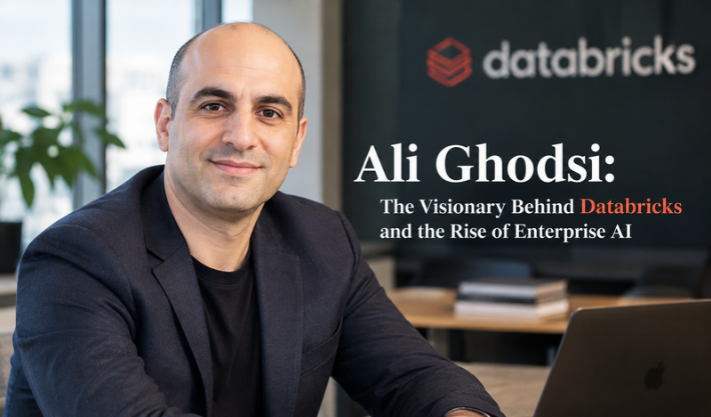
Ali Ghodsi is a computer scientist and technology entrepreneur and co-founder and CEO of Databricks. He is also deeply involved with Apache Spark, the open-source data processing platform that helped change the way organisations operate with big data. Today, Ghodsi is among the top leaders driving the convergence of data, cloud computing and artificial intelligence.
His career includes academic research, open-source software, entrepreneurship and enterprise technology. As Databricks has evolved from its original focus on Apache Spark into a larger Data + AI platform, Ghodsi has been more focused on helping organisations apply data and AI in actual business settings.
Who Is Ali Ghodsi?
Ali Ghodsi is the co-founder and CEO of Databricks, a data, analytics and artificial intelligence firm. Along with Ion Stoica, Matei Zaharia, Patrick Wendell, Reynold Xin, Andy Konwinski, and Arsalan Tavakoli-Shiraji, Ghodsi is one of the founding leaders of Databricks.
His background is in distributed computing and academic research. He received an MBA in 2003 from Mid-Sweden University and a PhD in distributed computing in 2006 from KTH Royal Institute of Technology, Sweden. He eventually worked with the research community around large-scale computing at UC Berkeley.
What makes his career significant is that it links research with commercial technology. Ghodsi’s approach was not to think of academic research and business as separate realms, but to take on the challenge of transforming developments in distributed computing and data processing into technology used by companies all over the world.
What is Ali Ghodsi most famous for?
Ali Ghodsi is perhaps most known for founding Databricks and his association with Apache Spark.
Apache Spark began as a research project at UC Berkeley. The project started in 2009, was open-sourced in 2010 and later became an Apache Software Foundation project. The original creators of Spark and other technologies that are now significant aspects of the modern data ecosystem formed Databricks.
Ghodsi was among those who helped develop Spark and then helped construct Databricks around the bigger difficulties organisations confront when working with large data.
That’s an important distinction. Spark itself is open source, Databricks built a managed commercial platform on top of Spark, and then extended into data engineering, analytics, machine learning, governance, and AI.
What Is Databricks?
Databricks is a comprehensive data analytics and AI platform for enterprises.
The company refers to itself as a data and AI company. Its platform is designed on a lakehouse architecture, aiming to combine features normally found in data lakes and data warehouses.
Databricks also has infrastructure to handle Apache Spark workloads. The current platform goes beyond Spark to areas such as machine learning, data governance, analytics, AI applications and AI agents.
Databricks says more than 20,000 organisations across financial services, retail, IT, manufacturing, media and other industries are using its Data + AI Platform as of 2026.
When did Ali Ghodsi take over as CEO of Databricks?
Ali Ghodsi has been Databricks’ CEO since January 2016.
Prior to becoming CEO, he was the company’s VP of Engineering and Product Management. His move to chief executive represented a shift from technical and product roles to overall company leadership, growth and worldwide expansion.
Under his leadership, Databricks has grown from being a startup focused on Apache Spark to being a much larger enterprise data and AI firm.
That evolution is part of a larger transition in the digital industry: more and more firms want their data infrastructure, analytics systems, machine-learning tools and AI apps to function together rather than being isolated systems.
What Was Ali Ghodsi’s Contribution to Apache Spark?
Ali Ghodsi was among the contributors who were involved in the birth and growth of Apache Spark.
Spark is an essential open-source framework for distributed data processing that was created at the AMPLab at UC Berkeley. It was created to make it easier to process massive data collections across clusters of computers.
Eventually, the project became an Apache project, which helped to make it widely adopted open-source technology. Databricks continues to contribute to Spark and build products on top of it.
Databricks still cares about Spark. Databricks’ compute clusters and SQL warehouses are built on Apache Spark, as stated in the current documentation.
What Did Ali Ghodsi Study?
Ali Ghodsi studied computer science and distributed computing, and his academic work has been in areas important to large-scale computing systems.
He obtained his PhD in distributed computing from KTH Royal Institute of Technology in 2006. His work in resource management, scheduling and data caching has inspired platforms such as Apache Mesos and Apache Hadoop, Databricks said.
His academic background accounts for the technological underpinning of his profession. Distributed computing is extremely useful in scenarios when a large volume of information is being processed on multiple machines instead of a single computer.
That field has become more essential as organisations collect more data and implement more computationally intensive artificial intelligence (AI) systems.
How Did Academic Research Influence Ali Ghodsi’s Career?
Academic research was a big part of Ghodsi’s career, in part because some of the technologies he worked on in the early days tackled fundamental difficulties in distributed computing.
Spark’s development highlighted how university research may become widely used open-source infrastructure. Databricks then built commercial technology on top of this environment.
This research paradigm, open source and commercialisation has become an essential pattern in current technology.
Similarly, many of the biggest developments in AI and cloud computing go through universities and research labs before reaching the open source, startup or commercial product stages.
This is the story of Ghodsi’s career from academic research to technology business.
What’s Ali Ghodsi’s Leadership Focus?
More and more, Ghodsi, the CEO, has been talking about the need to combine data with AI.
This is exactly the approach Databricks has adopted. Spark remains a core aspect of the platform, but the firm is now positioning itself around a broader Data + AI Platform that enables organisations to design, deploy, and administer AI applications on their own data.
Databricks in 2026 expanded its scope to AI agents and business applications. The company released Genie One, which it calls an agentic coworker to assist business teams interact with company data.
This speaks to a larger trend in workplace AI: companies want to do more than generate text or answer queries; they want to integrate artificial intelligence systems with business data and procedures.
What’s Ali Ghodsi’s Deal with Enterprise AI?
Ghodsi’s link to enterprise AI is a result of Databricks’ work on infrastructure and applications that aim to assist organisations construct artificial intelligence systems from their own organisational data.
One difficulty with enterprise AI is that generic models may not inherently comprehend a company’s internal jargon, data schemas, policies, or business context.
Databricks has been leaning more and more toward this topic.
In 2026, the company characterised it as a mechanism to connect AI to business context and organisational data. Its Genie One launch was focused on use cases in sectors such as finance, marketing, and sales.
Ghodsi has thus become a significant public voice in conversations about how artificial intelligence might transition from experimental demonstrations to production contexts.
What did Ali Ghodsi say about business data and AI?
Ghodsi has stressed that enterprise AI needs access to solid business context, not just plausible solutions.
He said that much of the enterprise AI difficulties are around context, the ability of artificial intelligence systems to grasp the real business information of a company, with the 2026 Genie One announcement from Databricks.
This is the heart of modern enterprise AI.
A firm may have access to a powerful language model, but that model still needs proper access to company-specific information to answer questions around sales, customers, inventory, finance, operations or other internal activities.
That’s one reason why data infrastructure has grown more critical to AI strategy.
What does Ali Ghodsi do at UC Berkeley?
Ali Ghodsi remains an academic affiliate of UC Berkeley.
He is an adjunct professor at UC Berkeley and serves on the board of UC Berkeley’s RiseLab, Databricks says.
His link with Berkeley is particularly interesting as Apache Spark is a product of research done at Berkeley.
In fields like distributed systems and artificial intelligence, where fresh research can quickly influence commercial products, the connection between universities and technology corporations is becoming increasingly significant.
Apache Spark, Delta Lake and MLflow Explained
Databricks ecosystem Apache Spark, Delta Lake and MLflow are separate technologies in the Databricks ecosystem.
Apache Spark is a distributed computing engine that can analyse massive data sets.
Delta Lake is an open-source storage layer that brings dependability and transactional capabilities to data lakes.
MLflow is an open-source platform for managing the machine learning (ML) lifecycle.
These are projects Databricks highlights as technologies that have emerged from its founders and engineering community.
These technologies together helped lay the technical framework for the modern lakehouse concept.
Why the Lakehouse Architecture Is Important?
The lakehouse paradigm aims to combine the benefits of traditional data warehouses with the flexibility and scalability of data lakes.
In the past, structured business analytics relied on traditional data warehouses. Data lakes can meanwhile contain vast amounts of structured and unstructured information.
Lakehouse seeks to give a single architecture for both.
Much of the Databricks platform was created around this method and the business now touts the architecture as the basis for modern data and AI workloads.
The appeal for corporations is rather basic: if data engineering, analytics, machine learning and artificial intelligence all run on a common basis, companies could be able to eliminate fragmentation in their technology stack.
How Ali Ghodsi is changing Databricks
Databricks has grown a lot since Ghodsi took over as CEO in 2016.
Its early identity was closely tied to Apache Spark and big-data processing. Since then, the firm has grown into lakehouse architecture, data warehousing, machine learning, governance, generative AI, AI agents and application development.
Databricks said it reached a $5.4 billion revenue run-rate, growing more than 65% year-over-year for the cited quarter in February 2026. The company also announced more than $7 billion in fresh investment commitments, comprising equity finance and expanded loan capacity.
These are company-reported numbers, not independently audited numbers, and should be understood to be in that context in the release quoted.
What Ali Ghodsi Sees for AI’s Future
Ghodsi has said many times in public that AI needs to be tied to trustworthy organisational data.
Databricks is increasingly positioning AI not as a standalone chatbot but as part of a bigger data infrastructure.
This comprises AI bots that can access enterprise information, analyse business context and support workflows.
Databricks expanded its Genie product line and launched technologies in 2026 to assist organisations develop AI applications and agents on top of enterprise data.
The bigger objective is to provide insight to the data businesses already depend on, making AI relevant across organisations.
What will Ali Ghodsi be doing in 2026?
Ghodsi is currently CEO and co-founder of Databricks, where he continues to lead the company’s product and technology strategy.
He was one of the keynote speakers at the Databricks 2026 Data + AI Summit, together with other Databricks co-founders and tech experts. The seminar was quite heavy on breakthroughs in data, AI, AI agents and enterprise applications.
The year also saw Databricks continue to grow its AI platform. In September 2026, the company said it was buying Row Zero, a spreadsheet platform, and that the technology will be folded into Genie to give business teams a governed spreadsheet experience.
The moves are indicative of Databricks moving its platform from traditional data engineering to AI-driven business activities.
Why Is Ali Ghodsi Important To The Tech Industry?
Ali Ghodsi’s work is important because it links together a number of main trends in modern computing: distributed systems, open-source software, cloud computing, big data, machine learning, and enterprise AI.
His work on Apache Spark connects him to one of the major open-source solutions for large-scale data processing.
His work at Databricks combines that technical base with a commercial platform for organisations to run their data and AI workloads.
His current focus on enterprise AI is indicative of the industry’s shift to standard artificial intelligence systems that can operate with proprietary business data and business processes.
What are the lessons for entrepreneurs from Ali Ghodsi’s career?
Ghodsi’s career exemplifies the need for bridging strong technical expertise with real-world business use cases.
His route has included academic research in open-source technologies and entrepreneurship.
Another lesson is that fixing infrastructure problems is important. Spark and similar technologies are not consumer-facing items but they can become essential pieces for thousands of organisations.
Third, you need to be able to adapt as the technology changes. Databricks was deeply tied to big-data processing, but then grew when organisations migrated to cloud analytics, machine learning and AI.
This is an example of how a first technical breakthrough can lead to a much bigger company for technology entrepreneurs, as long as the problem you are solving is still relevant.
Commonly Asked Questions on Ali Ghodsi
Who is Ali Ghodsi?
Ali Ghodsi is the CEO and co-founder of Databricks. He is a computer scientist working in distributed computing who has worked with Apache Spark.
Is Ali Ghodsi a co-founder of Databricks?
Yes. Ghodsi is a co-founder of Databricks and is currently its CEO. He is also listed by Databricks as part of its founding team.
What is Ali Ghodsi’s educational background?
Ghodsi holds an MBA from Mid-Sweden University and a PhD in distributed computing from KTH Royal Institute of Technology in Sweden.
What is Ali Ghodsi known for?
He is most famous for being the co-founder and CEO of Databricks, and for his work in the creation and commercialisation of large-scale data processing and artificial intelligence (AI) technologies.
Was Apache Spark developed by Ali Ghodsi?
Ghodsi was one of the developers who helped build Apache Spark during its early days. Spark originated as research at UC Berkeley and subsequently became an open-source Apache project.
When did Ali Ghodsi become CEO of Databricks?
Ali Ghodsi has been CEO of Databricks since January 2016, having previously served as VP of Engineering and Product Management.
Is Ali Ghodsi still the CEO of Databricks?
Yes. Ali Ghodsi is presently listed as a co-founder and CEO on Databricks’ website.
Databricks is the data and AI company that unlocks data value for enterprises, developers and analysts.
Databricks delivers a Data + AI Platform for organisations to design, deploy, manage and share data, analytics, machine learning and AI applications at scale.
What is Ali Ghodsi’s link to UC Berkeley?
Ghodsi is an adjunct professor at UC Berkeley and has an academic affiliation with the university. UC Berkeley was also where Apache Spark was born as a research project.
What is the connection between Enterprise AI and Ali Ghodsi?
Ghodsi, Databricks CEO, is steering the company’s transition from data infrastructure to corporate AI comprising AI agents, business apps, and AI connected to organisational data.
Does Databricks run on Spark?
Apache Spark is a core technology in the Databricks ecosystem. Databricks offers a managed environment for Spark workloads and continues to invest in the open-source project.
What is Ali Ghodsi’s influence on technology?
You may get a sense of Ghodsi’s impact from his work on distributed computing, Apache Spark, Databricks, and enterprise data and AI. His career shows how academic research and open-source technology may turn into popular commercial infrastructure.
Conclusion
Ali Ghodsi’s narrative is intertwined with the rise of modern data technology. His career has spanned many significant stages in the evolution of the technology sector, from distributed-computing research and Apache Spark to Databricks and enterprise AI.
Nowadays, his work at Databricks revolves more and more around the intersection of data and AI. The company’s move into AI agents, business apps and contextual corporate AI is the next stage of its evolution from its original big-data beginnings.
Also Read:-
Step by Step Guide: How to Apply for a Passport in Panama?
Jensen Harris: Career, Leadership, and Microsoft Experience
Sebastian Thrun: Shaping AI, Self-Driving Cars & Education