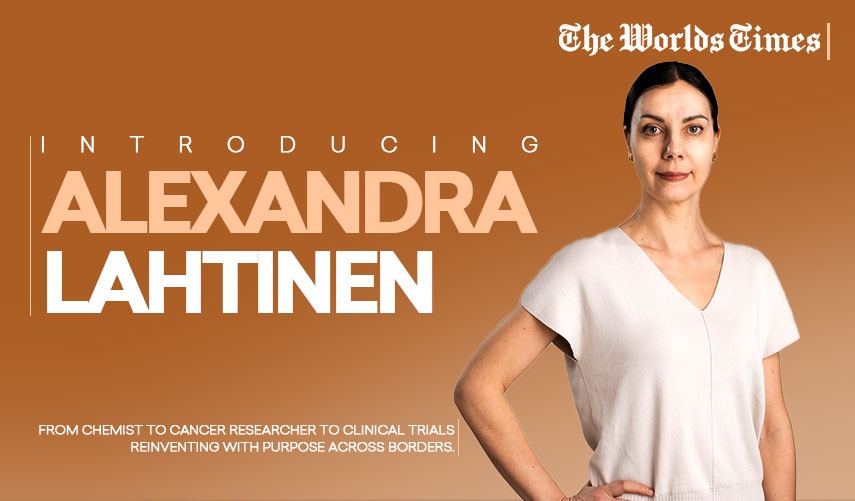
A Conversation With Alexandra
In today’s rapidly evolving professional world, few careers reflect resilience and reinvention as powerfully as that of Alexandra. From beginning her journey as a biochemist in Moscow to rebuilding her life and career in Finland, her path has crossed science, marketing, academia, oncology research, and clinical research operations.
Recognized as a Pink Ribbon Cancer Researcher in Finland, Alexandra’s work bridges scientific discovery with real-world patient impact. Alongside her achievements in academia and clinical research, she is also a published children’s author, proving that science and creativity can thrive together.
We spoke with Alexandra about adapting to change, pursuing lifelong learning, and the experiences that shaped both her scientific and personal journey.
Reinventing a Career Across Industries and Countries
We began the interview by asking, “What motivated you to continuously reinvent yourself across industries and countries?”
Alexandra replied, “For me, reinvention was never really a planned decision. Life simply kept pushing me into new directions, and I learned to grow with it.
I started my career in Moscow as a biochemist because science was always my foundation. But quite early, I realized that science alone does not change healthcare. Communication, understanding people, and connecting ideas with real life are equally important. That naturally led me into sales and marketing for many years.
When I moved to Finland at the age of 32, everything changed again. Suddenly, the experience and career I had built before did not automatically mean anything anymore. I did not speak Finnish, I had no professional network, and I had to rebuild myself from scratch.
Of course, there were difficult moments, but I also saw it as an opportunity to create a completely new chapter instead of holding onto the old one.
I applied to Finnish universities and was accepted into all of them, which gave me confidence that my background and knowledge still mattered. Later, I completed a second Master’s degree and eventually earned a PhD.
For me, that journey became deeply personal. It proved that it is never too late to start again, learn something new, or build a different future.
What continues to motivate me is curiosity. I genuinely enjoy learning and challenging myself. Every stage of my career, whether in sleep research, oncology, or clinical research coordination, has taught me something valuable both professionally and personally.
Careers today are no longer linear, and the ability to adapt and evolve is one of the most important skills we can have.”
Research That Connects Science With Human Impact
The Worlds Times asked, “Your academic work spans sleep science and ovarian cancer research, and you were recognized as a Pink Ribbon Cancer Researcher in Finland. Which research experience had the deepest emotional and professional impact on you?”
Alexandra explained, “Cancer research had the strongest emotional impact on me.
During my postdoctoral work in ovarian cancer research, I became much more aware of the human side of science. Behind every sample, every experiment, and every data point, there is a real person and a family hoping for better outcomes. Once you truly understand that, research feels very different.
Being recognized as a Pink Ribbon Cancer Researcher in Finland was especially meaningful because it felt like recognition not only for scientific work, but also for contributing to something larger and more human.
Cancer research can be emotionally heavy because progress is often slow, but even small discoveries matter.
My earlier PhD work in sleep science also shaped me significantly. Sleep affects every aspect of human health and daily life, and it taught me how interconnected the human body truly is. But oncology introduced a completely different level of urgency and responsibility.
It showed me how essential translational medicine is and how important collaboration between universities, hospitals, and clinical research organizations becomes.
Professionally, these experiences made me more analytical and disciplined as a researcher. Personally, they made me more empathetic.
Science is never only about publications or statistics. At the end of the day, it is about improving people’s lives.”
Moving From Academia Into Clinical Research Operations
The Worlds Times asked, “After building a successful academic career with publications and mentorship experience, what inspired you to return to the pharmaceutical industry as a Clinical Research Associate?”
Alexandra responded, “Academia gave me a great deal. I published scientific papers, supervised students, and worked on meaningful research projects. But over time, I realized I wanted to move closer to the practical side of medicine and see how research directly impacts patient care.
That is what attracted me to clinical research operations.
I wanted to understand how clinical trials function in real life and gain industry experience in Finland. Clinical research exists exactly between science and patient care, which makes it incredibly interesting to me.
As a Clinical Research Associate, I work closely with hospitals and study sites, ensuring that clinical trials are conducted ethically and according to regulations.
The role combines communication, organization, science, and problem solving all at once.
Interestingly, my earlier experience in marketing and communication became valuable again because building trust and maintaining relationships are essential parts of clinical research.
For me, my career has never felt like separate chapters. Everything connects together. Chemistry gave me scientific thinking, marketing taught me communication, academia taught me research, and clinical operations allows me to combine all of those skills.
I also believe growth often begins when you are willing to step outside your comfort zone and become a beginner again.”
Lessons in Resilience, Adaptation, and Starting Over
The Worlds Times asked, “What lessons about resilience and adaptation would you share with professionals facing major life transitions?”
Alexandra shared, “The first lesson I learned is that adaptation requires humility.
When you move to a new country, especially after already having an established career, you suddenly have to prove yourself all over again. That can be emotionally difficult because you know what you are capable of, but nobody around you knows your story yet.
I also learned that language is much more than communication. Learning Finnish was important not only professionally, but emotionally and socially as well. Language helps you feel that you belong somewhere. It shows respect for the culture and allows you to connect with people on a much deeper level.
Another important lesson is that age should never limit ambition.
Sometimes I was the oldest student or the oldest newcomer in the room, but I stopped seeing that as a disadvantage. Experience brings discipline, emotional intelligence, and perspective, and those qualities are incredibly valuable.
Most importantly, I learned that adapting does not mean losing yourself.
You do not abandon your identity, you expand it.”
Balancing Science and Creativity
Beyond science and clinical research, Alexandra is also a published children’s author in Russia.
When asked how creativity influences her professional life, she explained, “Writing children’s books has always been a very personal and joyful part of my life.
I actually believe science and creativity are much closer than people imagine. Both require curiosity, imagination, and the ability to see connections others might miss.
Being published by a major publisher in Moscow was a wonderful experience because writing allows me to express emotions and ideas in a completely different way from scientific work.
In science, everything is based on precision and evidence. In literature, you work more with emotions, imagination, and storytelling.
At the same time, creativity has also helped me professionally. It improves communication, problem solving, and the ability to explain complex ideas in a simple and human way. Even mentoring students requires creativity because every person learns differently.
I also believe creativity helps maintain balance in life. Research and clinical work can be highly structured and intense, while writing provides freedom and emotional energy.
Most importantly, I hope my daughter grows up seeing that people do not have to fit into only one role. You can be a scientist, a researcher, a mother, a writer, and an artist all at the same time.”
Building a Career Without Limits
Alexandra’s journey reflects the realities of the modern professional world, one where reinvention, adaptability, and continuous learning matter more than following a perfectly linear path.
From rebuilding her life in a new country to contributing to cancer research and clinical trials, her story demonstrates how resilience and curiosity can open entirely new opportunities at any stage of life.
By combining science, communication, research, and creativity, Alexandra represents a new generation of multidisciplinary professionals shaping the future of healthcare and innovation.
To learn more:
https://samokatbook.ru/izdatelstvo/authors/lakhtinen-aleksandra/
Connect with Alexandra on LinkedIn – https://www.linkedin.com/in/alexandra-lahtinen-a7974522/
Also Read:-
Professor El Namaki on Strategy, Entrepreneurship & AI Today in Focus!
Leading Through Impact with Manuel Santa Clara Corrêa
Sergey Volnov on Trust in a Synthetic Content World