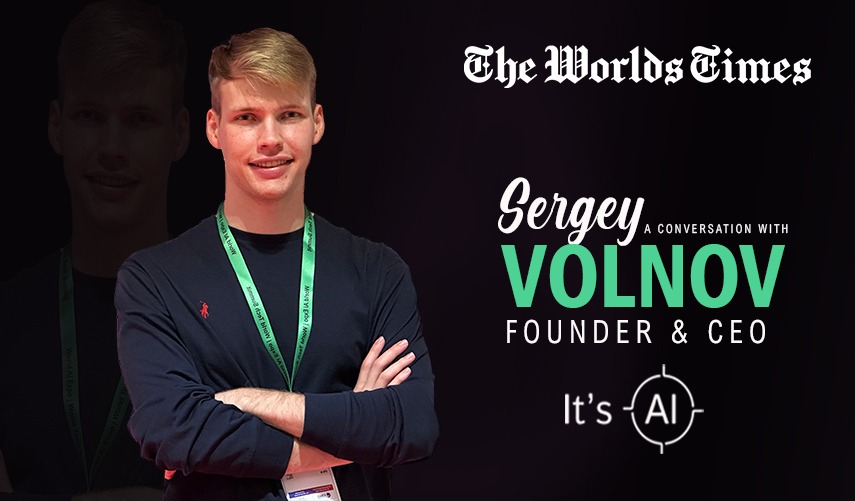
A Conversation With Sergey Volnov
Synthetic text is now part of everyday life from homework to headlines to customer chats. Sergey Volnov, Founder & CEO of It’s AI, argues that the next layer of the internet is not “more content,” but clearer signals about where that content came from and how to interpret it.
Why Trust in Content Matters
We started the interview by asking, “Why does the average reader or citizen, need to care about AI-generated text?”
Sergey Volnov replied, “Because credibility is social infrastructure. When you cannot tell whether advice, news commentary, or a personal appeal was written by a human, you lose the basis for trust. That affects education, media, online communities, and even ordinary commercial relationships. The goal is not fear of AI; it is restoring enough transparency to make good decisions.”
Experience to Authenticity Focus
The Worlds Times: What led you to build It’s AI?
Sergey Volnov replied, “I spent years applying machine learning in banking and product companies. I watched generative models improve faster than verification. Schools, businesses, and platforms were struggling to distinguish human from machine writing with tools that were not keeping up. I saw a gap: we needed serious science and product discipline focused on authenticity, not gimmicks.”
Smart AI Integration
The Worlds Times: Is the answer stricter bans on AI in schools and workplaces?
Sergey Volnov replied, “Bans rarely scale. The better answer is integration with guardrails: teach how to use AI, require disclosure where appropriate, and give educators and managers tools that reduce guesswork. The conversation should shift from “caught you” to “let us be clear about what this is.”
Simple, Explainable Detection for Users
The Worlds Times: How does It’s AI actually work for a non-technical user?
Sergey Volnov replied, “You submit text and receive a probability-based assessment—an overall signal plus more granular insight into which parts look more consistent with AI generation and which patterns influenced the score. It is designed to be explainable enough for a thoughtful review, not a single scary number with no context.”
Addressing Accuracy
The Worlds Times: Critics say detectors can be wrong. How do you respond?
Sergey Volnov replied, “They are right that naive detectors fail, which is why false positive rate matters so much. We optimize for minimizing wrongful accusations, use diverse training and continuous evaluation, and we are explicit that outputs are supportive evidence, not a courtroom ruling especially in sensitive settings like education.”
Why Benchmarks Build Credibility
The Worlds Times: You emphasize benchmarks. Why should people outside academia care?
Sergey Volnov replied, “Because marketing claims are easy; independent datasets are harder. We publish and iterate against benchmarks such as MGTD, RAID, and ASAP, where we report strong results including leading performance on MGTD, about 98.3% accuracy on RAID, and under 0.8% false positive rate on ASAP. For the public, that means a product team that treats verification as an engineering discipline, not a slogan.”
AI Trust Challenges
The Worlds Times: Which industries feel this problem most acutely right now?
Sergey Volnov replied, “Education was the early flashpoint, but the same tension appears anywhere originality and accountability meet volume: newsrooms and content platforms, hiring and admissions, legal and financial drafting support, and customer operations at scale. The pattern is global.”
Global Perspectives
The Worlds Times: Does geography change how people think about AI and trust?
Sergey Volnov replied, “The details differ regulation, language, classroom culture, but the underlying need is universal: innovation without losing standards. Regions investing heavily in digital transformation often move faster from denial to structured policies, which is healthy if those policies emphasize transparency rather than panic.”
Balancing AI Power
The Worlds Times: What is your personal philosophy on AI and human creativity?
Sergey Volnov replied, “AI can amplify creativity when people remain accountable for what they ship. The risk is anonymity: when outputs feel authoritative but are unmoored from a human author. Our mission is to make authenticity measurable enough that society can keep both benefits speed and scale, and the norms that make communication trustworthy.”
Scaling an Authenticity-First Future
Lastly we asked, “What comes next for It’s AI?”
“We will keep pushing accuracy as models evolve, and we are building toward a broader authenticity platform helping people write better, stay original, and use AI responsibly. If readers want to explore the product or follow our research updates, they can start on our website and reach out via LinkedIn.” Sergey Volnov concluded
Connect with Sergey Volnov on LinkedIn
For more information visit It’s AI
Also Read:-
Professor El Namaki on Strategy, Entrepreneurship & AI Today in Focus!
Leading Through Impact with Manuel Santa Clara Corrêa
Charlie Nahabedian Revolutionizing Digital Healthcare Access Today