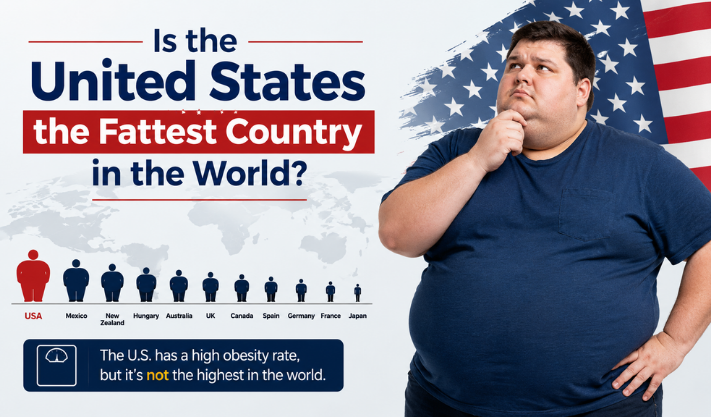
The United States is often associated with high obesity rates, large food portions, fast food, and sedentary lifestyles. This leads to a common question: Is the United States the fattest country in the world?
The short answer is no. The United States has one of the highest obesity rates among large, high-income countries, but it does not have the highest adult obesity rate in the world.
The answer also depends on what is meant by “fattest country.” Some rankings measure adult obesity, while others combine overweight and obesity. Different sources, years, age groups, and definitions can therefore produce different rankings.
So, how does the United States compare with other countries, and why is obesity such a major issue in America?
Is the United States the Fattest Country in the World?
No. The United States does not have the highest adult obesity rate in the world.
Several smaller countries and island nations have reported higher adult obesity rates than the United States.
However, the U.S. still has one of the highest obesity rates among large, wealthy and industrialized countries. This is why America frequently appears near the top of international obesity rankings.
It is important to distinguish between having the highest obesity percentage and having the largest number of people living with obesity. These are two different measurements.
What Is the Obesity Rate in the United States?
More than two in five U.S. adults have obesity according to recent national health data.
The exact percentage varies depending on the year, survey, age group, and definition used.
For adults, obesity is commonly classified using body mass index, or BMI. A BMI of 30 or higher is generally classified as obesity.
However, BMI is a screening tool rather than a perfect measurement of an individual’s body fat or overall health.
Which Country Has the Highest Obesity Rate?
The highest adult obesity rates are generally found in several small Pacific island nations and some countries in the Pacific and Middle East, rather than the United States.
Countries and territories such as Nauru, Tonga, Tuvalu, Samoa, and American Samoa have historically reported extremely high adult obesity prevalence.
The exact ranking can change depending on the dataset and year.
This distinction matters because a small country with a population of only tens of thousands can have a higher obesity percentage than the United States while having far fewer people living with obesity in absolute numbers.
Is America the Fattest Developed Country?
The United States has one of the highest obesity rates among developed, high-income countries, although it is not always ranked number one.
When the U.S. is compared specifically with wealthy industrialized countries, its obesity rate stands out.
However, when every country and territory in the world is included, several smaller populations have higher obesity prevalence.
International rankings can also vary because countries use different health surveys, populations, years, and reporting methods.
Why Is the United States So Obese?
Obesity in the United States is caused by a combination of dietary, environmental, behavioral, biological, and socioeconomic factors.
There is no single reason why obesity is so common in America.
Modern American life provides easy access to calorie-dense foods while many jobs, transportation systems, and daily activities require relatively little physical movement.
Factors that can contribute to obesity include:
- Large food portions
- Highly processed foods
- Sugar-sweetened beverages
- Fast-food availability
- Sedentary jobs
- Increased screen time
- Low levels of physical activity
- Poor sleep
- Chronic stress
- Socioeconomic differences
- Genetic and biological factors
These factors can interact with one another and influence body weight over time.
Is Fast Food Making America Obese?
Fast food can contribute to obesity, but it is not the sole reason for America’s high obesity rate.
Many fast-food meals contain large amounts of calories, added sugars, sodium, and saturated fat.
Frequently consuming calorie-dense foods can make it easier to consume more energy than the body uses.
However, obesity is a complex health issue. Overall eating patterns, portion sizes, physical activity, sleep, genetics, stress, medications, and environmental conditions can all influence body weight.
Therefore, blaming fast food alone does not fully explain obesity in the United States.
Are Americans More Overweight Than People in Other Countries?
The United States has a relatively high prevalence of overweight and obesity compared with many other wealthy countries.
What particularly distinguishes the United States among high-income nations is the large proportion of adults affected by obesity.
However, America is not alone in experiencing rising obesity rates.
Changes in diet, transportation, employment, urban environments, physical activity, and lifestyles have contributed to increasing obesity in many countries around the world.
The global obesity problem has therefore expanded far beyond the United States.
Why Is Obesity Increasing?
Obesity has increased partly because modern environments make high-calorie foods widely available while reducing the amount of physical activity required in everyday life.
People can work, shop, travel, communicate, and entertain themselves with relatively little physical movement.
At the same time, highly processed and energy-dense foods are widely available and are often convenient and inexpensive.
Other factors, including sleep, stress, medications, genetics, and socioeconomic conditions, can also influence body weight.
This creates a complex relationship between individual behavior and the environment in which people live.
What Is the Difference Between Overweight and Obesity?
Overweight and obesity are related but different categories.
For adults, BMI is commonly used as a screening tool.
Generally:
- A BMI from 25 to below 30 is classified as overweight.
- A BMI of 30 or higher is classified as obesity.
These categories are useful when studying large populations, but BMI has limitations when applied to individuals.
For example, BMI does not directly measure body fat and does not distinguish between muscle and fat.
Therefore, BMI should not be treated as a complete measure of an individual’s health.
Is Obesity a Major Health Problem in the United States?
Yes. Obesity is a major public health concern in the United States.
Obesity is associated with an increased risk of several chronic health conditions, including type 2 diabetes, cardiovascular disease, high blood pressure, sleep-related conditions, and certain other diseases.
However, individual health is more complicated than body weight alone.
Healthcare professionals may consider factors such as blood pressure, blood sugar, cholesterol, physical fitness, diet, sleep, medical history, and body composition when assessing health.
Why Do Pacific Island Countries Have Such High Obesity Rates?
Several Pacific island nations have extremely high obesity rates because of complex historical, economic, dietary, cultural, and environmental changes.
In some island populations, imported foods became increasingly available as traditional food systems and lifestyles changed.
Calorie-dense processed foods became more accessible in some communities, while physical activity declined because of changes in employment, transportation, and daily life.
However, the issue cannot be explained simply by culture or personal choices.
Obesity is influenced by wider economic, social, environmental, and food-system factors.
Is America Getting Fatter?
The United States experienced a substantial increase in obesity over recent decades, although trends differ by age, sex, location, and demographic group.
The increase has made obesity one of the country’s major public health challenges.
Researchers continue to study why obesity rates have increased and why some communities have much higher rates than others.
Differences in income, food access, healthcare, neighborhood environments, physical activity opportunities, education, and other social factors can contribute to these differences.
Is Obesity Genetic?
Genetics can influence a person’s risk of obesity, but genes do not fully explain obesity.
Hundreds of genetic variants can affect appetite, metabolism, fat storage, and body-weight regulation.
However, genes interact with the environment.
A person may have a genetic tendency toward higher body weight, while diet, physical activity, sleep, medications, stress, and other environmental factors can also influence weight.
This is why obesity is considered a complex condition rather than simply a matter of willpower.
Does Being Overweight Always Mean Being Unhealthy?
No. Body weight alone does not provide a complete picture of an individual’s health.
Weight and BMI are useful screening measures, particularly when researchers study large populations.
However, individual health can also depend on blood pressure, blood sugar, cholesterol, fitness, diet, sleep, medical history, and body composition.
Therefore, someone’s health cannot be determined solely by appearance or body weight.
Which Countries Have Higher Obesity Rates Than the United States?
Several countries and territories have historically reported higher adult obesity prevalence than the United States, particularly small Pacific island populations.
The exact order changes depending on the source, year, age group, and definition being used.
For this reason, there is no single permanent ranking that always produces the same result.
A reliable comparison should always identify the specific dataset and definition of obesity being used.
Does the United States Have the Most People With Obesity?
The United States has a very large number of people living with overweight and obesity because it combines a large population with a high obesity prevalence.
This is different from having the highest obesity percentage.
For example, a small country may have a higher percentage of adults with obesity, while the United States may have a much larger absolute number of affected people because its total population is much larger.
Therefore, the highest obesity rate and the largest number of people with obesity are not the same thing.
What Is the Main Reason America Has High Obesity Rates?
There is no single main cause of America’s high obesity rate.
The issue results from a combination of:
- Food environments
- High availability of calorie-dense foods
- Physical inactivity
- Sedentary lifestyles
- Portion sizes
- Socioeconomic conditions
- Genetics
- Sleep
- Stress
- Healthcare and environmental factors
Modern life makes calorie-rich food easy to access while reducing the amount of physical movement required for many everyday activities.
Understanding these environmental factors is important because obesity cannot be explained solely through individual choices or willpower.
Final Answer
No. The United States is not the world’s fattest country when measured by adult obesity prevalence.
However, the United States has one of the highest obesity rates among large, wealthy countries and faces a significant obesity-related public health burden.
Several Pacific island nations and territories have historically recorded higher adult obesity rates than the United States.
The U.S. ranking can also change depending on whether the measurement considers the percentage of adults with obesity, overweight plus obesity, a specific age group, or the total number of people affected.
The most accurate conclusion is that the United States has a very high obesity rate, but calling it the “fattest country in the world” is an oversimplification.
Frequently Asked Questions
Is the United States the most obese country?
No. Several countries and territories have higher adult obesity rates than the United States.
Which country has the highest obesity rate?
Small Pacific island nations frequently have some of the highest adult obesity rates in the world.
Is America the most obese developed country?
The United States has one of the highest obesity rates among high-income countries.
Why is obesity common in America?
Obesity is influenced by diet, physical activity, food environments, socioeconomic conditions, genetics, sleep, stress, and other factors.
Does fast food cause obesity?
Frequent consumption of high-calorie fast food can contribute to obesity, but obesity has many causes.
Are Americans overweight?
A substantial proportion of American adults are classified as overweight or obese.
What is obesity?
Obesity is a condition involving excessive body fat that can increase the risk of various health problems. For adults, a BMI of 30 or higher is commonly used to classify obesity.
Is BMI a perfect measure of obesity?
No. BMI is a useful screening tool, but it does not directly measure body fat.
Are Pacific island nations more obese than America?
Several Pacific island nations have historically reported higher adult obesity rates than the United States.
Is obesity genetic?
Genetics can influence obesity risk, but environmental, behavioral, and socioeconomic factors are also important.
Is America getting fatter?
The United States experienced a major increase in obesity over recent decades, although trends differ among population groups.
What is the main cause of obesity in America?
There is no single cause. Obesity results from an interaction of biological, behavioral, social, economic, and environmental factors.
Also Read:-
Clément Delangue: Shaping the Future of Open-Source AI
Where Is AI Driving the Most Innovation in New York?
Thomas Wolf: Open-Source AI Visionary Shaping Machine Learning