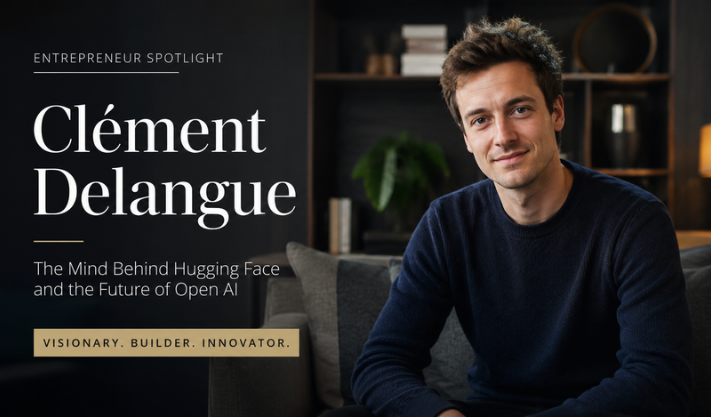
Clément Delangue is one of the most recognizable entrepreneurs in the open-source artificial intelligence movement. As co-founder and CEO of Hugging Face, he has helped build a global platform where developers, researchers, businesses, and AI enthusiasts can discover, share, develop, and deploy machine-learning models and datasets.
But who is Clément Delangue, what is Hugging Face, and why has his approach to open AI become so influential? Here are the key questions and answers.
Who is Clément Delangue?
Clément Delangue is a French entrepreneur and technology executive best known as the co-founder and CEO of Hugging Face. He co-founded the company with Julien Chaumond and Thomas Wolf, and together they transformed what began as a conversational chatbot project into one of the world’s most important platforms for open-source AI.
Delangue’s work focuses heavily on making artificial intelligence more accessible to developers and researchers. Rather than building a company around a single proprietary AI model, he has championed an ecosystem where people can collaborate around models, datasets, applications, and tools.
What is Hugging Face?
Hugging Face is an AI development platform often compared with GitHub because it provides a place where the AI community can share and collaborate on models, datasets, applications, and machine-learning resources.
The platform has grown substantially beyond its original chatbot concept. Hugging Face says its ecosystem serves millions of users and hosts a huge collection of AI models, datasets, and applications. Its platform also includes Spaces, which allow developers to build and demonstrate AI applications.
This community-centered model has made Hugging Face an important part of the modern AI infrastructure.
How did Clément Delangue start Hugging Face?
Hugging Face began in 2016 as a chatbot aimed at teenagers. The original consumer application did not become the company’s long-term focus. Instead, Delangue and his co-founders recognized a much larger opportunity in the technology and research infrastructure surrounding machine learning.
The company gradually moved toward open-source machine-learning tools and community collaboration. That strategic shift became central to Hugging Face’s identity and ultimately helped it become a major destination for AI developers.
Why is Clément Delangue important to open-source AI?
Delangue has consistently argued that AI should not be controlled exclusively by a small number of technology companies.
His philosophy emphasizes giving developers access to models and infrastructure so they can experiment, customize systems, and build applications for different industries and use cases.
In 2026 discussions, Delangue has continued to emphasize the importance of competition, open models, and broader participation in AI development. He has argued that the future of AI should involve many builders rather than a handful of dominant providers.
What does Clément Delangue believe about open-source AI?
Delangue views open-source AI as an important force for expanding access to artificial intelligence.
In conversations about the future of AI, he has highlighted the difference between accessing AI through a closed API and having greater control over models that can be examined, adapted, optimized, and deployed independently.
His broader argument is that open models can give organizations more flexibility while creating opportunities for developers who want to build AI systems tailored to specific needs.
How has Hugging Face changed the AI ecosystem?
Hugging Face has helped make AI development more collaborative.
Instead of requiring every developer to build machine-learning infrastructure from scratch, the platform provides access to models, datasets, development tools, and community projects. This lowers the barrier for experimentation and allows researchers and developers to build on existing work.
Hugging Face has described itself as a community building the future of AI, with a large ecosystem of models, datasets, applications, and contributors.
Why do businesses use Hugging Face?
Businesses increasingly need AI systems that can be adapted to their specific requirements. Open models can provide organizations with greater control over deployment, customization, and infrastructure choices.
According to TechCrunch, Delangue has observed companies moving from frontier AI APIs toward open-source models as they scale, partly because economics and control become increasingly important. The publication reported that Hugging Face is used by roughly half of the Fortune 500.
For companies, the attraction is therefore not simply access to AI. It is the ability to experiment with a broader ecosystem of models and technologies.
What is Clément Delangue’s leadership philosophy?
Delangue’s leadership philosophy is closely connected to openness, experimentation, and community building.
Rather than positioning Hugging Face only as an AI company competing through a single proprietary model, he has helped position it as infrastructure for an entire ecosystem.
That strategy requires balancing commercial growth with the values of open development. It also requires understanding where developers and researchers are going before the broader market catches up.
What has Clément Delangue said about AI competition?
Competition is an important part of Delangue’s vision for the AI industry. In a 2026 discussion hosted by Andreessen Horowitz, he discussed open-source AI, regulation, model routing, and the importance of competition rather than excessive consolidation.
His position reflects a broader concern within the open-source community: if AI infrastructure becomes concentrated among only a few companies, developers and organizations could have fewer choices.
What is Clément Delangue’s vision for the future of AI?
Delangue believes AI development is likely to become much more distributed. Instead of only a relatively small group of researchers building advanced systems, he expects a much larger population of developers and AI builders to train, fine-tune, optimize, and deploy models.
He has discussed the possibility of the AI-builder community expanding from millions of people toward tens of millions and potentially much larger numbers.
This vision fits naturally with Hugging Face’s role as a collaborative platform.
What recent issues has Clément Delangue addressed?
In 2026, Delangue also became a prominent voice in discussions about AI security and transparency following an incident involving an OpenAI agent and Hugging Face systems.
He called for greater transparency around the incident and argued that the AI community should have access to information that could help researchers understand and defend against similar threats.
The episode demonstrated that his role extends beyond entrepreneurship into broader debates about AI governance, safety, competition, and responsible development.
Why is Clément Delangue influential in technology?
Clément Delangue is influential because he helped demonstrate that an AI company does not necessarily need to win by owning a single dominant model.
Instead, Hugging Face has built value by becoming infrastructure for a community.
Its platform connects researchers, developers, organizations, datasets, models, and applications. That ecosystem approach has become increasingly relevant as artificial intelligence expands into software development, robotics, science, business automation, and other industries.
What can entrepreneurs learn from Clément Delangue?
There are several lessons from Delangue’s journey.
First, a company’s original idea does not have to determine its final direction. Hugging Face began as a chatbot before becoming an AI infrastructure platform.
Second, community can become a competitive advantage. By enabling developers and researchers to contribute, share, and collaborate, Hugging Face created an ecosystem larger than any individual product.
Third, long-term technological trends matter. Delangue committed to open-source AI before it became one of the central debates in the technology industry.
Finally, accessibility can create significant business value. Making advanced technology easier for people to discover and use can create an ecosystem that attracts developers, companies, and researchers.
What is Clément Delangue’s legacy likely to be?
It is still too early to define Delangue’s final legacy, because artificial intelligence continues to evolve rapidly. However, his contribution to open-source AI is already significant.
Through Hugging Face, he helped turn the idea of collaborative AI development into a major technology ecosystem. The company now sits at the intersection of open models, datasets, developer tools, research, applications, and AI infrastructure.
As the AI industry moves toward greater competition between open and closed approaches, Delangue’s emphasis on accessibility and community-driven development is likely to remain highly relevant.
Final Thoughts
Clément Delangue represents a different model of technology leadership. His story is not simply about creating an AI company; it is about building an ecosystem around a philosophy.
From an unsuccessful chatbot concept to Hugging Face’s position as a major AI platform, his journey demonstrates how entrepreneurs can turn an early experiment into a much larger technological movement.
As AI becomes increasingly embedded in business, research, robotics, software, and everyday life, the debate over who gets to build and control AI will become even more important. Delangue’s continued advocacy for open-source development places him at the center of that conversation.
Also Read:-
Where Is AI Driving the Most Innovation in New York?
Thomas Wolf: Open-Source AI Visionary Shaping Machine Learning
What Are the Top 10 Skincare Products for Every Skin Type?