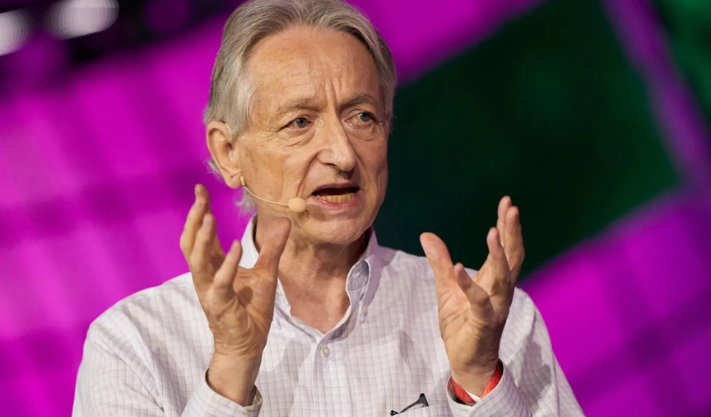
Artificial intelligence has transformed from a research concept into one of the most influential technologies in the world. Behind this transformation are scientists whose decades of research helped make today’s AI systems possible. Among them, Geoffrey Hinton stands out as one of the most important figures in the development of modern machine learning and neural networks.
Known for his pioneering work on deep learning, Hinton helped establish techniques that now influence computer vision, speech recognition, natural-language processing, and generative AI. His career also reflects an unusual combination of scientific ambition, persistence, and concern about the future consequences of increasingly powerful AI.
Who is Geoffrey Hinton?
Geoffrey Hinton is a British-Canadian computer scientist and cognitive psychologist best known for his foundational research in artificial neural networks and deep learning.
He spent much of his academic career exploring how computers could learn from data in ways inspired by the human brain. At a time when neural networks were not considered the dominant approach to artificial intelligence, Hinton continued developing them and helped demonstrate their practical potential.
His research became especially influential when advances in computing power, large datasets, and specialized hardware made deep neural networks increasingly effective.
What is Geoffrey Hinton famous for?
Geoffrey Hinton is most famous for helping pioneer the field of deep learning.
Deep learning uses neural networks with multiple layers to identify patterns in large amounts of data. Instead of requiring humans to manually program every feature a computer should recognize, these systems can learn useful representations from examples.
Hinton’s work contributed to important developments in neural-network training, representation learning, and computer vision. His research helped create the foundation for technologies that can recognize images, understand speech, process language, and generate content.
What did Geoffrey Hinton contribute to neural networks?
One of Hinton’s major contributions was demonstrating that neural networks could learn increasingly sophisticated representations through multiple computational layers.
His research helped advance techniques for training networks and understanding how representations could be learned automatically. This was important because earlier approaches to artificial intelligence often depended heavily on manually engineered rules and features.
Hinton and his collaborators helped show that neural networks could become remarkably powerful when trained with sufficient data and computational resources.
This shift became one of the defining developments in modern AI.
What is deep learning, and why is Hinton important to it?
Deep learning is a branch of machine learning in which artificial neural networks learn through multiple layers of processing.
For example, when analyzing an image, early layers might identify simple patterns such as edges, while later layers can combine those patterns into shapes and eventually recognize objects.
Hinton’s research helped establish neural networks as a powerful approach for this kind of hierarchical learning. His work was particularly influential in demonstrating that systems could learn representations rather than relying entirely on features designed by programmers.
That principle is now central to many modern AI systems.
What was the ImageNet breakthrough?
A major milestone came in 2012, when Hinton and his students, including Alex Krizhevsky and Ilya Sutskever, developed AlexNet, a deep convolutional neural network that achieved a major breakthrough in the ImageNet image-recognition competition.
AlexNet significantly outperformed competing approaches and demonstrated the potential of deep neural networks for large-scale visual recognition.
The achievement helped accelerate investment and research in deep learning. It became an important turning point in the broader AI industry, encouraging researchers and companies to explore neural networks for increasingly complex tasks.
Did Geoffrey Hinton win a Nobel Prize?
No. Geoffrey Hinton is not a Nobel Prize winner.
However, he received the 2024 Nobel Prize in Physics, jointly with John Hopfield, for foundational discoveries and inventions that enable machine learning with artificial neural networks.
The award recognized the importance of neural-network research to modern technological development and highlighted how ideas originally explored in physics and computational science contributed to today’s AI revolution.
What awards has Geoffrey Hinton received?
Hinton has received numerous major scientific honors.
In 2018, he shared the ACM A.M. Turing Award with Yann LeCun and Yoshua Bengio. The award is often described as one of the highest honors in computer science.
The three researchers were recognized for conceptual and engineering breakthroughs that made deep neural networks a critical component of computing.
Hinton has also received other major academic honors throughout his career, reflecting the long-term influence of his research.
Why is Geoffrey Hinton sometimes called the “Godfather of AI”?
Hinton is frequently described as one of the “Godfathers of AI” because of his foundational contributions to neural networks and deep learning.
The nickname reflects his role in advancing an approach that eventually became central to modern artificial intelligence.
However, modern AI is not the work of one individual. Researchers including Yann LeCun, Yoshua Bengio, John Hopfield, David Rumelhart, Ronald Williams, and many others contributed important ideas to the development of neural networks and machine learning.
Hinton’s significance comes from the depth and longevity of his contributions to the field.
Why did Geoffrey Hinton leave Google?
In 2023, Hinton announced that he had left Google after more than a decade with the company.
His departure attracted global attention because he wanted greater freedom to speak publicly about the potential risks associated with rapidly advancing artificial intelligence.
Hinton has argued that increasingly capable AI systems could create significant societal challenges. His concerns include misinformation, job displacement, autonomous systems, and the possibility that future AI systems could become difficult for humans to control.
His decision helped intensify the public conversation about AI safety and responsible development.
What are Geoffrey Hinton’s concerns about AI?
Hinton has expressed concerns about the long-term consequences of increasingly capable AI.
One of his central concerns is that AI systems could eventually become more capable than humans in many areas while remaining difficult to understand or control.
He has also warned about the impact of AI-generated misinformation, employment disruption, autonomous weapons, and the possibility of advanced AI pursuing objectives that conflict with human interests.
Importantly, Hinton’s position is not simply that AI should stop developing. Instead, he has emphasized the need for researchers, governments, and society to take AI safety seriously while the technology continues to advance.
What is Geoffrey Hinton’s legacy?
Geoffrey Hinton’s legacy extends far beyond individual algorithms or research papers.
His work helped change the direction of artificial intelligence research. Neural networks that were once viewed by many researchers as impractical became central to some of the world’s most powerful AI systems.
Today, deep-learning techniques influence everything from image recognition and recommendation systems to large language models and generative AI.
At the same time, Hinton’s later warnings have added another dimension to his legacy. He is both a major contributor to the rise of modern AI and one of its most prominent voices calling for careful consideration of its risks.
What can we learn from Geoffrey Hinton’s career?
Hinton’s career demonstrates the importance of persistence in scientific research.
For many years, neural networks were not the dominant approach in artificial intelligence. Hinton continued investigating them, refining methods, publishing research, and training new generations of researchers.
His story also shows how technological breakthroughs often emerge when fundamental research meets improvements in computing power, data availability, and engineering.
Most importantly, his career illustrates that creating powerful technology and thinking critically about its consequences can happen at the same time.
Frequently Asked Questions About Geoffrey Hinton
Why is Geoffrey Hinton important to AI?
Geoffrey Hinton is important because his research helped establish deep learning and neural networks as major technologies behind modern artificial intelligence.
What did Geoffrey Hinton invent?
Hinton did not invent AI itself. His major contributions include influential advances in neural-network learning, representation learning, and deep learning.
Did Geoffrey Hinton create ChatGPT?
No. Hinton did not create ChatGPT. ChatGPT was developed by OpenAI using technologies and research from the broader field of deep learning and neural networks.
What did Hinton win the Nobel Prize for?
Hinton shared the 2024 Nobel Prize in Physics with John Hopfield for foundational discoveries and inventions that enable machine learning with artificial neural networks.
Why did Hinton warn about artificial intelligence?
Hinton became increasingly concerned about the possibility that highly capable AI could create serious risks, including misinformation, job disruption, autonomous systems, and future challenges involving human control.
Is Geoffrey Hinton still influential in AI?
Yes. His decades of research, scientific recognition, former industry work, and public discussions about AI safety continue to make him an influential figure in artificial intelligence.
Conclusion
Geoffrey Hinton’s story is closely connected to the rise of modern artificial intelligence. Through decades of research into neural networks and deep learning, he helped advance technologies that eventually became fundamental to today’s AI systems.
His influence can be seen in the evolution of computer vision, machine learning, language technologies, and generative AI. Yet perhaps the most interesting part of his legacy is the tension between innovation and responsibility.
Also Read:-
What Are the Latest Market and Banking Updates from New York?
World’s Best Countries for Expats to Live and Work in 2026
Where Can You Find Affordable Beauty Services in California?