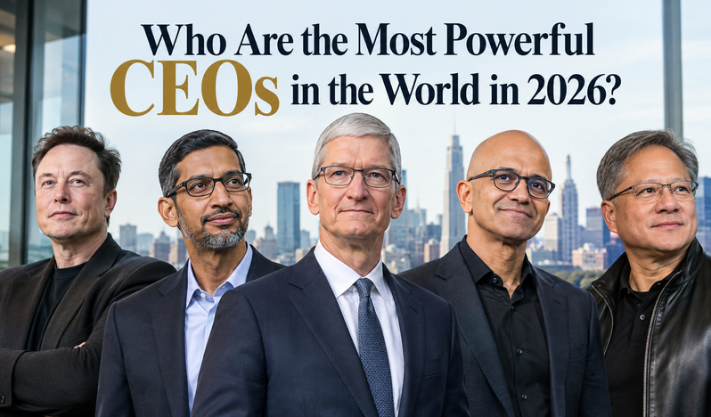
Introduction: Who Are the Most Powerful CEOs in the World in 2026?
The most powerful CEOs in the world in 2026 are leaders who influence global technology, finance, retail, artificial intelligence, energy, healthcare, and consumer markets. Their decisions can affect millions of customers, employees, investors, suppliers, and businesses across multiple countries.
Some of the most influential business leaders include Jensen Huang of NVIDIA, Tim Cook of Apple, Satya Nadella of Microsoft, Andy Jassy of Amazon, Sundar Pichai of Alphabet, Mark Zuckerberg of Meta, and Jamie Dimon of JPMorgan Chase. Other important figures include Elon Musk, who leads Tesla and SpaceX, and Sam Altman, who leads OpenAI.
However, there is no single official ranking of the world’s most powerful CEOs. A chief executive’s influence depends on several factors, including company size, financial performance, technological innovation, international reach, and the ability to shape entire industries.
Fortune’s 2026 Global 500 highlights the scale of corporate power. The companies on the list generated $43.1 trillion in combined revenue for the 2025 fiscal year and employed approximately 70.2 million people. Amazon ranked first by revenue, followed by Walmart and State Grid. These figures demonstrate how decisions made by large corporations can influence the global economy.
This article explores influential CEOs, their leadership approaches, the industries they shape, and the reasons their decisions matter in 2026.
1. Who Are the Most Powerful CEOs in the World in 2026?
The following executives are among the most influential business leaders to examine in 2026. This is a representative list based on industry impact, business scale, innovation, and strategic influence, not an official numerical ranking.
Jensen Huang — CEO of NVIDIA
Jensen Huang is one of the most influential technology executives because NVIDIA’s graphics processing units and computing platforms are central to modern artificial intelligence infrastructure.
His leadership has helped position NVIDIA as a major supplier of chips and systems used to train and run advanced AI models. These technologies support cloud computing, scientific research, autonomous systems, and enterprise software.
Why is Jensen Huang powerful in 2026?
His influence comes from the strategic importance of AI computing. As businesses and governments invest in AI infrastructure, demand for powerful processors, networking systems, and accelerated computing platforms makes NVIDIA an important player in the technology supply chain.
Tim Cook — CEO of Apple
Tim Cook leads Apple, a global technology company known for the iPhone, Mac, iPad, Apple Watch, digital services, and its wider connected-device ecosystem.
Cook’s leadership emphasizes operational efficiency, product integration, customer experience, and the development of services that encourage long-term customer relationships.
Why is Tim Cook one of the world’s most influential CEOs?
Apple’s products and services reach consumers across international markets. Decisions about product design, privacy, software, pricing, and supply chains can influence competitors, developers, manufacturers, and consumer expectations.
Satya Nadella — Chairman and CEO of Microsoft
Satya Nadella has led Microsoft’s transformation toward cloud computing, subscription software, enterprise platforms, and artificial intelligence.
Microsoft’s business spans Windows, Microsoft 365, Azure, GitHub, enterprise security, and AI-powered productivity tools. Its products are used by businesses, public institutions, developers, and individual consumers.
What makes Satya Nadella powerful?
His influence comes from Microsoft’s role in business technology. Cloud infrastructure and AI services can affect how organizations operate, manage information, develop applications, and automate routine work.
Nadella’s leadership approach also emphasizes organizational learning, collaboration, and adapting established products to changing technological needs.
Andy Jassy — CEO of Amazon
Andy Jassy leads Amazon, a company with significant operations in e-commerce, cloud computing, logistics, digital advertising, and subscription services.
Amazon’s scale gives its leadership influence over online shopping, warehouse operations, delivery networks, third-party sellers, and the digital infrastructure used by organizations worldwide.
Why is Andy Jassy among the most powerful CEOs?
Amazon’s combination of retail and technology businesses gives it influence across several industries. Its decisions about delivery speed, marketplace policies, cloud services, and automation can affect businesses and consumers on a global scale.
Sundar Pichai — CEO of Alphabet and Google
Sundar Pichai leads Alphabet, Google’s parent company. Its businesses include Google Search, YouTube, Android, Google Cloud, advertising technology, and artificial intelligence research and products.
Google’s services help people find information, watch videos, navigate locations, communicate, and access digital tools.
Why is Sundar Pichai influential in 2026?
Search and AI platforms play an important role in how people discover information online. Google’s decisions about search results, advertising, AI-generated answers, and digital platforms can influence publishers, marketers, businesses, and internet users.
Pichai’s leadership is particularly important as AI changes how people interact with search engines and online services.
Mark Zuckerberg — CEO of Meta Platforms
Mark Zuckerberg leads Meta, the company behind Facebook, Instagram, WhatsApp, and Threads, alongside its investments in artificial intelligence and immersive technologies.
Meta’s platforms connect individuals, creators, advertisers, communities, and businesses across numerous countries.
What makes Mark Zuckerberg powerful?
His influence stems from the reach of Meta’s communication and social media platforms. Decisions about recommendation systems, advertising, content moderation, messaging, and AI features can shape online communication and digital marketing.
Meta’s investments in AI also influence competition for computing resources, technical talent, and consumer attention.
Elon Musk — CEO of Tesla and SpaceX
Elon Musk is a prominent business leader associated with electric vehicles, space transportation, satellite connectivity, and artificial intelligence. His leadership roles across multiple companies give him influence beyond a single industry.
Tesla operates in electric vehicles, energy storage, and related technologies. SpaceX develops launch systems and satellite services, including Starlink.
Why is Elon Musk considered one of the most powerful business figures?
Musk’s influence comes from the strategic importance of the sectors in which his companies operate. Electric mobility, satellite communications, and space infrastructure have implications for transportation, connectivity, manufacturing, and national security.
His public profile also gives his statements and decisions considerable visibility, although public attention should not be confused with measurable business performance.
Sam Altman — CEO of OpenAI
Sam Altman leads OpenAI, a company focused on developing artificial intelligence systems and making AI tools available to individuals, developers, and organizations.
The rapid adoption of generative AI has made AI company leadership increasingly important to businesses, educators, software developers, and policymakers.
Why is Sam Altman influential in 2026?
AI tools can change how people write, code, research, analyze information, and complete workplace tasks. Decisions about model capabilities, product availability, pricing, safety, and partnerships can influence how organizations adopt AI.
Altman’s position places him within the broader debate about AI’s economic potential, risks, governance, and long-term social impact.
Jamie Dimon — Chairman and CEO of JPMorgan Chase
Jamie Dimon leads JPMorgan Chase, one of the world’s major financial institutions. Its operations span consumer banking, investment banking, lending, payments, wealth management, and financial services for businesses.
What makes Jamie Dimon one of the most influential CEOs?
Large banks help move money through the global economy. Their lending decisions, risk management, payment services, and financial market activities affect businesses, consumers, and investors.
Dimon’s leadership is particularly relevant during periods of economic uncertainty, changing interest rates, financial market volatility, and regulatory change.
Mary Barra — Chair and CEO of General Motors
Mary Barra leads General Motors, a major automotive manufacturer with brands and operations serving markets around the world.
The automotive industry is undergoing significant change as manufacturers respond to electric vehicles, software-defined cars, battery technology, supply-chain challenges, and changing consumer expectations.
Why is Mary Barra influential?
Her decisions affect manufacturing investment, vehicle development, employment, supplier relationships, and the pace of automotive technology adoption. GM’s strategic direction also illustrates the challenges established manufacturers face when adapting to new mobility technologies.
2. How Do These CEOs Influence the Global Economy?
Powerful CEOs influence the global economy by directing investment, creating jobs, developing products, managing supply chains, and deciding how companies respond to economic and technological changes.
Their decisions can affect several areas:
- Employment: Major companies hire workers directly and support additional jobs through suppliers, contractors, and business partners.
- Technology: Investments in AI, cloud computing, robotics, and software can accelerate innovation across entire industries.
- Consumer markets: Product launches, subscription models, and pricing decisions can change how people purchase goods and services.
- Financial markets: Corporate earnings, capital spending, acquisitions, and strategic announcements can influence investor expectations.
- International trade: Global supply chains connect companies with manufacturers, distributors, and customers across national borders.
- Sustainability: Decisions about energy use, manufacturing, transportation, and materials can affect environmental outcomes.
The influence of a CEO is therefore not limited to the company’s headquarters. A strategic decision made in one country can affect workers, suppliers, investors, and consumers in many others.
3. Which CEOs Are Most Influential in Artificial Intelligence in 2026?
Jensen Huang, Satya Nadella, Sundar Pichai, Mark Zuckerberg, and Sam Altman are among the prominent executives influencing the AI industry.
Each contributes through a different part of the AI ecosystem.
Jensen Huang’s NVIDIA supplies computing infrastructure used in AI development. Satya Nadella oversees Microsoft’s cloud and AI offerings for businesses. Sundar Pichai leads Google’s AI research, infrastructure, and consumer products. Mark Zuckerberg directs Meta’s AI development and its integration into social platforms. Sam Altman leads OpenAI’s development and deployment of generative AI products.
Their influence extends beyond product launches. They make decisions about computing capacity, research investment, commercial partnerships, model accessibility, data use, and safety practices.
Which AI CEO is the most powerful?
There is no universally accepted winner. Huang has significant influence over AI hardware, Nadella over enterprise software and cloud services, Pichai over Google’s broad technology ecosystem, Zuckerberg over social platforms and AI development, and Altman over OpenAI’s generative AI products.
The answer depends on whether influence is measured by infrastructure, consumer adoption, enterprise deployment, research, or public visibility.
4. Are the Most Powerful CEOs Always the Wealthiest Business Leaders?
No. The most powerful CEOs are not necessarily the wealthiest business leaders.
Personal wealth usually reflects ownership stakes, investments, and other assets. CEO power is more closely associated with the authority to make decisions, allocate corporate resources, set strategy, and influence an organization’s operations.
For example, a founder who owns a large share of a company may have considerable personal wealth, while a professional CEO may oversee a much larger workforce or corporate budget without owning a comparable share of the business.
Similarly, a wealthy entrepreneur who no longer holds an executive role may retain influence but does not necessarily manage the company’s daily operations.
To compare business leaders accurately, it is important to distinguish among net worth, company revenue, market value, executive authority, and industry influence.
5. What Qualities Do the World’s Most Powerful CEOs Share?
Although these leaders work in different industries, several leadership qualities frequently appear across successful global businesses.
Strategic Thinking
Influential CEOs must identify long-term opportunities and prepare their companies for technological, economic, and competitive changes.
Decision-Making Under Pressure
Corporate leaders regularly make decisions involving uncertainty, financial risk, changing customer expectations, and competing priorities.
Innovation and Adaptability
Businesses must adapt to emerging technologies and changing markets. Leaders who encourage experimentation and learning can help their organizations respond to new opportunities.
Talent Development
A company’s performance depends on its people. Effective executives build leadership teams, attract skilled employees, and establish environments where teams can collaborate.
Financial Discipline
Growth alone does not guarantee success. CEOs must balance investment, profitability, cash flow, debt, and long-term business resilience.
Accountability
Powerful leaders must also address corporate governance, cybersecurity, customer trust, employee welfare, regulatory obligations, and environmental responsibilities.
These qualities do not guarantee success, but they help explain how executives navigate complex global businesses.
6. How Is CEO Power Changing in 2026?
CEO power is evolving as artificial intelligence, geopolitical uncertainty, digital competition, and changing consumer expectations reshape business strategy.
AI is one of the most important developments. CEOs must decide where to invest in automation, how to use AI responsibly, and how to prepare employees for changes in their work.
Cybersecurity and data protection are also becoming central leadership responsibilities. As organizations rely more heavily on digital infrastructure, executives must balance innovation with reliability, privacy, and risk management.
Supply-chain resilience is another major priority. Companies need to assess manufacturing dependencies, transportation costs, access to essential materials, and exposure to international disruptions.
At the same time, public expectations of business leaders continue to evolve. Customers, employees, investors, and regulators increasingly scrutinize corporate behavior, workplace practices, environmental commitments, and transparency.
In 2026, the most influential CEOs are not simply those who control the largest businesses. They are also those whose decisions help determine how companies adapt to major technological and economic changes.
7. How Can You Measure a CEO’s Power Accurately?
A useful comparison should examine several indicators instead of relying on a single ranking.
Company revenue indicates the scale of a company’s commercial operations. Market capitalization reflects the market value of a publicly traded company’s equity. Workforce size shows the extent of its employment footprint. Technological influence measures the importance of its products and infrastructure to other businesses. Global reach reflects the company’s customers, operations, and supply-chain relationships.
Other relevant factors include profitability, investment capacity, market share, brand influence, regulatory significance, and the CEO’s actual decision-making authority.
These indicators should be interpreted together. A company with high revenue may have relatively low profit margins, while a smaller technology company may have an outsized influence on an emerging industry.
A balanced assessment also considers leadership performance, including whether the company innovates responsibly, maintains financial stability, and creates sustainable long-term value.
Conclusion: Who Holds the Greatest Corporate Influence in 2026?
The most powerful CEOs in the world in 2026 operate across technology, artificial intelligence, retail, finance, automotive manufacturing, and other industries that shape modern life.
Jensen Huang, Tim Cook, Satya Nadella, Andy Jassy, Sundar Pichai, Mark Zuckerberg, Elon Musk, Sam Altman, Jamie Dimon, and Mary Barra represent different forms of corporate influence. Some lead essential technology platforms, others manage global consumer businesses, and others direct organizations that support finance, transportation, and industrial activity.
There is no single executive who can be definitively identified as the most powerful in every category. The answer depends on the measure being used and the industry being examined.
Ultimately, the most influential CEOs are those whose decisions have lasting effects on innovation, employment, investment, competition, and the global economy. Understanding their leadership offers a useful perspective on where business is heading and how major companies may shape the future.
Frequently Asked Questions (FAQs)
Who is the most powerful CEO in the world in 2026?
There is no universally accepted ranking of the most powerful CEO in 2026. Jensen Huang, Satya Nadella, Tim Cook, Sundar Pichai, and Andy Jassy are influential because their companies play major roles in technology, AI, cloud computing, and global commerce.
Who is the most powerful CEO in the technology industry?
Several executives are leading the technology industry, including Jensen Huang at NVIDIA, Satya Nadella at Microsoft, Tim Cook at Apple, Sundar Pichai at Alphabet, and Mark Zuckerberg at Meta. Their relative influence depends on the technology sector being considered.
Which CEO has the greatest influence on artificial intelligence?
Jensen Huang, Satya Nadella, Sundar Pichai, Mark Zuckerberg, and Sam Altman are among the leading figures shaping AI development. They influence different areas, including computing hardware, cloud infrastructure, AI research, consumer platforms, and generative AI applications.
Are the world’s most powerful CEOs billionaires?
No. Some CEOs are billionaires, while others are professional executives whose wealth is primarily derived from compensation, investments, and company shares. Personal wealth and corporate decision-making power are different measures of influence.
Who is the most powerful CEO in the United States?
The answer depends on the industry and measurement criteria. Leaders such as Jensen Huang, Tim Cook, Satya Nadella, Andy Jassy, and Jamie Dimon oversee major businesses with substantial economic and technological influence.
Why are CEOs important to the global economy?
CEOs establish business strategies, allocate investment, manage employees, oversee innovation, and make decisions that affect customers, suppliers, and financial markets. Their actions can influence economic growth, competition, employment, and technological development.
How are the most powerful CEOs ranked?
CEO influence can be assessed using company revenue, market capitalization, profitability, workforce size, international reach, technological impact, and executive authority. No single measurement captures every dimension of corporate power.
Who are the most influential female CEOs in 2026?
Mary Barra of General Motors is one prominent example of a female CEO leading a major global business. Other influential female executives lead companies across energy, healthcare, finance, and consumer industries. Leadership positions can change, so current roles should be verified before publishing a definitive list.
Will AI change the role of CEOs in the future?
Yes. AI is expected to influence strategic planning, productivity, customer service, hiring, cybersecurity, and product development. CEOs will increasingly need to evaluate AI investments, manage associated risks, and help employees adapt to changing workplace requirements.
What is the difference between a CEO and a company founder?
A founder establishes a business, while a CEO leads its overall operations and strategy. One person can hold both positions, but a company may appoint a professional CEO who did not found the organization.
Also Read:-
Step by Step Guide: How to Apply for a Passport in Nicaragua?
20 Richest Entrepreneurs in the World and How They Got Rich
Step by Step Guide: How to Apply for a Passport in El Salvador?