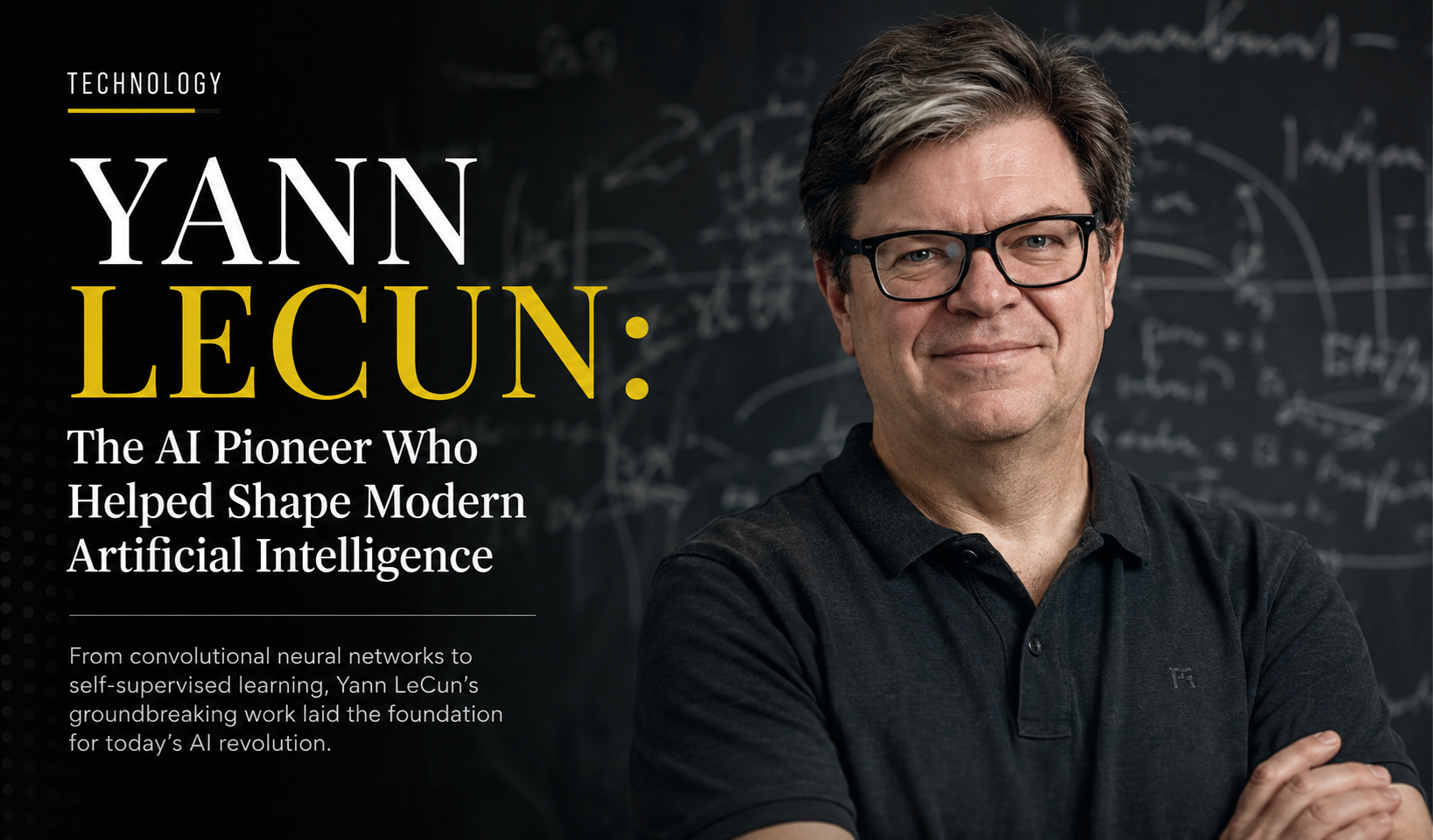
Who is Yann LeCun?
Yann LeCun is a French-American computer scientist widely recognized as one of the pioneers of modern artificial intelligence and deep learning. His research played a major role in developing convolutional neural networks, a technology that became fundamental to computer vision and image recognition.
LeCun has spent decades working at the intersection of machine learning, computer science, and intelligent systems. He is also known for his strong views about the future of AI, particularly the need to develop machines that can learn more efficiently from the world and understand it through observation and interaction.
Why is Yann LeCun important to artificial intelligence?
Yann LeCun is important because his research helped transform neural networks from a largely academic concept into practical technology.
One of his most influential contributions is the development and application of convolutional neural networks (CNNs). CNNs are designed to identify patterns in visual information. They became particularly successful in tasks such as recognizing objects, faces, handwriting, and other visual features.
His work demonstrated that neural networks could learn useful representations directly from data rather than relying entirely on manually designed rules.
This approach eventually became an important foundation for many modern AI applications.
What are convolutional neural networks?
Convolutional neural networks are machine-learning systems particularly suited to analyzing images and other structured data.
Instead of treating an image as a collection of unrelated pixels, CNNs learn patterns at different levels. Early layers can identify simple features such as edges, while deeper layers can recognize increasingly complex shapes and objects.
LeCun’s research helped establish CNNs as a powerful approach to machine learning. Their influence can now be seen in areas ranging from medical imaging and autonomous systems to smartphone photography and visual search.
What did Yann LeCun contribute to handwritten digit recognition?
One of LeCun’s best-known research achievements involved using neural networks to recognize handwritten numbers.
His work on the LeNet family of neural networks demonstrated how neural networks could process visual patterns effectively. The technology was used for practical applications including recognizing handwritten digits on checks and financial documents.
This was significant because it showed that neural-network research could solve real-world problems at scale.
The broader lesson was equally important: machines could automatically learn useful visual features instead of requiring engineers to explicitly program every recognition rule.
Where has Yann LeCun worked?
Yann LeCun has held major academic and industry positions throughout his career.
He has been associated with New York University, where he has worked as a professor and researcher. He also became a prominent figure at Meta, where he served as Chief AI Scientist and helped guide the company’s research efforts in artificial intelligence.
His career reflects the growing connection between universities, technology companies, and large-scale AI research laboratories.
What is Yann LeCun’s role at Meta?
At Meta, LeCun has been a leading voice in the company’s artificial intelligence research.
His work has included research into machine learning, computer vision, self-supervised learning, robotics, and approaches for building more capable intelligent systems.
Rather than focusing exclusively on scaling existing language models, LeCun has frequently argued that future AI systems will need additional capabilities, including better understanding of the physical world, reasoning, planning, and learning through interaction.
What does Yann LeCun think about large language models?
Yann LeCun has been one of the most outspoken critics of the idea that simply making large language models bigger will automatically lead to human-level intelligence.
He acknowledges the usefulness and importance of large language models but argues that they have significant limitations.
For example, language models primarily learn from text and other training data, while humans learn from many different forms of experience. Babies can observe their surroundings, interact with objects, experiment, and learn from relatively limited amounts of information.
LeCun believes future AI systems should develop richer forms of world understanding rather than depending primarily on predicting the next piece of language.
What is Yann LeCun’s vision for the future of AI?
LeCun’s vision centers on creating machines that can learn how the world works.
He has advocated research into world models, where AI systems develop internal representations of their surroundings and use those representations to predict outcomes, plan actions, and make decisions.
This could eventually allow AI systems to move beyond generating information and toward interacting intelligently with the physical and digital world.
His perspective places particular importance on learning through observation, reasoning, planning, and interaction.
What is self-supervised learning, and why does it matter?
Self-supervised learning allows AI systems to learn useful representations from large amounts of unlabeled data.
Traditional supervised learning often requires humans to label examples. That can be expensive and time-consuming.
Self-supervised methods can instead create learning signals from the data itself. This idea has become increasingly influential across AI research because enormous quantities of text, images, video, and other information are available without manually created labels.
LeCun has been a major advocate of self-supervised learning and has argued that it is an important pathway toward more capable AI systems.
Has Yann LeCun received major recognition?
Yes. Yann LeCun received the 2018 ACM A.M. Turing Award, jointly with Geoffrey Hinton and Yoshua Bengio.
The three researchers are often associated with the deep-learning revolution because their work helped establish neural networks as a powerful approach to modern machine learning.
The Turing Award is one of the highest honors in computer science, and the recognition reflected the enormous influence their research had on AI.
How does Yann LeCun differ from other AI pioneers?
LeCun shares many foundational ideas with researchers such as Geoffrey Hinton and Yoshua Bengio, particularly regarding the importance of neural networks and representation learning.
However, his views about the future direction of AI can be distinctive.
While some researchers place considerable emphasis on scaling language models, LeCun has argued that intelligence requires more than language prediction. He emphasizes learning about the physical world, building internal models, planning, and learning from diverse forms of experience.
This debate is important because it raises a fundamental question: What does an AI system actually need to become genuinely intelligent?
Why does Yann LeCun’s work matter today?
LeCun’s influence extends far beyond individual research papers.
The technologies associated with his work helped establish deep learning as a practical approach to computer vision and machine learning. Meanwhile, his current research interests contribute to ongoing discussions about what the next generation of AI should look like.
As AI becomes increasingly integrated into healthcare, robotics, transportation, business, entertainment, education, and scientific research, questions about how machines learn and understand the world are becoming more important.
LeCun’s career illustrates how foundational research can eventually become part of everyday technology.
What can we learn from Yann LeCun’s career?
Yann LeCun’s career offers several important lessons.
First, major technological breakthroughs can take decades to mature. Neural-network research existed long before today’s AI boom, but improvements in algorithms, computing power, and data eventually made these techniques highly effective.
Second, foundational research matters. Ideas that initially appear theoretical can become essential building blocks for future technologies.
Finally, AI development is still an open scientific challenge. Even as current systems become remarkably capable, researchers continue to debate how machines can achieve deeper reasoning, physical understanding, memory, planning, and general learning.
What is Yann LeCun’s legacy in AI?
Yann LeCun’s legacy is closely connected to the evolution of neural networks from experimental research into one of the most influential technologies in computer science.
His contributions to convolutional neural networks helped advance computer vision, while his continuing work on self-supervised learning and machine intelligence addresses some of the biggest unanswered questions in AI.
Also Read:-
Jeff Dean: Shaping Large-Scale Computing and the Future of AI
What Are the Best Startup Ideas for Entrepreneurs?
What Are the Top AI Businesses and Startups in California?