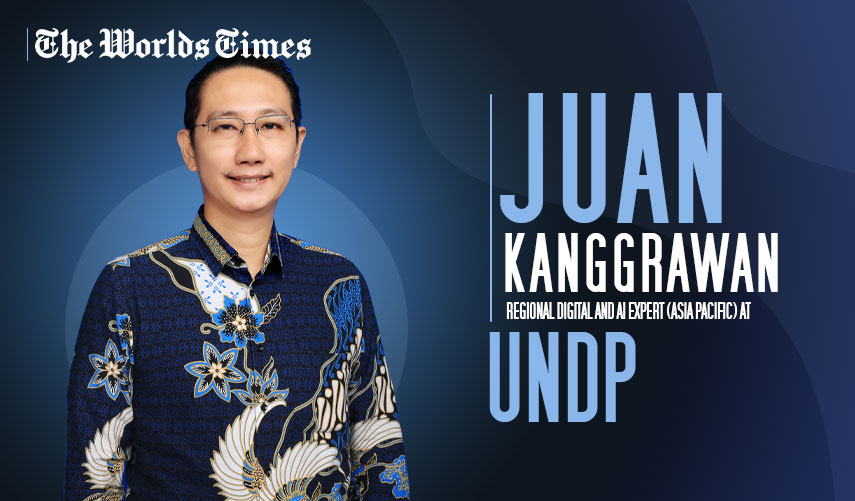
Juan Kanggrawan Interview
Digital transformation in government and enterprise rarely succeeds by technology alone. It requires leadership that understands policy, data, business, and people, and knows how to connect them into measurable impact.
Juan Kanggrawan is one of Indonesia’s most prominent digital and AI leaders, with more than fifteen years of experience across government, business, and technology. From leading national-scale digital platforms for tens of millions of users, to shaping AI strategy at ministerial and international levels, his work reflects a consistent focus on results, collaboration, and long-term value.
Currently serving as a Senior AI Expert and Taskforce Member at the Ministry of Communication and Digital Affairs, a Regional Digital and AI Expert for Asia-Pacific at the United Nations Development Programme (UNDP), and Chief of Digital and Business Operations at Gihon Telecommunication and Technology Group, Juan previously led Data and Digital Products at Jakarta Smart City and GovTech Indonesia from 2018 to 2024.
His career sits at the intersection of technology execution, public policy, and business strategy, making him a key voice in the future of digital government and AI-driven transformation.
Defining Impact Beyond Technology
Global Policy & Innovation Review: Juan, you’ve worked across government, enterprise, and international organizations. How do you personally define success in digital transformation?
Juan Kanggrawan replied, “Success is not about launching technology or following trends. It’s about whether decisions become better, faster, and more accountable because of what you build. In government especially, digital transformation must translate into real outcomes for citizens, better services, fairer distribution, and smarter policies.
Technology is only an enabler. The real success lies in aligning strategy, policy, data, and execution. If people’s lives are not improving, then no matter how advanced the system is, we haven’t truly succeeded.”
This principle has shaped Juan’s approach across both public and private sectors, where impact is measured by adoption, policy relevance, and long-term sustainability rather than short-term visibility.”
Delivering Digital Transformation at National Scale
During his tenure as Head of Data and Digital Products at Jakarta Smart City and GovTech Indonesia, Juan led one of Southeast Asia’s most ambitious public-sector digital portfolios.
Global Policy & Innovation Review: What were the biggest challenges in delivering digital platforms at that scale?
Juan Kanggrawan replied, “Scale exposes everything, strengths, weaknesses, and governance gaps. When you’re serving millions of users, you cannot afford fragmented systems or unclear ownership.
At Jakarta Smart City, we planned, built, and commercialized more than twenty digital products with over five million users. In education, we supported digital platforms reaching twenty thousand schools and around thirty million users nationwide. The challenge was not only technical, but organizational.
You have to ensure data integrity, policy alignment, operational readiness, and user trust, all at once. That’s why leadership in digital government must be cross-functional by design.”
His work directly influenced public service quality, KPI-based governance, social aid distribution, flood prediction systems, and COVID-19 vaccination and subsidy programs, demonstrating how data-driven platforms can reshape policy execution.”
How AI Moves from Hype to Strategic Capability
As a Senior AI Expert within Indonesia’s Ministry of Digital AI Taskforce, Juan has been deeply involved in shaping national AI direction.
Global Policy & Innovation Review: Many organizations rush into AI adoption. What separates meaningful AI transformation from hype?
Juan Kanggrawan replied, “AI becomes ineffective when it’s treated as a trend instead of a capability. Many organizations deploy AI without clear use cases, success metrics, or organizational readiness.
What we did at the ministry level was to develop an AI blueprint and roadmap that focuses on strategic sectors, agriculture, logistics, banking, manufacturing, where AI can create real economic and social value.
The future of AI is results-oriented. It must be embedded into core processes, not isolated in technical teams. Non-technical departments must understand, adopt, and co-own AI implementation. That’s when transformation truly happens.”
This approach ensures AI becomes a strategic investment, not an experimental side project.”
Breaking Silos Between Business, Policy, and Technology
Juan’s leadership spans strategy, product, data, engineering, economics, policy, marketing, and operations, a deliberate structure designed to eliminate silos.
Global Policy & Innovation Review: How do you practically bridge business, policy, and technology at scale?
Juan Kanggrawan replied, “Silos are common everywhere, in governments, conglomerates, even global organizations. My role is to make collaboration unavoidable and productive.
I usually start with executable pilot initiatives that can be delivered in three to four months. Once people see tangible impact, resistance disappears. Data teams inform strategy, policy enables products, products shape operations, and feedback loops improve decisions.
Digital transformation is not about hierarchy. It’s about orchestration. When teams see how their contributions complement one another, momentum builds naturally.”
This pragmatic approach has allowed Juan to scale initiatives from pilot stages to enterprise-wide and national-level adoption.”
The Future of AI-Driven Government and Enterprises
In addition to his national roles, Juan now contributes at a regional level as UNDP’s Digital and AI Expert for Asia-Pacific, advising governments on inclusive and sustainable digital transformation.
Global Policy & Innovation Review: Looking ahead, what will define successful digital governments and enterprises?
Juan Kanggrawan replied, “The future belongs to organizations that treat AI and data as foundational capabilities, not optional tools. Successful governments and enterprises will redesign their entire processes, decision-making, service delivery, accountability, around data and AI.
Importantly, this transformation must be human-centered. Technology should empower civil servants, business leaders, and citizens, not replace judgment or responsibility.
Those who succeed will be the ones who combine long-term vision, policy clarity, business realism, and technical excellence.”
A Leadership Philosophy Rooted in Impact
Beyond his formal roles, Juan is an active contributor to talent development, academic research, journal editorial work, and public discourse, driven by a deep commitment to learning and knowledge-sharing.
Across all his work, one theme remains consistent:
Digital transformation is not about systems. It is about decisions, responsibility, and measurable impact.
In an era where AI and digitalization move faster than institutions, Juan Kanggrawan’s leadership offers a grounded, results-driven blueprint for governments and enterprises navigating the future.
Connect with Mr. Juan:
https://www.linkedin.com/in/juan-kanggrawan-78ab755a/
To learn more:
https://www.undp.org/digital
Also Read:
Cindy Murray: Bridging Public-Sector Leadership
Daouda Diabatè: Ambassador of “Abedical
Michel Wichman Excellence in Alpine Hospitality