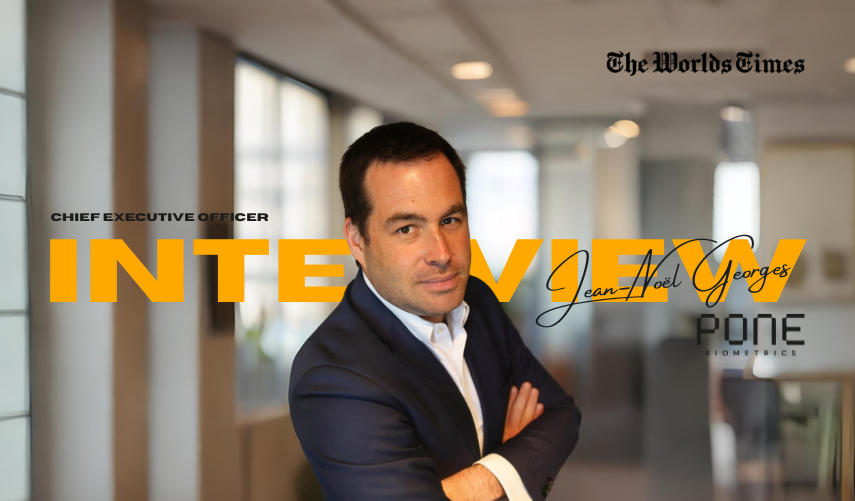
Jean-Noël Georges Interview
Jean-Noël’s career reflects a clear mission: strengthening digital trust in an increasingly connected world. Drawing from deep experience in fintech, cybersecurity, and digital identity, he emphasizes that security is ultimately about protecting people, not just systems. As CEO of PONE Biometrics, he advocates for privacy-preserving, hardware-backed, and passwordless authentication that balances usability with robust protection. His work with global institutions, regulators, and governments highlights a leadership approach grounded in ecosystem collaboration, regulatory alignment, and ethical innovation positioning European cybersecurity solutions as key contributors to global digital resilience.
From Fintech to Cybersecurity
We started the interview by asking, “Jean-Noël, what inspired you to dedicate your career to cybersecurity, digital identity, and fintech?”
Jean-Noël Georges replied, “My interest in cybersecurity and digital identity emerged naturally from my early work in fintech and digital payments. I saw first-hand how digital services were scaling faster than trust mechanisms. As systems became more connected, identity became the weakest link, whether through passwords, social engineering, or poorly protected credentials.
What truly motivated me was realizing that cybersecurity is not only about protecting systems, but about protecting people. Digital identity determines who can access services, move money, vote, or receive healthcare. When identity fails, trust collapses. That realization pushed me to focus on building secure, user-centric authentication models that combine strong security with simplicity and respect for privacy.”
Biometrics as the Foundation of Passwordless Authentication
The Worlds Times: As CEO of PONE Biometrics, how do you see biometric security reshaping authentication?
Jean-Noël Georges replied, “Biometric security is fundamentally changing authentication by shifting it from what users know to who they are, but the real transformation happens when biometrics are combined with cryptographic hardware and local verification.
At PONE Biometrics, we do not see biometrics as a magic solution on their own. Fingerprints or facial recognition only make sense when biometric matching happens locally, and credentials never leave a secure element. That is the philosophy behind OFFPAD. Authentication is phishing-resistant, fully passwordless, and privacy-preserving by design.
The future of authentication is about reducing friction while increasing security. Biometrics, when implemented responsibly, allow users to authenticate faster, with fewer errors, and far less exposure to fraud. That balance between usability and security is what will drive mass adoption.”
Lessons from Global Collaboration
The Worlds Times: You’ve worked with global leaders such as Visa, Mastercard, and Thales. What lessons have these collaborations taught you?
Jean-Noël Georges replied, “Working with global organizations like Visa, Mastercard, and Thales taught me the importance of ecosystem thinking. No company, regardless of size, can solve cybersecurity challenges alone. Interoperability, standards, and partnerships are essential.
Another key lesson is adaptability. Regulatory frameworks, user expectations, and risk models vary widely across regions. A solution that works in Europe may require adjustments in Africa or Asia. Finally, innovation only matters if it reaches the market. Technology must be paired with strong execution, education, and go-to-market discipline.
These experiences shaped my leadership approach. I focus on alignment between technology, regulation, and business reality.”
Turning Regulation into a Catalyst for Innovation
The Worlds Times: How do you balance innovation with regulation in sensitive areas like cybersecurity and digital identity?
Jean-Noël Georges replied, “I see regulation as a structural advantage rather than a constraint. In cybersecurity, trust is everything, and regulation provides the foundation for that trust. Frameworks like GDPR, NIS2, or eIDAS define clear expectations around privacy, accountability, and security.
At PONE Biometrics, we design products that anticipate regulatory requirements instead of reacting to them. This approach allows us to innovate faster in the long run because we are building solutions that institutions and governments can deploy at scale.
The key is early dialogue with regulators and a deep understanding of their objectives. When technology aligns with policy goals, adoption becomes much smoother and more sustainable.”
Government Responsibility
The Worlds Times: You have advised European governments on national digital strategies. What role do governments play in secure digital infrastructures?
Jean-Noël Georges replied, “Governments play a critical role because they set the standards that enable trust across society. Digital identity and cybersecurity are not just technical topics; they are matters of sovereignty, economic resilience, and citizen protection.
When advising governments, I emphasize that secure digital identity is an enabler. It allows citizens to access public services, healthcare, banking, and education securely and efficiently. However, success depends on balance. Systems must be secure, easy to use, and inclusive.
Governments also act as ecosystem orchestrators, bringing together private companies, regulators, and international partners. The most successful strategies are those that combine long-term vision with pragmatic implementation.”
Navigating Complexity and Opportunity
The Worlds Times: What do you see as the biggest challenges and opportunities in cybersecurity over the next decade?
Jean-Noël Georges replied, “The biggest challenge will be complexity. Digital identities are multiplying across devices, platforms, and services, while attackers increasingly use automation and artificial intelligence. Legacy authentication models based on passwords and centralized credentials are no longer fit for purpose.
At the same time, this creates a significant opportunity. Passwordless authentication, hardware-backed identity, and decentralized trust models can dramatically reduce fraud while improving user experience. There is also a growing demand for European-built security solutions that align with local values around privacy and data protection.
Organizations that can simplify security without weakening it will define the next decade.”
Scaling Trust in a Deep-Tech Security Company
The Worlds Times: What are the main challenges of scaling a deep-tech cybersecurity company like PONE Biometrics?
Jean-Noël Georges replied, “Scaling a cybersecurity company is not only a technical challenge, it is a trust challenge. Customers are cautious by nature, especially when security protects critical assets. Building credibility takes time, certifications, partnerships, and consistent delivery.
Another challenge is balancing speed and robustness. Deep-tech products require rigorous testing and long development cycles, while markets often expect fast results. As a CEO, my role is to align teams around clear priorities, ensure disciplined execution, and maintain financial and operational resilience.
Scaling successfully means transforming innovation into repeatable, deployable solutions without compromising security.”
Leadership Built on Clarity, Ethics, and Execution
The Worlds Times: What leadership philosophy guides you as you drive growth and transformation?
Jean-Noël Georges replied, “My leadership philosophy is based on clarity, trust, and execution. Teams perform best when they understand the vision, feel empowered to act, and know that accountability is shared.
In cybersecurity, ethics and transparency are non-negotiable. I encourage open dialogue, fast learning, and pragmatic decision-making. Transformation does not come from ambition alone, but from consistent execution and the ability to adapt when conditions change.
Ultimately, leadership is about aligning people, technology, and purpose. When those elements are aligned, sustainable growth follows.”
Europe’s Strategic Role
Lastly we asked, “Finally, how do you see the role of European cybersecurity companies in the global landscape?”
“European cybersecurity companies have a unique role to play. Europe combines strong regulatory frameworks, deep technical expertise, and a cultural focus on privacy and user rights. These values are increasingly relevant globally.
I believe European companies can become trusted global partners by offering secure, compliant, and user-centric solutions. At PONE Biometrics, our ambition is to contribute to that ecosystem by delivering authentication technologies that strengthen digital trust worldwide.” Jean-Noël Georges concluded
Connect with Jean-Noël Georges on LinkedIn
For more information visit PONE Biometrics
Also Read:
Sheba Simpson-Amsterdam: Empowering Communities with Purpose
William Westbrook: Tech-Driven Global Trade Innovation
Tom Larsen on Eloro’s polymetallic growth strategy