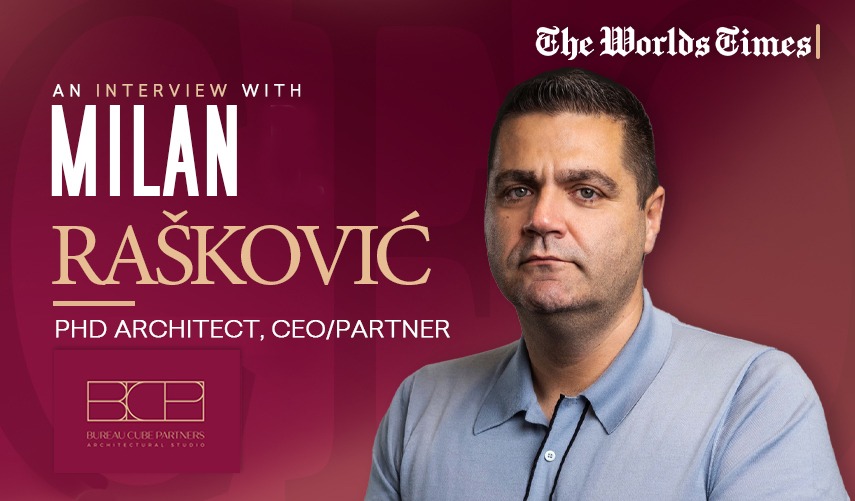
Milan RAŠKOVIĆ Interview
Milan RAŠKOVIĆ is the founder and principal architect of Bureau Cube Partners, an architectural practice established in 2009 and recognized for its multidisciplinary structure, contextual intelligence, and strong design authorship. From the very beginning, his approach has positioned architecture not simply as the creation of buildings, but as a cultural act and civic responsibility, one that must respond thoughtfully to history, urban complexity, and contemporary social needs.
Under his leadership, Bureau Cube Partners has developed into a highly skilled team of licensed architects and engineers capable of delivering projects across diverse typologies, from cultural institutions and public buildings to residential developments and large-scale urban strategies. Rašković’s work is defined by conceptual precision, innovation under real-world constraints, and rigorous technical execution. The ambition is clear: to create architecture that shapes identity, preserves collective memory, and contributes meaningfully to the evolving life of cities.
Architecture as Cultural Strategy
We began the conversation by asking: “You’ve led Bureau Cube Partners since its founding in 2009. How has your vision shaped the firm’s evolution, and what core principles define your architectural approach?”
Milan RAŠKOVIĆ responded: “Since founding Bureau Cube Partners in 2009, my intention has been to frame architecture as both cultural responsibility and strategic practice. From the outset, the studio was conceived not merely as a design office, but as an integrated platform where concept, urban narrative, engineering logic, and construction precision develop together. Architecture, in our view, must operate as a meaningful civic artifact, not as a purely formal exercise.
Over time, this philosophy shaped the firm into a research-oriented and context-sensitive practice. Every project is understood as part of a broader spatial and historical continuum. Whether we are designing housing, public institutions, or cultural buildings, the goal is never to erase what exists, but to reinterpret identity through a contemporary architectural language. Respect for place, clarity of concept, and intelligent problem-solving under real constraints remain the foundation of our work.
This approach has allowed Bureau Cube Partners to grow into a professional team capable of operating both locally and internationally while maintaining strong authorship and professional integrity. By combining tradition with advanced methodologies and strategic thinking with technical rigor, we aim to deliver projects that outlast trends. Our ambition is to create architecture that contributes to the city, communicates values, and actively participates in shaping collective memory and future urban identity.”
A Global Collaboration That Defined a Philosophy
The Worlds Times: Bureau Cube Partners has collaborated with globally recognized firms. Can you highlight a project that best represents your design philosophy and share the key lessons from it?
Milan RAŠKOVIĆ replied: “One of the projects that most clearly reflects our design philosophy is our collaboration with Zaha Hadid Architects on the Nikola Tesla Museum in Belgrade, developed through an international competition. This project represents more than an architectural proposal; it demonstrates how we approach architecture as dialogue between history and future ambition, between local identity and universal values, and between conceptual vision and technical precision.
The project required architecture to function simultaneously as a space of memory, an educational platform, and a forward-looking cultural landmark. The collaboration itself was based on genuine intellectual exchange. It showed how contemporary design language can reinterpret industrial heritage without diminishing its identity, transforming it into a new spatial narrative aligned with Tesla’s visionary spirit.
The same principles apply to projects of a more intimate scale. The Kings Villa residential development reflects our approach to careful mediation between landscape, historical context, and contemporary living standards. Rather than imposing form, the design emerges from topography, views, and the character of the surrounding neighborhood. Sustainability here is achieved through proportion, material integrity, and long-term livability rather than technological spectacle.
The most important lesson from these experiences was the value of dialogue between local expertise and global perspective, between ambition and constraint, and between different professional cultures. The strongest architecture emerges when local specificity and international discourse are not treated as opposites, but as complementary forces.”
Urban Habitat and Global Standards
The Worlds Times: You were selected as a juror for the CTBUH Annual Awards in the Urban Habitat category. How do global standards for urbanism and tall buildings influence your work?
Milan RAŠKOVIĆ responded:“Serving as a juror for the CTBUH Annual Awards in the Urban Habitat category offered valuable insight into how global standards for dense cities and tall buildings are evolving. Today, urban quality is no longer defined solely by height or iconic presence. It is defined by how architecture contributes to human experience through social connectivity, environmental responsibility, inclusivity, and long-term adaptability.
This perspective reinforces our belief that architecture must be understood as part of a larger urban ecosystem. Global principles such as mixed-use integration, climate-responsive design, public realm activation, and ecological balance inform our evaluation of every project, regardless of scale.
At Bureau Cube Partners, even when working on complex urban developments or high-density structures, the central question remains the same: How does this project support everyday life? How does it strengthen the relationship between the built environment and its social and natural context?
Engaging with global urban discourse sharpens our ability to translate international benchmarks into locally grounded solutions. Standards should function as frameworks, not formulas. Architecture must remain contextual, responsible, and human-centered.”
Innovation and Sustainability in Heritage Architecture
The Worlds Times: Architecture today faces growing challenges, from sustainability to complex urban dynamics. How do you integrate innovation and sustainability into your practice, especially in public or heritage projects?
Milan RAŠKOVIĆ replied: “Innovation and sustainability are not additions introduced at the end of the design process. They are foundational principles embedded from the first sketch. Every project begins with rigorous contextual research including climate, urban morphology, cultural layers, construction logic, and patterns of long-term use. Sustainable strategies must grow from place rather than be imposed through standard solutions.
Heritage and public projects are particularly demanding because they operate simultaneously within history, present-day functionality, and future resilience. In the restoration and adaptive reuse of the Palace of the Serbian Academy of Sciences and Arts, the process required close collaboration between architects, engineers, conservators, and public institutions. The goal was not simply preservation, but reinterpretation, ensuring that historical architecture remains relevant through technical upgrades and environmental improvements.
Similarly, the revitalization of the historic Hotel Bristol in Belgrade required balancing strict conservation principles with contemporary hospitality standards. Adaptive reuse became the primary sustainable strategy. Structural rehabilitation, energy performance improvement, and careful integration of modern systems allowed the building to evolve while preserving its identity and collective memory.
In projects located within sensitive historical contexts, innovation often lies in restraint. A residential and commercial building in Cara Dušana Street demonstrates how contextual integration through proportion, material articulation, and mixed-use programming can strengthen urban vitality without competing with history.
For us, sustainability extends beyond environmental metrics. It includes cultural continuity, urban regeneration, and long-term adaptability. True sustainability means creating architecture capable of enduring socially, culturally, and technologically over time.”
The Future of Bureau Cube Partners
The Worlds Times: Looking ahead, what goals and trends are shaping your architectural journey and the future of Bureau Cube Partners?
Milan RAŠKOVIĆ replied: “Looking forward, my work continues to explore how architecture can operate meaningfully within layered and often challenging contexts where innovation, sustainability, and social responsibility must be addressed simultaneously. My academic research and professional practice remain closely connected, allowing theoretical investigations to inform built outcomes, particularly in cities undergoing rapid transformation.
For Bureau Cube Partners, the future lies in strengthening international collaborations while expanding our engagement in urban regeneration, infrastructure-related architecture, and climate-responsive design. These fields demand integrated thinking and recognize cities as interconnected social and environmental systems.
At the same time, we remain committed to working across scales from strategic urban frameworks to highly detailed architectural interventions. Our ambition is to create architecture that is resilient and forward-looking, yet firmly rooted in cultural identity.
Ultimately, we aim to contribute projects that foster human connection, support environmental responsibility, and uphold architectural integrity. Architecture should not merely respond to present demands; it should help shape more inclusive, thoughtful, and sustainable urban futures.”
Conclusion
With a strong commitment to cultural continuity, technical excellence, and responsible urban innovation, Milan RAŠKOVIĆ continues to position Bureau Cube Partners as a practice where architecture becomes more than design, it becomes strategy, memory, and vision. From heritage restorations to global collaborations, his work reflects the conviction that architecture must not only serve functional needs, but also elevate the civic and emotional experience of the city.
Connect with Milan RAŠKOVIĆ on LinkedIn
Also Read:
Zarine Manchanda: Compassion in Action
Octavio Díaz: Leadership Beyond Results
Jean-Noël Georges Building Digital Trust