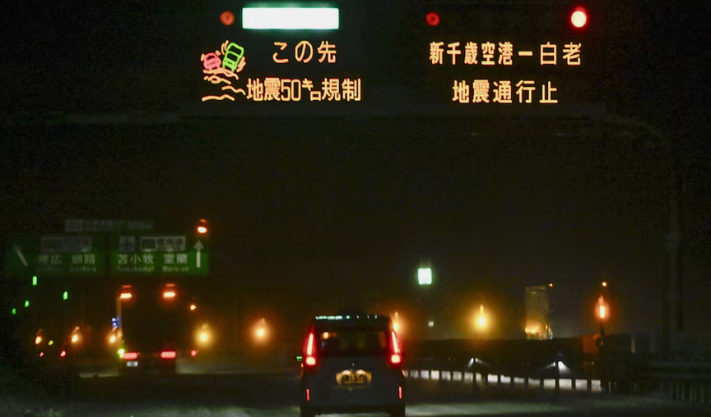
Japan lifted tsunami warnings on Tuesday after a strong 7.5-magnitude earthquake hit the northeastern part of the country. At least 30 people were injured, and around 90,000 residents had to leave their homes.
The earthquake happened off the coast at 11:15 p.m. on Monday. The Japan Meteorological Agency (JMA) initially warned that a tsunami up to 3 metres (10 feet) high could hit the northeastern coast. Warnings were given for Hokkaido, Aomori, and Iwate prefectures. Small tsunamis of 20 to 70 cm (7 to 27 inches) were recorded at several ports.
By early Tuesday, the JMA lowered the warnings to advisories and later removed them entirely. No major damage was reported. The quake’s epicentre was 80 km (50 miles) off the coast of Aomori prefecture at a depth of 54 km. In Hachinohe city, Aomori, the quake was so strong that people could not stand and had to crawl to move.
Prime Minister Sanae Takaichi said, “So far, 30 people are injured, and there has been one fire.”
East Japan Railway temporarily stopped some train services in the affected area, which was also hit by a 9.0-magnitude quake in 2011. Other trains in northern Japan faced delays.
After the quake, the JMA issued an advisory for a wide area from Hokkaido to Chiba prefecture, asking residents to stay alert as another strong earthquake could happen within a week.
“There is a chance that stronger earthquakes may occur in the next few days,” a JMA official said.
No problems were reported at nearby nuclear power plants run by Tohoku Electric Power and Hokkaido Electric Power. Thousands of homes lost power after the quake, but electricity was restored by Tuesday morning.
The yen weakened briefly against the dollar and euro after the quake.
バイクは無事でよかった
バイク「は」!我が家は津波警報が出る前に4つの水槽が大津波よ
右水槽見てわかるけど地震起きても寝ること優先で陰に行くから
ナマズが暴れたら地震来るは嘘 pic.twitter.com/01rTdPqpz8— Rじゃない方のらいだー (@not_Rrider) December 8, 2025
Japan is one of the most earthquake-prone countries in the world, with tremors happening at least every five minutes. It sits in the Pacific “Ring of Fire,” which causes about 20% of the world’s earthquakes of magnitude 6.0 or higher.
The northeastern region was badly hit before, on March 11, 2011, when a 9.0-magnitude quake caused a massive tsunami and killed nearly 20,000 people. That disaster also damaged the Fukushima Daiichi nuclear plant, causing explosions and meltdowns.
【八戸市 地震の瞬間】
激しく音をたて揺れるABA青森朝日放送・八戸支社の様子▼【最新情報】速報中https://t.co/wee4B6NLRV pic.twitter.com/TulEO3ZmJy
— テレ朝NEWS (@tv_asahi_news) December 8, 2025
Since then, Japan has improved its warning system. Now, whenever a significant quake hits the region, the government issues a one-week “megaquake” advisory.
Published: 9th December 2025
For more such articles, please follow us on Twitter, Linkedin & Instagram
Also Read:
How to Get Your Company Featured in Top Business Directories
Boost LinkedIn impact with smart language edits
YouTube Says Australia’s Social Media Ban Will Make Kids Less Safe