Rajani Kumari Vaddepalli Interview
Rajani Kumari Vaddepalli, Senior Data Engineer at Callaway Golf, USA, is redefining how organizations harness data as a strategic asset. A visionary at the intersection of AI, data engineering, and business transformation, Rajani has built a global reputation as both a hands-on innovator and a thought leader. In this exclusive feature, she shares insights into her journey, philosophy, and the future of data-driven enterprises.
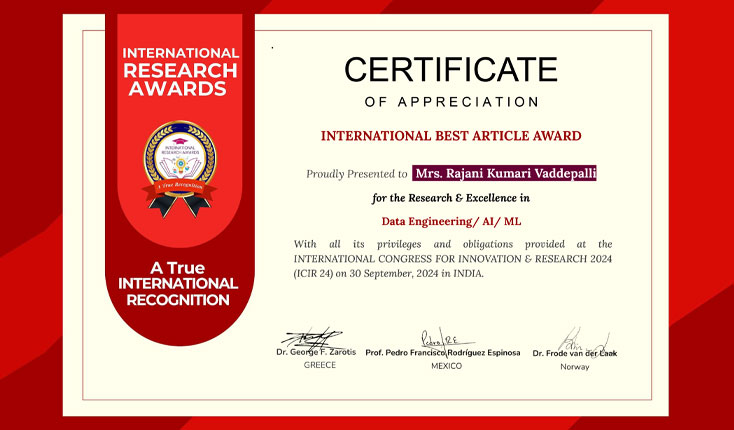
Award Recognition – Recipient of the ‘International Best Article Award 2024’ for Research & Excellence in Data Engineering, AI, and ML.
1. What inspired you to pursue a career in data engineering and AI?
Rajani Kumari: “My fascination with data began early, but what truly inspired me was the realization that data is not just numbers, it is the foundation of strategic decision-making. Over time, I saw how organizations struggled with fragmented systems and underutilized insights. That challenge motivated me to architect solutions that bridge deep technical engineering with business impact.
For me, the turning point came when I worked on large-scale data platforms capable of processing billions of records in real time. I realized then that with the right architecture, data could move from being a passive asset to becoming an active driver of transformation. That is what keeps me energized every day.”
2. You have led enterprise-scale AI and data initiatives. What do you consider your most impactful achievement?
Rajani Kumari: “One of the most rewarding projects I led was implementing a data mesh framework for a global enterprise. Traditionally, organizations relied on centralized systems that created bottlenecks. We flipped that model by decentralizing ownership, empowering business units to manage and scale their own data domains while still maintaining governance.
This architecture not only improved agility but also unlocked innovation at scale. In parallel, I have worked on optimizing neural architecture search to accelerate AI model deployment. By blending cutting-edge research with applied engineering, we achieved significant cost reductions while increasing system performance. That balance of innovation and business value is what I consider my proudest achievement.”
3. You’re also a keynote speaker. How do you simplify complex AI topics for diverse audiences?
Rajani Kumari: “Storytelling is key. Whether I am speaking to technical engineers or C-suite executives, I ground complex AI concepts in real-world use cases. For instance, when explaining streaming analytics, I do not start with algorithms, I start with a business scenario, like how real-time insights can optimize supply chains or personalize customer experiences.
From there, I connect the technical dots such as cloud architectures, data pipelines, and governance models so the audience sees both the why and the how. My goal is always to empower people with actionable knowledge they can take back to their organizations.”
4. Ethical AI and governance are hot topics. How do you approach building responsible AI systems?
Rajani Kumari: “Ethical AI is not optional, it is foundational. Every AI system should be built with fairness, transparency, and accountability at its core. I advocate for embedding responsible AI governance right into the design phase, not as an afterthought.
Practically, this means creating frameworks that audit models for bias, ensuring explainability, and involving multidisciplinary teams including ethicists and domain experts in the process. Beyond compliance, it is about trust. When businesses adopt AI responsibly, they not only mitigate risks but also strengthen their brand reputation and customer loyalty.”
5. Looking ahead, what do you see as the future of enterprise data engineering and AI?
Rajani Kumari: “The future lies in scalable, decentralized, and intelligent data ecosystems. I believe data mesh architectures, combined with advances in generative AI and cloud-native platforms, will reshape how enterprises innovate.
We are moving toward a world where organizations will not just react to data, they will anticipate outcomes in real time. Imagine AI systems that self-optimize pipelines, predict bottlenecks before they occur, and surface insights proactively for decision-makers.
But equally important is ethical scaling, ensuring that as we accelerate AI adoption, we do so responsibly. The future belongs to enterprises that treat data not just as a technical challenge but as a strategic, ethical, and human-centric opportunity.”
Closing Note
Rajani Kumari is not just building data systems, she is shaping the future of enterprise AI. From pioneering scalable architectures to championing ethical governance, she exemplifies how visionary leadership can transform organizations in the AI-driven era.
Connect with Rajani on LinkedIn
Also Read:
Prof. Ir. Dr. Arkam C. Munaaim: Shaping Future Engineers
Dr.Kursat Sahin Yildirimer, Academic Journey & Insights
Frances Harder: Empowering Fashion Entrepreneurs Globally