Margit Olle Interview
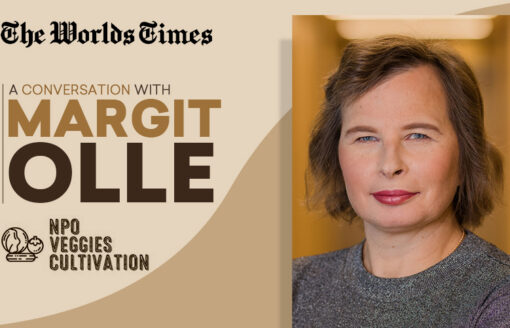
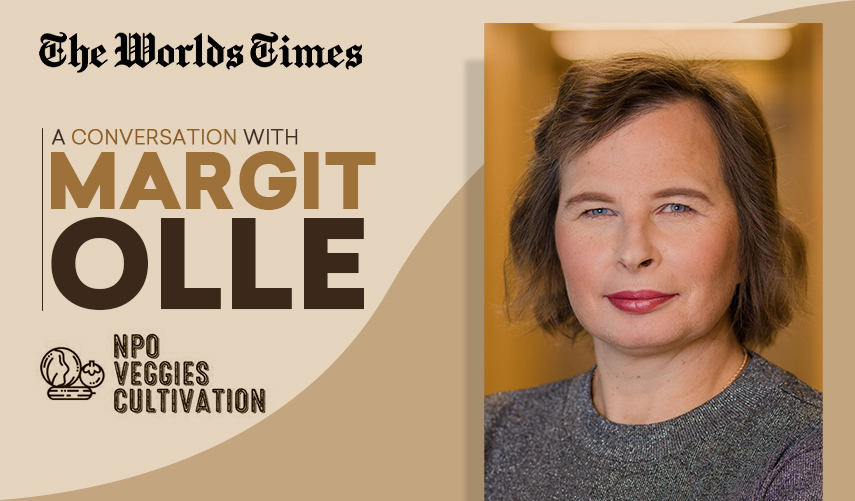
Margit Olle is a distinguished researcher in vegetable crop science and the driving force behind NPO Veggies Cultivation, an initiative dedicated to advancing sustainable agricultural practices through scientific innovation. Her work bridges the gap between plant physiology, environmental control, and practical farming applications, positioning her as a leading voice in modern horticultural science.
With a strong academic foundation and international research experience, Olle has focused extensively on understanding plant nutrient dynamics, particularly calcium uptake, and how environmental factors influence crop quality. Her approach goes beyond traditional cultivation methods, emphasizing predictive models, controlled environment agriculture, and ecological balance.
Under her leadership, NPO Veggies Cultivation has become a platform for research-driven solutions that support farmers, greenhouse growers, and vertical farming systems worldwide. Her mission is clear: to improve crop health, enhance food quality, and promote sustainable farming practices that align with the future of global agriculture.
A Scientific Journey Rooted in Sustainability
We began the conversation by asking: “What inspired your journey into vegetable research and sustainable cultivation, and how has that shaped your work today?”
Margit Olle responded:
“My journey into agricultural science began with a deep curiosity about how plant physiology influences both yield and quality. Early in my research, I recognized that many of the challenges faced by growers are not simply about inputs, but about understanding how plants interact with their environment.
This realization shaped my focus on vegetable crops, where precision in cultivation can significantly impact outcomes. At NPO Veggies Cultivation, my work is centered on developing scientifically grounded methods that farmers can apply in real conditions. Sustainability is not an abstract goal for me; it is a practical necessity.
By combining research with application, I aim to create cultivation systems that reduce dependency on chemical inputs while improving plant health and productivity. This balance between science and practice continues to define my approach.”
Understanding Calcium Deficiency as a Core Agricultural Challenge
The Worlds Times: Calcium deficiency remains a major issue in vegetable production. Why is it so complex, and how does your research address it?
Margit Olle replied:
“Calcium deficiency is one of the most critical and misunderstood challenges in vegetable cultivation. It is not always caused by a lack of calcium in the growing medium, but rather by the plant’s ability to absorb it under varying environmental conditions.
Factors such as temperature, humidity, and light intensity directly influence calcium movement within the plant. When these conditions are not optimized, physiological disorders can develop, significantly reducing crop quality and market value.
My research focuses on identifying these environmental triggers and developing predictive models that help growers prevent deficiencies before they occur.
Instead of reacting to visible symptoms, we aim to manage the conditions that cause them.
This shift from reactive to preventive cultivation is essential for improving consistency, reducing losses, and ensuring high-quality vegetable production.”
Environmental Control as a Tool for Crop Optimization
The Worlds Times: Your research highlights the role of environmental factors in plant health. What are your most impactful findings in this area?
Margit Olle responded:
“One of the most important discoveries in my work is the extent to which environmental control can influence nutrient uptake, particularly calcium. By adjusting light spectrum, temperature regimes, and humidity levels, we can significantly improve plant health and reduce physiological disorders.
For example, specific lighting strategies and temperature differences between day and night can enhance calcium distribution within the plant. These adjustments may seem subtle, but their impact on crop quality is substantial.
In addition, I have explored the use of beneficial microorganisms and elements like silicon to strengthen plant structure and resilience. These approaches contribute to a more balanced and sustainable cultivation system.
The key takeaway is that innovation in agriculture does not always require more inputs. Often, it requires a deeper understanding of how plants respond to their environment and using that knowledge to optimize conditions.”
Shaping the Future of Controlled Environment Agriculture
The Worlds Times: How does your work contribute to greenhouse systems and the rapidly growing field of vertical farming?
Margit Olle replied:
“Controlled environment agriculture offers a unique opportunity to apply scientific precision to crop production. In greenhouse and vertical farming systems, we have the ability to regulate all key growth factors, which allows us to implement optimized cultivation models.
My research provides growers with strategies to fine-tune environmental conditions in ways that improve nutrient uptake, prevent disorders, and increase overall efficiency. This is particularly important in vertical farming, where production systems are highly intensive and sensitive to imbalance.
By applying these models, growers can achieve more consistent yields, better product quality, and longer shelf life. At the same time, resource use becomes more efficient, supporting the economic and environmental sustainability of these systems.
The future of agriculture will rely heavily on such controlled systems, and scientific research must play a central role in guiding their development.”
A Vision for Sustainable Global Food Systems
The Worlds Times: Looking ahead, what is your long-term vision for vegetable cultivation and sustainable agriculture worldwide?
Margit Olle responded:
“My long-term vision is to create a global agricultural system where productivity and sustainability are not in conflict, but fully aligned. This requires a shift in how we approach cultivation, moving from input-heavy practices to knowledge-driven systems.
Education and knowledge transfer are essential components of this vision. Farmers, researchers, and industry professionals must have access to practical, science-based solutions that can be adapted to different environments.
I also believe that collaboration across disciplines and regions will be key to addressing future challenges. Agriculture is not only about food production; it is about environmental stewardship, resource management, and human well-being.
Ultimately, my goal is to contribute to a system where high-quality vegetables are produced efficiently, sustainably, and in harmony with natural processes.”
Conclusion
Through her research-driven approach and commitment to sustainable innovation, Margit Olle continues to redefine the future of vegetable cultivation. Her work demonstrates that the key to modern agriculture lies not in increasing inputs, but in advancing understanding.
By integrating plant physiology, environmental precision, and practical farming solutions, she is helping shape a more resilient and sustainable food system. From addressing calcium deficiency to optimizing controlled environment agriculture, her contributions reflect a broader vision where science and sustainability work hand in hand.
As global agriculture faces increasing challenges, Margit Olle’s work stands as a testament to the power of knowledge, innovation, and responsibility in building the future of food.
To learn more:
https://www.npoveggiescultivation.com
Also Read:
Jay Meyer on Technology, Trust, and Inclusive Growth
Eduardo Miguel Ego-Aguirre on Leadership and Human Finance
Dr. Akintoye Akindele Building Enduring Institutions