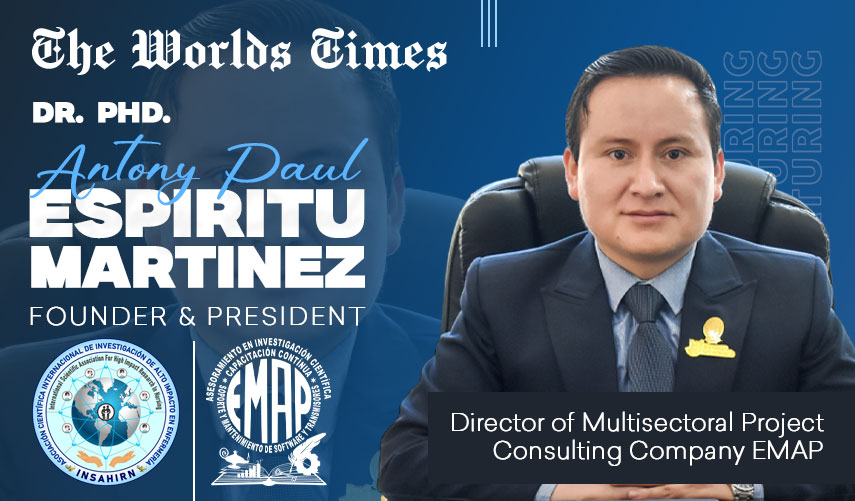
Dr. Antony Paul Espiritu Martinez Interview
Dr. PhD. Antony Paul Espiritu Martinez comes from the Beautiful Pearl of the Andes – Tarma / Peru, a nationally and internationally renowned RENACYT researcher, entrepreneur and writer. Professor of undergraduate and graduate studies with an outstanding participation in foreign universities. In the interview with The World Times, Dr. Antony is pleased to share his aspirations and fundamental knowledge about the wide world of high-impact scientific research, as well as his involvement in the public and private business sector, as well as the impact of his remarkable academic career and work both nationally and internationally.
Based on a mission to reduce gaps in public health
We began the interview by asking, “What inspired your deep commitment to high-impact scientific research nationally and internationally?”
Dr. Antony Paul Espiritu Martínez responded: “My commitment to high-impact multidisciplinary scientific research was born from a deep convergence between human experience, professional vocation and an ethical conviction forged from my early years of clinical training. Having accompanied people in situations of extreme vulnerability revealed to me that science only transcends when it dialogues with social reality and transforms lives, and that health sciences and pedagogy are humanistic disciplines that can lead this transformation if they are articulated with public health, management, technology, education and critical thinking. Throughout my career, I understood that complex problems require multiple perspectives and that scientific production, when built on rigor, sensitivity, and international collaboration, has the power to broaden horizons, democratize knowledge, and open opportunities for historically neglected populations. That purpose, which is to generate knowledge that not only describes, but acts, questions, connects and transforms, is the engine that sustains my dedication to high-impact research in national and international scenarios.”
Promoting ethics in an AI-driven academic world
The Worlds Times: As a leading researcher nationally and internationally, how do you promote a culture of responsible and ethical research while artificial intelligence is immersed in university education?
Dr. Antony Paul Espiritu Martínez responded: “Fostering a culture of responsible and ethical research in a scenario where artificial intelligence is increasingly integrated into university education requires leadership that combines humanistic vision, methodological rigor and a deep understanding of contemporary techno-scientific transformations. From my experience, I promote this commitment by training researchers capable of recognizing that AI does not replace human intelligence, but rather enhances its analytical capacity when used critically, transparently, and with respect for academic integrity. This involves teaching students how to validate sources, understand algorithms, identify biases, protect data confidentiality, and, above all, prioritize intellectual creativity over simple automation. Likewise, I promote ethical reflection as a transversal axis of any training process, remembering that all technological tools must be subordinated to human well-being, scientific justice and positive social impact. In this way, AI does not become a shortcut, but a catalyst for building authentic, responsible and transformative knowledge, in line with the national and international demands of contemporary research.”
Quality university education from mixed research approaches in the framework of neuroeducation
The Worlds Times: As a researcher internationally recognized for his experience leading scientific associations and his approach to qualitative and mixed research. How do you interpret theory and practice from the applicability of neuroeducation?
Dr. Antony Paul Espiritu Martinez responded: “From my perspective, neuroeducation offers an integrative framework that allows us to interpret theory and practice as two inseparable dimensions of the training process, especially when qualitative and mixed research is approached from a humanistic and scientific perspective at the same time. Understanding how the brain learns, how it constructs meanings, how emotions are mobilized, how knowledge is consolidated, and how experience transforms cognitive architecture, has allowed me to design teaching and research leadership strategies based on the uniqueness of the student, their history, and their particular way of relating to knowledge. In this sense, theory ceases to be an abstract set of postulates to become a guide that guides critical research, while practice becomes a living laboratory where ideas are tested, reinterpreted and enriched in interaction with the environment. Thus, neuroeducation not only strengthens the coherence between thinking and doing, but also enhances creativity, metacognition and deep immersion in scientific analysis, allowing qualitative and mixed methodologies to achieve greater sensitivity, epistemic solidity and transformative capacity.”
Integration of specialties for impact results in the construct of scientific knowledge
The Worlds Times: It is important to highlight his training and leadership in the public and private sectors to make epidemiology, occupational health, and biostatistics comprehensively applicable. How is the intersection of these disciplines in your research philosophy?
Dr. Antony Paul Espiritu Martínez responded: “The intersection between epidemiology, occupational health and biostatistics constitutes for me an articulating axis that gives meaning to a research philosophy aimed at understanding human complexity and transforming realities based on evidence. Epidemiology allows me to read the patterns, inequities and determinants that shape collective health; occupational health offers a preventive and contextualized vision of work environments and the conditions that shape work life; and biostatistics offers the analytical rigor that ensures that every decision, interpretation, and proposal is supported by sound data and reliable methodologies. When these disciplines converge, new possibilities arise to design more comprehensive studies, interpret phenomena in greater depth, and generate interventions that not only respond to immediate problems, but also anticipate risks and promote long-term well-being. This integration feeds my conviction that research must be useful, ethical, interdisciplinary and socially transcendent, capable of connecting theory, territory and technology to produce high-impact knowledge in both the public and private spheres.”
Transforming research and pedagogy in nursing sciences
The Worlds Times: As a founder of scientific associations and a leading member of high-impact scientific journals. What is your vision for advancing nursing science and pedagogy?
Dr. Antony Paul Espiritu Martinez responded: “My vision to advance nursing science and pedagogy is based on an integrative model where rigorous research, educational innovation, and humanism converge to transform training systems and professional practice. I believe that it is essential to strengthen a global scientific community that dialogues from epistemological diversity, promotes qualitative, mixed and emerging methodologies, and that situates care as an epistemological construct capable of responding to the social, technological and environmental challenges of the 21st century. From the scientific associations and journals that I direct or integrate, I promote an agenda that articulates neuroeducation, critical thinking, the ecology of learning, and clinical evidence, so that nursing not only consolidates its disciplinary identity, but also expands its capacity to influence public policies, technological innovations, and pedagogical models that prioritize human sensitivity. the complexity of care and the training of researchers capable of transcending conceptual and geographical borders. This vision seeks, in essence, that the science we produce transforms lives, strengthens communities and dignifies the essence of the act of care.”
An invitation to strengthen ethical governance
The Worlds Times: Your involvement in decision-making in the public and private sectors is remarkable, from being immersed in the business sector to your leadership as a political advisor in response to your outstanding academic background and work experience. What is your opinion of current political leaders and how could the credibility and trust of the citizenry be rebuilt, that it seems to be losing due to an unsustainable degree of corruption?
Dr. Antony Paul Espiritu Martínez responded: “I believe that the most urgent challenge for today’s political leaders is to regain the ability to inspire confidence through moral coherence, technical competence and social responsibility. In a context marked by repeated episodes of corruption, citizens perceive a widening gap between discourse and action, which erodes not only institutional legitimacy, but also collective hope. From my experience in public and private decision-making arenas, I am convinced that rebuilding credibility requires leaders who are able to link scientific knowledge with public ethics, to make evidence-based decisions, and to understand that modern governance needs radical transparency, permanent accountability, and a true openness to dialogue with civil society. Corruption is not fought only with sanctions, but with organizational cultures that reward integrity, strengthen meritocracy and put human well-being above personal or partisan interests. Only in this way can we restore lost trust and build a policy that looks to the future with honesty, strategic vision and commitment to sustainable human development.”
Weaving bridges between local and global academic excellence.
The Worlds Times: About your participation as a professor in the national territory of Peru and universities abroad such as Blackwell Global University / Orlando – United States. What would be the complementary and enriching framework of intersection towards an education of academic excellence?
Dr. Antony Paul Espiritu Martínez responded: “The framework of intersection that I conceive between my teaching work in Peru and my academic experience at foreign universities, such as Blackwell Global University in the United States, is based on a vision that integrates cultural diversity, scientific rigor and pedagogical innovation as pillars of an education of excellence. This convergence allows the strengths of both contexts to be articulated; of Peru, social sensitivity, intercultural richness and deep understanding of its culture; of the international arena, global openness, standardization of good practices and access to emerging technologies and methodologies. I believe that when these elements dialogue, a formative environment is generated where theory is tense with reality, research is linked to social impact and the student becomes the protagonist of critical, autonomous and situated learning. Thus, academic excellence ceases to be an abstract concept and is transformed into a living practice that combines local relevance, global vision and a pedagogy capable of training professional researchers who respond, with solvency and humanity, to contemporary challenges.”
Reflecting on the meaning of his honors
The Worlds Times: He has received multiple awards, including an Honorary Doctorate awarded by the Facultade do Centro Oeste Paulista (FACOP) in Brazil, in recognition of his excellent professional career and outstanding leadership in favor of the homeland, society and human development. What personal and professional meaning do these recognitions mean to you?
Dr. Antony Paul Espiritu Martinez responded: “These recognitions represent for me a point of convergence between constant effort, ethical responsibility and the deep vocation that has guided each stage of my career. Personally, I receive them as a reminder of my roots, my family, the people who shaped me, the patients and students who have marked my path; Each distinction is also a tribute to them, their stories and the lessons they taught me about resilience, dignity and humanity. Professionally, they signify a renewed commitment to excellence, high-impact research, and service to society, because I understand that recognition does not consecrate an achievement, but rather inaugurates new responsibilities in the formation of leaders who transform realities, promote science with a human sense, and strengthen institutions that work for development and collective well-being. Thus, each honor, including FACOP’s Honorary Doctorate, is not a point of arrival, but an impulse to continue building knowledge, generating opportunities and serving with coherence, humility and vision of the future. It is important to note that each achievement will always be dedicated to God, to my family: beloved wife Katerine and beloved son son Nash, to my parents: Lupe and Max, to my second mother: Virginia who today gives her care from the infinite sky, siblings: Sindy, Moises and Max, nephews: Avril, Thiana, Mavi and Micaela, brother-in-law: Eduardo and Merida, in-laws: Rubén and Carmen, my sister-in-law Lissandra, dear relatives – friends and my dear students, without the presence of all of them in my life no recognition would make sense”
A father’s advice for a resilient future
Finally, we ask: “In the family we know that your firstborn was born recently. In the near future, what would be the greatest recommendation for self-improvement and resilience that you would like to convey to your child and why not to future generations?”
“If I had to pass on to my son and through him to the next generations an essential recommendation for his future, I would tell him that true overcoming is born from the ability to persevere with humanity even in the midst of uncertainty, and that resilience is not only about resisting, but about transforming every pleasant or adverse experience into an opportunity to grow with purpose. I would teach you that knowledge is a powerful tool, but that its deepest value arises when it is combined with sensitivity, empathy and ethics; who maintains curiosity as a compass, discipline as a bridge and values as an unbreakable anchor to navigate in a complex world where personal coherence is his greatest strength. And, above all, I would remind him that no achievement is greater than that of building one’s own path, guided by authenticity, respect for others and the conviction that each step can contribute to collective well-being, because only in this way does life acquire true meaning and transcendence. In addition, I would ask God to act day by day in the work of my wife Katerine and me to sow in their hearts eternal gratitude to God, to their family lap and to their neighbors. This last paragraph with appreciation to my family: beloved wife Katerine and beloved son Nash” Dr. Antony Paul Espiritu Martinez concluded.
About Dr. Antony Paul Espiritu Martínez
Researcher and Teacher RENACYT, International Postdoctoral Fellowship – Neurosciences, Education and Scientific Research, Costa Rica, International Postdoctoral Fellowship in Didactics of Scientific Research, International Postdoctoral Fellowship in Qualitative Research. PhD in Health Sciences and Public Health, PhD candidate in Health Administration. International Diploma in Artificial Intelligence (AI) applied to scientific research. Dr. Honoris Causa, Master’s Degree in Biostatistics Applied to Health Sciences, Madrid – Spain, Master’s Degree: Nursing – Health Services Management, Specialist: Epidemiology, Occupational Health, Biostatistics, Intensive Care, Emergencies and Disasters, Human Growth and Development. General Director of the Multisectoral Project Development Area of GEAP. Graduate Professor: Blackwell Global University – Orlando, USA Undergraduate Professor: Universidad Nacional Autónoma Altoandina de Tarma (UNAAT) – Universidad Peruana Los Andes (UPLA). Past. Undergraduate Professor: (UNDAC), Postgraduate: (UNAC – UHV – UNDAC). National Peer Reviewer: Universidad Peruana Cayetano Heredia (UPCH) and Universidad Internacional (Miscelánea). Author and author of published books. Director of University Welfare – UNAAT, Head of the FCS Research Unit – UNAAT. President/Founder of the International Scientific Association for High Impact Research in Nursing – (INSAHIRN), President/Founder of the Regional Association of Teaching Nurses, Junín (ARED-J). Member of the Editorial Boards and Scientific Journals: (SOL – SCOPUS), (CSRBS), (Rationalities), (REMUVAC) (IJE), (PSP), (JHHR), (TNHCR), (Unidad Sanitaria XXI), (AJNHS), (JQHE). Emeritus member of scientific associations and societies: Spanish Society of Epidemiology (SEE), Latin American Association of Occupational Health (ALSO – SOPESO). Network of Professors of Latin America and the Caribbean (DOLAC Network), Network of Scientific Researchers of Latin America and the Caribbean (ICALC Network), Peruvian Association for the Quality of Health (ASOCALP), Leader of the Scientific Committee of the Peruvian Society of Nursing Auditing – (SPAE), International Nursing Network – (INN), Member of the Scientific Committee of the International NANDA Community, Scientific Association of the Health Care Process – (ACPAE).
Contact Dr. Antony Paul Espiritu Martinez on LinkedIn.
For more information, visit their website: https://antonypaulespiritumartinez.com/
As well as his page as a RENACYT RESEARCHER: https://ctivitae.concytec.gob.pe/appDirectorioCTI/VerDatosInvestigador.do?id_investigador=0106238</strong”>
Also Read:
Brandon Wong: Skating Beyond the Game to Inspire
Hamdan Audi Alanazi: Alaudi Group Driving Global Industry
Aris Aristidou: Elevating Hospitality with Real Human Touch