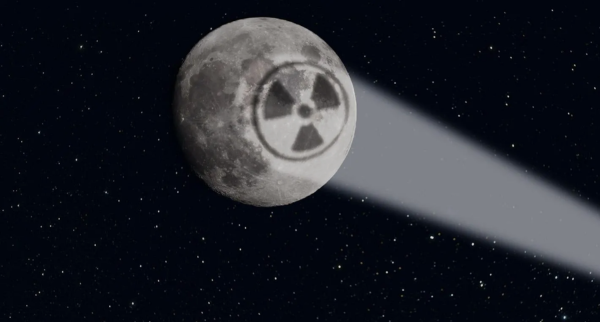
NASA administrator Sean Duffy recently announced that the Trump administration wants to place a working nuclear reactor on the moon before the end of the decade. He explained that the U.S. is in a race with China to secure resources and territory on the moon.
Unlike planting a flag, putting down a nuclear reactor can help claim useful areas, such as craters that hold frozen water.
Duffy’s 5-year timeline may sound fast, but NASA already has a long history of using nuclear power in space. Since the 1960s, Apollo missions, space probes, and Mars landers have used small nuclear batteries called radioisotopes. These create electricity from the heat of decaying plutonium. Some of those devices are still working today on the moon and even on probes that left the solar system.
However, those older devices only produce about 100 watts—enough for a lightbulb. The new reactors NASA is planning are far more powerful, creating about 100 kilowatts, which is enough to power a few dozen homes on Earth. Still, many would be needed to run a moon base.
Why nuclear power? Solar panels don’t work well on the moon because nights there last about 14 Earth days. Burning fuels like oil or gas isn’t possible either. That’s why NASA began working on small reactors years ago, starting with the Kilopower project. In 2022, NASA gave $5 million each to three teams to design 40-kilowatt reactors. The goal is to make a system that’s small and light enough to fit on a rocket, can last 10 years without maintenance, and runs safely on its own.
Sebastian Corbisiero, who leads space reactor research at Idaho National Lab, says this is challenging because normal reactors on Earth are big and heavy. In space, they must be small and light.
Still, he believes a lunar reactor is a key step toward eventually powering human colonies on Mars. As his team concluded in 2023: “Nuclear power on the surface is essential for a permanent presence on the moon.”
In 2022, Corbisiero’s team chose three groups to work on a NASA contract.
-
Lockheed Martin and BWXT: They had already been working with NASA on DRACO, a $500 million nuclear-powered spacecraft.
-
Westinghouse and Aerojet Rocketdyne: Westinghouse, an experienced reactor builder, plans to adapt its small eVinci reactor for space.
-
X-Energy with Maxar and Boeing: X-Energy is already building microreactors for companies like Dow Chemical and Amazon, but it wants to use its own special fuel instead of the standard uranium fuel NASA prefers.
Corbisiero avoids saying which design he likes best. The final system will probably use a Stirling engine to turn nuclear heat into electricity and a liquid sodium cooling system that prevents meltdowns. Can it be ready for the moon in five years? Corbisiero says yes, if the Artemis missions move forward on schedule (Artemis II is set for 2026) and if NASA gets the funding.
On Earth, microreactors cost billions. Still, U.S. officials believe building them on the moon is urgent. China is planning its Chang’e-8 mission in 2029, aiming to test 3D printing and robot-built lunar bases by the 2030s. Both the U.S. and China want to control the valuable areas near the moon’s poles, where sunlight is constant and ice is available. Duffy says: “We need to get there first and secure it for America.”
Published: 19th August 2025
For more such articles, please follow us on Twitter, Linkedin & Instagram
Also Read:
5 High-Income Skills to Learn for Free in 2025
Dua Lipa Shows Off Tough Yoga Pose at Ibiza Birthday Trip
Best Countries to Visit in 2025, Chosen by Travel Experts